
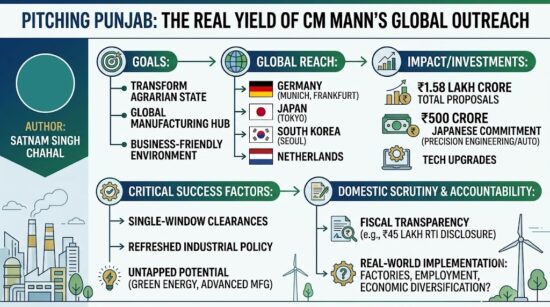
 In an era where states fiercely compete for industrial dominance, international roadshows have become the standard playbook for chief executives aiming to project their regions as global manufacturing hubs. Punjab Chief Minister Bhagwant Mann’s strategic tours across Germany, Japan, South Korea, and the Netherlands represent a calculated effort to reposition a traditionally agrarian state into a multi-sector industrial contender. By pitching directly to global heavyweights in Munich, Frankfurt, Tokyo, and Seoul, the administration has sought to bypass traditional bureaucratic inertia and present a streamlined, business-friendly Punjab. These high-level delegations emphasise a refreshed industrial policy, streamlined single-window clearances, and untapped potential in green energy and advanced manufacturing.
The tangible dividends of these journeys are beginning to crystallise, though they reflect a mix of immediate wins and long-term gestation periods. The late 2025 delegation to East Asia, for instance, yielded an immediate and concrete commitment of nearly ₹500 crore in fresh investments from Japanese conglomerates, strengthening ties in precision engineering and automotive components. More broadly, the administration attributes a significant portion of its claimed ₹1.58 lakh crore in cumulative domestic and international investment proposals to the momentum generated by these global outreach campaigns. Securing footprints from Dutch agricultural innovators and German engineering firms not only brings capital but also introduces technological upgrades crucial for modernising Punjab’s existing industrial clusters in Ludhiana and Jalandhar.
However, the optics of high-profile foreign travel invariably invite sharp domestic scrutiny, particularly concerning fiscal accountability. While the government celebrates signed memoranda and investment pledges, a persistent lack of consolidated, publicly accessible data regarding the exact expenditure incurred by the state exchequer on these foreign tours remains a point of contention. Critics and taxpayers alike are left to piece together the financial picture from sporadic Right to Information (RTI) disclosures, such as a previously revealed ₹45 lakh expense for a brief domestic charter rather than an official, comprehensive balance sheet of international delegation costs. For these global tours to be universally recognized as a success, transparency in state expenditure must match the enthusiasm of the investment pitches.
Ultimately, the true measure of Chief Minister Mann’s international standard-bearing will not be found in the grandeur of European or Asian boardrooms, nor in the initial volume of investment pledges. The real test lies in implementation how quickly these high-level agreements translate into brick-and-mortar factories, local employment, and economic diversification on Punjab soil. While the initial investment inflows and strategic partnerships demonstrate that global capital is willing to look toward Punjab, the administration must maintain a rigorous follow-through mechanism to ensure that public funds spent abroad yield permanent, transformative prosperity at home.
Disclaimer: This article and accompanying images are for informational and illustrative purposes only. Some visuals may be AI-generated or digitally enhanced and may not depict actual events or persons.Views expressed are based on publicly available information and analysis.