
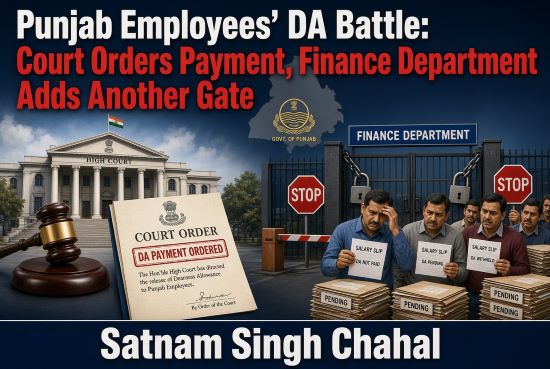
The Punjab Government has found yet another way to turn a court verdict into an administrative maze. On August 17, 2026, the Finance Department issued an order concerning cases covered by the Punjab and Haryana High Court’s judgment in Nirmal Singh Dhanoa & Others v. State of Punjab & Others. The instruction directs all Administrative Departments to submit complete details of such cases and makes it clear that orders covered by the judgment cannot be implemented without prior concurrence of the Finance Department, unless generalized directions are issued earlier.
That distinction matters. The viral political claim that the letter specifically says Chief Minister Bhagwant Mann or the Cabinet must personally approve every court-directed payment is not what the document says. The letter names the Finance Department as the mandatory approval point. But politically, the question remains uncomfortable: if the High Court has already ruled that employees are entitled to accrued DA/DR, why should the bureaucracy create another permission gate before implementing the judgment?And that is where the real controversy begins.
The timeline tells the story
April 30, 2021: The 6th Punjab Pay Commission submitted its report and recommended continuation of DA on the Central Government pattern.
June 17–21, 2021: The Finance Department placed the recommendations before the Council of Ministers. The Cabinet approved the relevant proposals on June 18, and the decision was communicated for implementation on June 21. The High Court later recorded that Punjab had adopted the Central Government pattern of DA/DR.
2021–2025: Punjab continued issuing DA revisions on the Central pattern but did not release all subsequent instalments to state employees and pensioners at the same pace. The dispute eventually centred on the instalments withheld beyond 42 per cent and the arrears that were deferred.
February 18, 2025: The Punjab Government issued its controversial Liquidation Plan, spreading payment of arrears over several years, including as many as 42 instalments for certain pensioners.
August 25, 2025: In an earlier round of litigation, the High Court directed the Finance Department to consider the employees’ representation and pass a speaking order. The employees were subsequently heard by the Additional Chief Secretary, Finance.
November 18, 2025: The Finance Department passed a speaking order saying that the Government had not yet taken a decision regarding the pending DA/DR instalments. That decision became one of the targets of the subsequent litigation.
April 8, 2026: The Single Judge of the Punjab and Haryana High Court ruled in favour of the employees and pensioners in the connected cases. The court held that Punjab had adopted the Central Government pattern and dealt with the withholding of accrued DA/DR and the Liquidation Plan.
May 2026: The State challenged the decision before a Division Bench. During the proceedings, the issue of how Punjab would clear its accumulated DA liabilities came under intense judicial scrutiny.
August 3, 2026: The Division Bench delivered a major setback to the Punjab Government. It dismissed the appeals and affirmed the Single Judge’s judgment. More importantly, it directed Punjab and PSPCL to release all up-to-date pending DA/DR instalments to employees and pensioners at the same rates paid to All India Services officers serving in Punjab, following the Central Government pattern, within a fortnight.
The court went further. If payment was not made within the stipulated period, the unpaid amount would attract 6 per cent simple interest from the expiry of the deadline until actual realization. The Chief Secretary was directed to ensure compliance and file an affidavit by August 31, 2026.And then came another unusually pointed direction: until the dues are cleared, Punjab was told not to resort to unproductive expenditure such as large-scale advertising campaigns, because such expenditure cannot justify withholding legitimate employee dues.
August 17: The Finance Department’s new gate
With the court’s fortnight deadline approaching, the Finance Department issued the August 17 letter.The instruction says departments must provide complete details of cases decided on the basis of the Dhanoa judgment and connected matters. It then states that no such orders may be implemented without prior concurrence of the Finance Department, unless generalized directions are issued earlier.So the immediate issue is not that the letter says “Bhagwant Mann must approve every payment.” It does not. The issue is whether an administrative approval mechanism is now being placed between a judicial command and its implementation.That is precisely why employees are likely to see the letter as another bureaucratic hurdle.
From “financial constraints” to “financial clearance”
The High Court has already addressed the Government’s argument about financial burden. In exceptionally strong language, the Division Bench held that the arrear liability—placed before it at approximately ₹14,191 crore—demonstrated the magnitude of the obligation but did not establish that the State was incapable of performing it. The court said financial constraints could not justify withholding benefits that had already accrued under an adopted standard.The judgment also criticised the logic of withholding employees’ dues while spending on non-essential publicity and other expenditure. The court specifically stated that large-scale advertising campaigns and other unproductive expenditure could not justify denying legitimate dues to employees.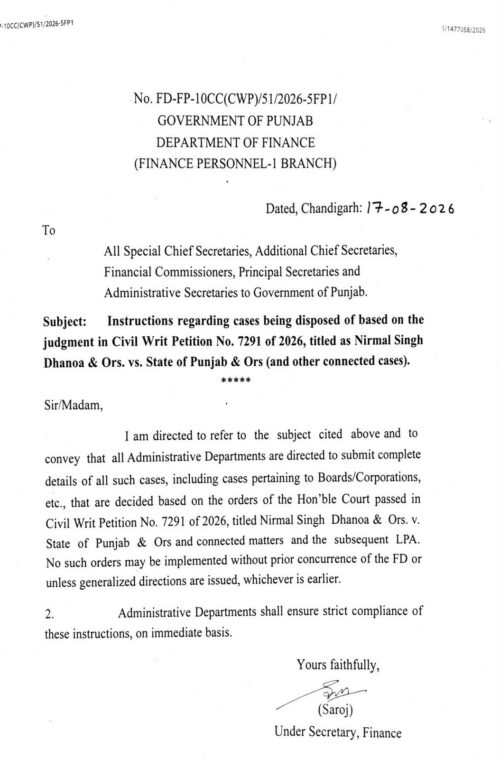
That makes the August 17 order politically explosive.The Government can reasonably argue that the Finance Department must exercise financial control before money is released. But employees can reasonably ask: How many more approvals are required before a court judgment becomes an actual payment?
The bigger question: Who is accountable?
This controversy is no longer simply about DA.
It is about the relationship between judicial orders, executive authority and financial management.A government obviously has to manage its finances. It cannot simply spend without accounting for available resources. But once a benefit has been judicially declared payable and a specific deadline has been fixed, the administration cannot indefinitely convert implementation into another round of internal decision-making.The High Court has already made the hierarchy clear: Punjab adopted the Central Government DA pattern; accrued instalments cannot simply be withheld indefinitely; the Liquidation Plan was quashed to the extent challenged; and the State was given a definite deadline for payment.
Therefore, the political opposition and employee organisations have every reason to ask the Punjab Government a simple question:
Is the Finance Department merely processing the High Court order—or is it creating another obstacle to implementing it?
A government cannot run on “file under process”
For Punjab’s employees and pensioners, this is not an accounting exercise. DA is meant to protect salaries and pensions against inflation. Every month of delay means the employee or pensioner continues to bear the cost of rising prices while waiting for money that the court has said is payable.The High Court itself put the matter starkly: every month of non-release transfers the burden of inflation from the State exchequer to the household of the employee or pensioner.That is why the August 17 letter has triggered anger.
Punjab’s employees have already waited through years of delayed DA, litigation, representations, speaking orders, liquidation plans and appeals. Now, just as the court has imposed a deadline, another administrative instruction says: first come back to the Finance Department for concurrence.The irony is difficult to miss.The court has given Punjab a fortnight. The bureaucracy has given itself another file.And Punjab’s employees are entitled to ask whether this is financial discipline—or simply another chapter in the politics of delay.
The Government’s responsibility now is straightforward: follow the court’s order, clear the legitimate dues, publish a transparent payment schedule, and stop making employees chase their own money through corridors of power.Because a government that can find money for publicity, programmes and political messaging must also be able to find a way to pay the people whose salaries and pensions it has already acknowledged as legally due.Justice delayed is bad enough. Justice ordered but kept “pending for Finance concurrence” would be an even bigger mockery.
Disclaimer: This article and accompanying images are for informational and illustrative purposes only. Some visuals may be AI-generated or digitally enhanced and may not depict actual events or persons.Views expressed are based on publicly available information and analysis