
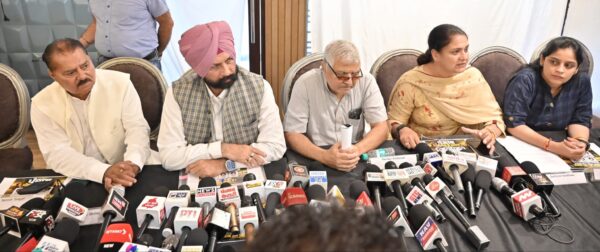
 Patiala: Former IPS officer Gurinder Singh Dhillon has strongly criticised the Aam Aadmi Party government in Punjab over what he described as its failure to fulfil commitments made to state employees, particularly regarding Dearness Allowance (DA) and the Old Pension Scheme (OPS).
Speaking at a press briefing in Patiala led by Dr Dharamvir Gandhi, MP, Dhillon highlighted the financial difficulties being faced by government employees as household expenses and the cost of living have increased substantially over the past several years.
Dhillon alleged that Punjab employees are still being denied the 60 per cent DA that they are demanding, while the Old Pension Scheme, despite a government notification issued in 2022, has not been implemented in the manner expected by employees. The issue has remained a major source of resentment among sections of the state government workforce.
The former IPS officer also raised questions over Punjab’s continuing two-tier pay structure, under which employees appointed before July 17, 2020, and those appointed after that date are allegedly being treated differently. He argued that such a system conflicts with the basic principle of “equal pay for equal work” and creates a sense of discrimination among employees performing similar duties.
The issue is particularly significant because government employees depend heavily on periodic DA revisions to offset inflation. With food, housing, education, healthcare and other household expenses rising, employees argue that delays in releasing DA and arrears effectively reduce their real income.
Dhillon further contrasted the government’s position on employee dues with Punjab’s borrowing requirements. According to the figures cited by him, the state has accumulated borrowing of approximately ₹4.36 lakh crore over the last four years, while the outstanding DA-related burden is estimated at around ₹14,300 crore. He questioned why the government could continue borrowing on such a large scale while allegedly struggling to clear employee-related dues.
The criticism comes amid continuing employee protests and demands for DA arrears, OPS implementation and resolution of other service-related issues. Recent reporting has also highlighted government employees’ protests over DA arrears and the Old Pension Scheme, indicating that the issue remains politically sensitive for the Punjab government.
The controversy puts the AAP government in a difficult position because government employees constitute a substantial and politically influential section of Punjab’s electorate. The employees’ argument is straightforward: if the state can arrange thousands of crores through repeated borrowing, they say, the government should also demonstrate a clear financial roadmap for settling legitimate salary and pension-related obligations.
At the Patiala briefing, the emphasis therefore was not merely on the percentage of DA or the technicalities of pension policy, but on the broader question of financial priorities, equality in government service and the credibility of government commitments.
The Punjab government now faces pressure to explain its position on the pending DA, the implementation of OPS and the continuation of different pay structures. The larger question being raised by critics is whether Punjab’s fiscal constraints genuinely prevent the government from meeting employee commitments—or whether the problem is one of priorities and financial management.