
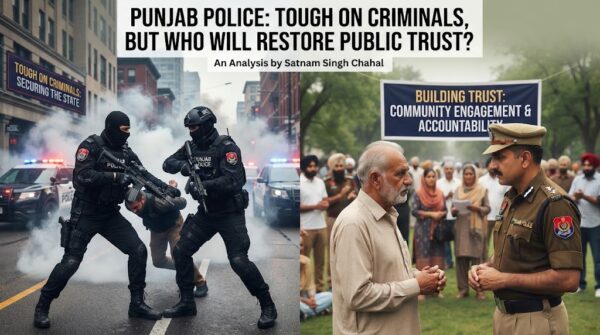
There is absolutely no question that the Punjab Police must deal firmly with criminals. Gangsters, drug traffickers, extortionists, murderers and organised criminal networks cannot be allowed to operate with impunity. A government that fails to control crime fails in one of its most basic responsibilities. But there is another equally serious question that the Punjab Police must answer: while fighting criminals, what is it doing to improve its own image among ordinary citizens?
A police force cannot build public confidence merely through arrests, encounters, raids and high-profile operations. Its real image is created when an ordinary citizen enters a police station, when a victim approaches an officer for help, when a protester raises a grievance, or when an activist questions those in power. If people who have committed no crime feel intimidated, humiliated or unnecessarily harassed by the police, the damage goes far beyond one individual incident. It gradually destroys public confidence in the institution as a whole.
The basic principle should be simple: criminals should fear the police, but ordinary citizens should not. A strong police force does not frighten the public. It makes the public feel protected. Police authority is necessary, but authority without accountability can quickly become a source of fear rather than security.
This is where the political question becomes unavoidable. Governments change, political parties change, and police officers are transferred, but allegations of political influence over policing have repeatedly remained part of public debate in Punjab. Whenever police action appears selective, questions naturally arise about whether the uniform is being used strictly for law enforcement or whether political considerations are influencing decisions. Even when such allegations are not proved, the perception itself damages the credibility of the police.
The Punjab Police therefore has to demonstrate that its loyalty is to the Constitution, the law and the people of Punjab not to whichever political party happens to be in power. The police belong to the State, not to the government of the day. A political government will eventually change, but the police institution will remain. Its credibility must therefore be protected above short-term political interests.
The controversy surrounding references to so-called “violent organisations” also requires caution. If any organisation or individual is genuinely involved in violence or criminal activity, the police should present evidence and take action according to law. But merely criticising the government, participating in a peaceful protest, holding an unpopular ideology or opposing those in power should not automatically be treated as evidence of violence. Violence is a criminal act; political disagreement is not.
If the police begin using broad labels without producing convincing evidence, they risk turning legitimate law enforcement into what the public may perceive as political policing. That would be extremely dangerous for Punjab. The answer to dissent in a democracy is evidence, dialogue and law not intimidation or indiscriminate criminalisation.
The Punjab Police also needs to understand that criticism of the police is not necessarily an attack on the institution. In fact, criticism can help an institution improve. Honest police officers should welcome mechanisms that distinguish professional policing from misconduct. When allegations of excessive force, illegal detention, intimidation or abuse arise, there should be credible and transparent investigation. If an officer has done nothing wrong, an independent inquiry can clear that officer. If an officer has violated the law, disciplinary or criminal action should follow.
Technology can also help restore confidence. Body cameras and proper video documentation during sensitive operations, transparent arrest procedures and accurate recording of police actions can protect both citizens and honest police officers. Transparency should not be viewed as a threat to the police; it should be viewed as protection for the police.
The handling of protests also deserves serious reconsideration. Every protester is not a criminal, and every criticism of the government is not a threat to national security. In a democracy, people have the right to question those in power within the limits of law. The police should be trained to distinguish peaceful dissent from genuine violence and criminal activity. A peaceful protest should be managed professionally rather than automatically treated as a law-and-order conspiracy.
The government has an equally important responsibility. The political leadership must decide whether it wants an independent police force or a politically convenient police force. If the government genuinely believes in democratic institutions, it should be the first to ensure that police officers are not pressured to act against political opponents, activists, journalists or critics simply because they are inconvenient to those in power.
The government should also stop automatically defending every controversial police action before the facts are established. Sometimes the strongest message a government can send is that if an officer is wrong, action will be taken. Accountability does not weaken the police. Accountability makes the police stronger.
Punjab needs a powerful police force because organised crime, drugs, gangsters and violence are real challenges. But power without public trust is ultimately fragile. The police cannot expect citizens to cooperate with them if citizens believe that approaching the police may itself create problems.
The Punjab Police should therefore begin a serious exercise to rebuild its relationship with the public. Senior officers should regularly engage with citizens, civil society organisations, journalists, students, farmers, traders and community representatives. Police stations should become places where people expect justice and assistance—not places they fear entering.
The real test of policing is not how many people are arrested. It is whether people feel safer because the police are present. It is whether victims believe they will receive justice. It is whether an innocent person can question authority without fearing retaliation. And it is whether the same law is applied to supporters and opponents of the government alike.
Punjab does not need a weak police force. It needs a strong, professional, politically neutral and accountable police force.Criminals should fear the law. Victims should trust the police. Ordinary citizens should feel protected. Political parties should know that the same law applies whether they are in government or opposition.That is how the Punjab Police can rebuild its image.Otherwise, every controversial police action will continue to strengthen the perception that the police are becoming an instrument of political power rather than an institution serving the people.And ultimately, the question Punjab must ask is not whether it needs a strong police force. It does.
The real question is:
Strong for whom—and accountable to whom?