
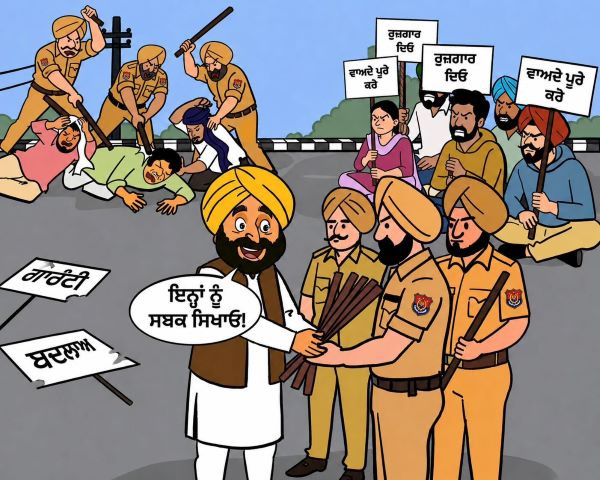
 The 2022 Punjab Assembly election marked a historic political shift when the Aam Aadmi Party (AAP) secured a sweeping mandate and formed the government under Chief Minister Bhagwant Mann. The victory was built on promises of transparent governance, corruption-free administration, improved law and order, employment opportunities for youth, better public services, and a new model of politics that would free Punjab from the influence of traditional political parties. The campaign generated enormous public expectations, particularly among young voters, unemployed graduates, farmers, employees, and those frustrated with decades of governance by established parties.
More than four years later, however, Punjab remains the subject of intense political debate. Critics argue that despite the promises and guarantees made during the election campaign, the state continues to face deep structural challenges. Questions are being raised about Punjab’s economic health, growing public debt, unemployment, law and order concerns, and the handling of public protests. Supporters of the government, on the other hand, maintain that many reforms take time to show results and point to government recruitment drives, anti-corruption measures, welfare schemes, and anti-gangster operations as evidence of progress. The reality lies within a complex landscape where expectations remain high while public dissatisfaction continues to emerge from various sections of society.
One of the most serious concerns relates to Punjab’s financial condition. The state has long struggled with fiscal stress, a problem that predates the current government. However, economists and financial observers continue to warn that Punjab’s debt burden remains among the highest in India. Budget documents show that a substantial portion of state revenue is consumed by salaries, pensions, interest payments, and debt servicing, leaving limited fiscal space for major development initiatives and infrastructure investment. Punjab’s 2025-26 budget projected continued revenue and fiscal deficits while requiring significant debt repayment obligations. Critics argue that without major economic reforms, industrial growth, and revenue generation, Punjab may find it increasingly difficult to finance development projects and create large-scale employment opportunities.
The issue of unemployment has become particularly sensitive. Punjab’s youth continue to face challenges in securing stable employment despite possessing educational qualifications and technical training. Large numbers of young Punjabis continue to seek opportunities abroad, reflecting concerns about the availability of attractive careers within the state. Various unemployed groups have repeatedly organized demonstrations demanding recruitment to government posts and fulfillment of promises regarding jobs. In recent years, unemployed teachers, technical graduates, apprentice workers, and other groups have staged protests in different parts of Punjab, arguing that recruitment processes remain inadequate or delayed.
The recent controversy involving apprentice linemen intensified this debate. Thousands of trained apprentices demanded preference in recruitment and organized demonstrations outside government facilities. The protests culminated in police action and a lathi-charge that attracted widespread criticism from opposition parties, farmer organizations, employee unions, and civil society groups. Critics described the incident as symbolic of a growing disconnect between government promises and the expectations of unemployed youth. For many observers, images of young job-seekers facing police force raised uncomfortable questions about governance and the treatment of citizens demanding employment opportunities.
The law and order situation has also become a recurring political issue. Punjab has faced challenges from organized crime, gang violence, narcotics trafficking, and extortion networks for many years. Opposition parties frequently accuse the government of failing to provide a sense of security to ordinary citizens. News reports of criminal incidents, extortion threats, and gang-related activities often fuel public concerns about safety. At the same time, the Punjab Police highlights extensive anti-gangster operations, arrests of criminal suspects, and the dismantling of organized criminal networks. Government officials argue that law enforcement agencies have achieved significant success against gangsters and anti-social elements. The debate therefore revolves not only around crime statistics but also around public perception of safety and confidence in institutions.
Beyond economic and security concerns, another criticism frequently raised by opponents relates to the structure of political decision-making in Punjab. Opposition leaders from different parties often allege that key decisions are influenced by AAP’s national leadership based in Delhi rather than being formulated entirely within Punjab. They argue that Punjab’s unique economic, agricultural, cultural, and federal concerns require independent decision-making by leaders accountable primarily to the people of the state. Supporters of AAP reject these allegations, maintaining that the party functions as a national organization with a common vision and that coordination between state and national leadership is normal in modern political parties. Nevertheless, the perception that important decisions originate outside Punjab remains a recurring theme in political discourse.
The issue of public protests has further intensified criticism. Punjab has a long history of democratic movements and public agitations. Farmers, employees, students, contract workers, unemployed youth, and social organizations have traditionally used protests to express grievances. Critics argue that the use of police force against demonstrators contradicts promises of participatory and people-centric governance. Images of lathi-charges and clashes between protesters and police have been cited by opponents as evidence that dissent is not being handled in the spirit promised during the election campaign. Supporters of the government respond that law enforcement agencies must maintain public order and that some demonstrations have involved attempts to block public institutions or disrupt essential services.
Another emotional dimension of these controversies involves allegations that some protesters have faced humiliation during confrontations with police. In Punjab, the turban is not merely a piece of clothing but a symbol of dignity, faith, and identity for many Sikhs. Whenever reports emerge suggesting disrespect toward turbans during clashes, public reactions tend to be strong and emotionally charged. Such incidents often become larger debates about respect, accountability, and the relationship between the state and its citizens.
The broader question facing Punjab today is whether the transformative change promised in 2022 has met public expectations. Supporters of the government point to recruitment announcements, anti-corruption initiatives, educational reforms, health programs, and law-enforcement operations as evidence that progress is underway. Critics counter that economic stress, unemployment, public debt, law and order concerns, and recurring protests suggest that many foundational problems remain unresolved. The contrast between ambitious promises and persistent challenges has become a central theme in Punjab’s political conversation.
As Punjab moves toward future electoral contests, the state’s voters will ultimately decide whether the current government has delivered meaningful change or whether expectations have exceeded achievements. What remains undeniable is that Punjab continues to face significant economic, social, and governance challenges that require long-term solutions extending beyond party politics. The state’s future will depend not only on electoral promises but also on the ability of any government to generate sustainable economic growth, create employment, strengthen institutions, maintain public confidence, and ensure that democratic dissent is addressed through dialogue rather than confrontation.
Disclaimer: The photographic elements used in the accompanying graphic are for symbolic and illustrative purposes only. The individuals depicted do not imply actual endorsement, involvement, or association with substance