
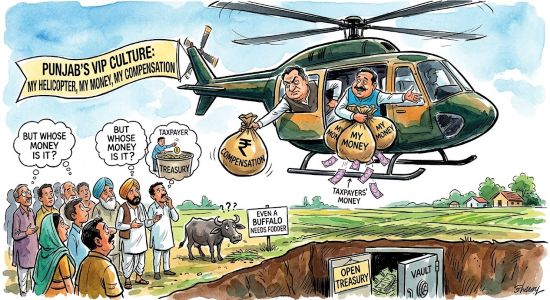
 Punjab’s political drama has reached a stage where every other day, someone seems to announce, “This is my helicopter,” “I gave money to these women,” or “I paid compensation to those people.” Listening to these statements, one might imagine that Punjab’s politicians have discovered a secret gold mine in their backyards! The helicopter is theirs, the money is theirs, the generosity is theirs—and apparently, the government treasury is just a family wallet kept conveniently open for public service.
But there is one small question that nobody seems eager to answer: If you are giving money as a public representative, is it your personal money or the money collected from taxpayers? The farmer pays taxes indirectly through the goods he buys, the shopkeeper pays taxes, the salaried employee pays taxes, and even the ordinary citizen contributes to government revenue. Then a politician appears before the cameras and announces, “I gave compensation!” Wonderful! But did the money come from his personal bank account, or was it sanctioned from public funds? If it was public money, why present it as a personal favour? And if it was personal money, a simple disclosure should settle the question.
The helicopter story is even more entertaining. In Punjab, a helicopter can apparently become a political family member. One leader says, “My helicopter,” another talks about official travel, and the public is left wondering whether the aircraft belongs to an individual, a private company, or the government. If it is privately owned, congratulations! If it is hired with public money or provided for official duties, then the public deserves to know who paid the bill. After all, a helicopter does not fly on political slogans; it needs fuel, maintenance, pilots and plenty of money. Even a buffalo needs fodder, so why should a helicopter be expected to run on promises?
Then comes the familiar announcement: “I gave money to the women.” Politicians speak as if they personally walked into their homes carrying bags of cash earned through years of hard work. But if the payment is part of a government scheme, it is not a personal gift. It is public expenditure or a benefit funded through the public budget. There is a difference between helping someone from your own pocket and implementing a scheme with taxpayers’ money. The first may be personal generosity; the second is a public responsibility. Taking credit for both is a wonderful arrangement—especially when the money comes from somewhere else!
The same comedy unfolds when compensation is announced after an accident, a tragedy or a public controversy. The politician stands before the cameras and says, “I have given compensation.” The cameras capture the generous face, the microphones record the announcement, and the headlines celebrate the benefactor. Meanwhile, the taxpayer who helped fund the payment remains invisible. Nobody invites the ordinary citizen to the press conference, even though the citizen may have contributed more to the treasury over a lifetime than the politician contributed personally to the compensation.
Of course, politicians deserve credit when they genuinely use their personal resources to help people. There is nothing wrong with generosity, and public welfare schemes deserve proper recognition. But the accounts must be clear. Was the payment personal or governmental? Was the helicopter privately owned, privately hired or publicly funded? Who approved the expenditure, and where are the records? These are not insulting questions. They are basic questions in a democracy.
Perhaps Punjab needs a new political dictionary. “My helicopter” should mean the ownership details are available. “My money” should mean a personal contribution supported by transparent records. And “I gave compensation” should come with an explanation of whether the money came from a private account or the public treasury.
Until then, the people of Punjab may continue watching this grand political magic show. The politician waves his hand, the money appears, the helicopter flies, the cameras flash, and the public applauds or at least is expected to. But the taxpayer is entitled to ask the magician one simple question:
“Sir, the trick may be yours, but was the money yours too—or did we all pay for the show?”
Disclaimer: This article and accompanying images are for informational and illustrative purposes only. Some visuals may be AI-generated or digitally enhanced and may not depict actual events or persons.Views expressed are based on publicly available information and analysis