
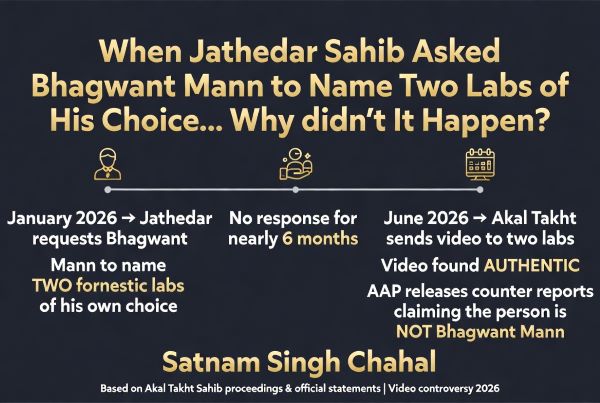
 The video recording released today of the interaction between the Akal Takht Jathedar and Punjab Chief Minister Bhagwant Mann, reportedly from January this year, raises important questions about the handling of the controversy surrounding the alleged videos.
During the exchange, Bhagwant Mann maintained that the video in question was fake. The Jathedar, however, stated that he was not in a position to determine whether the video featuring Mann was genuine or fabricated. Instead of reaching a conclusion on his own, he proposed that the matter be examined independently and asked Mann to suggest two laboratories of his own choice for testing the authentici…
[10:04 AM, 6/20/2026] Satnam Singh Chahal: Questions Raised by the Newly Released Conversation Between the Akal Takht Jathedar and Bhagwant Mann
The video recording released today of the interaction between the Akal Takht Jathedar and Punjab Chief Minister Bhagwant Mann, reportedly from January this year, sheds fresh light on a controversy that has generated considerable public debate. More importantly, the contents of the conversation raise questions about the course of events that followed and the decisions taken by the parties involved.
According to the recording, Bhagwant Mann unequivocally maintained that the video attributed to him was fake. The Jathedar, for his part, did not claim that the video was genuine. In fact, he expressly stated that he was not in a position to determine whether the video featuring Mann was original or fabricated. Rather than making a finding on the basis of competing claims, the Jathedar proposed what appeared to be a straightforward method of resolving the dispute: an independent examination of the videos by professional forensic laboratories.
Significantly, the Jathedar went a step further and invited Mann himself to suggest two laboratories of his choice for the purpose of verifying the authenticity of the videos. This was not a situation where laboratories were to be selected by the Akal Takht or by any party perceived to be adverse to Mann. The choice was being left to the Chief Minister. The recording shows Mann readily agreeing to the proposal and even consulting a person seated behind him regarding possible laboratories that could be recommended. At least from the contents of the conversation now in the public domain, there appears to have been no hesitation on his part in accepting the suggestion.
This aspect of the exchange raises an obvious and important question. If Bhagwant Mann was willing to have the videos examined by laboratories of his own choosing, why were the details of those laboratories never furnished to the Akal Takht? If he was convinced that the videos were fabricated, an examination by independent experts selected by him would have provided an opportunity to substantiate his claim through an objective and credible process. The absence of any follow-up on a proposal that he had apparently accepted inevitably invites scrutiny.
A second question relates to the sequence of events that followed. The issue of forensic verification appears not to have moved forward at the stage when the Jathedar offered it as a means of establishing the truth. Yet, after the Akal Takht eventually reached its conclusions and issued strictures against Mann, efforts were reportedly made to obtain forensic examination of the videos. This raises the question of timing. If forensic verification was considered important, why was it not pursued when the opportunity was first presented? Why was the process initiated only after adverse findings had already been made?
The significance of these questions lies not merely in the technical issue of whether the videos are genuine or fake. It also concerns the broader question of procedure and transparency. When a mechanism for independent verification is available at an early stage, and when the individual challenging the authenticity of the material is given the freedom to choose the testing institutions, the expectation would ordinarily be that such an opportunity would be promptly utilized. The fact that this did not happen has now become a matter of legitimate public interest.
The release of the conversation does not by itself settle the controversy, nor does it conclusively establish the correctness of any side’s position. What it does reveal, however, is that there was a clear discussion regarding forensic examination, that the Jathedar expressed willingness to rely on laboratories proposed by Bhagwant Mann, and that Mann appeared agreeable to that course of action. In light of these facts, the questions of why the laboratories were never nominated and why forensic examination was pursued only after the Akal Takht had pronounced upon the matter are likely to remain central to the debate in the days ahead.
Disclaimer: This article and accompanying images are for informational and illustrative purposes only. Some visuals may be AI-generated or digitally enhanced and may not depict actual events or persons. Views expressed are based on publicly available information and analysis.