
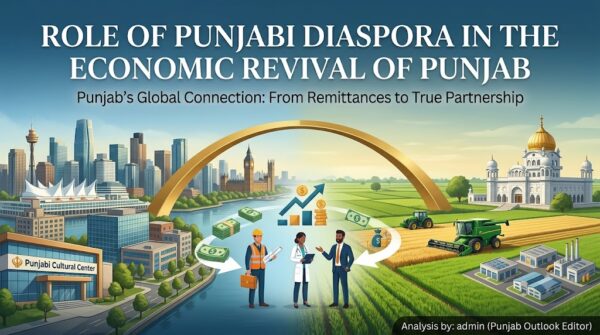
 Punjab has always enjoyed a unique relationship with its global diaspora. Millions of Punjabis living in countries such as the United States, Canada, the United Kingdom, Australia, New Zealand and Europe continue to maintain strong emotional, cultural and economic ties with their ancestral homeland. For decades, Non-Resident Indians (NRIs) have played a crucial role in supporting Punjab’s economy through foreign remittances, charitable contributions and private investments. In many villages and towns, the impact of NRI contributions is visible in modern homes, educational institutions, healthcare facilities and improved infrastructure.
When the new government assumed power in Punjab in 2022, many NRIs hoped that a new era of cooperation would begin between the state administration and overseas Punjabis. The government promised to address longstanding concerns related to property disputes, illegal occupation of land, delayed government services and difficulties faced by NRIs while dealing with local authorities. Several programs were launched to engage with overseas Punjabis and encourage them to invest in the state’s development. These initiatives created optimism among many members of the Punjabi diaspora who wanted to contribute more actively to Punjab’s economic growth.
Throughout 2022 and 2023, foreign remittances continued to flow steadily into Punjab. Although exact figures vary from year to year, Punjab remained one of the major recipients of overseas money transfers in India. These remittances supported thousands of families, helped finance children’s education, funded home construction, improved agricultural operations and provided financial security to elderly parents living in Punjab. In many districts, particularly in the Doaba region, remittance income became a major source of economic activity and local spending.
Despite the steady flow of remittances, large-scale foreign investment in Punjab did not grow at the pace many had expected. A significant portion of NRI investment remained concentrated in residential properties, agricultural land and commercial real estate rather than manufacturing, technology or industrial sectors. Many overseas Punjabis expressed concerns about bureaucratic delays, complicated approval processes, corruption, legal uncertainties and the lack of a stable investment environment. As a result, numerous potential investors preferred to invest in safer assets rather than undertake large industrial projects.
During 2024, concerns among NRIs became more pronounced. Many overseas Punjabis felt that while governments frequently highlighted the importance of the diaspora and welcomed their financial contributions, they were not being given a meaningful role in policy-making. Questions were raised regarding the effectiveness of institutions created to protect NRI interests and resolve grievances. Several NRI organizations argued that Punjab was benefiting from overseas money but was failing to fully utilize the expertise, professional experience and global business networks available within the Punjabi diaspora.
The issue of representation became one of the most discussed topics among NRIs during this period. Overseas Punjabis pointed out that they were rarely included in government boards, commissions, advisory committees or development authorities where important decisions affecting the state’s future were being made. Many argued that experienced professionals from the diaspora could contribute valuable knowledge in areas such as healthcare, education, technology, agriculture, infrastructure and international trade. However, opportunities for direct participation in governance remained limited.
In 2025, the Punjab government renewed efforts to attract investment and participation from overseas Punjabis. Various outreach programs were organized to encourage NRIs to become partners in the state’s development. The government promoted projects aimed at improving healthcare, education, sanitation and public infrastructure while inviting financial contributions from the global Punjabi community. Official statements highlighted investment commitments and sought to present Punjab as an attractive destination for investors. Nevertheless, many NRIs continued to seek stronger assurances regarding transparency, security and efficient implementation of projects.
A number of successful NRI-funded projects continued to emerge across Punjab between 2022 and 2026. Overseas Punjabis financed schools, colleges, hospitals, sports facilities, community centers, religious institutions and scholarship programs. In several villages, NRIs contributed funds for roads, drinking water systems, parks and healthcare services. These projects demonstrated the diaspora’s willingness to invest in social development even when larger industrial investments remained limited.
At the same time, concerns regarding property fraud, land grabbing, delayed legal proceedings and law-and-order issues continued to discourage some investors. Numerous NRIs reported difficulties in protecting family properties while living abroad. Such experiences often created hesitation among potential investors considering new projects in Punjab. Many diaspora organizations argued that unless these issues were addressed effectively, Punjab would struggle to attract the full potential of overseas investment available from its global community.
By 2026, the demand for formal representation had become stronger than ever. Many NRIs believed that overseas Punjabis should be granted seats on government boards, commissions and advisory councils dealing with economic development, industry, higher education, tourism and diaspora affairs. They argued that such representation would not only acknowledge the significant economic contributions made by NRIs but would also help Punjab benefit from international expertise and investment opportunities.
The story of Punjab between 2022 and 2026 highlights both the strength and the limitations of its relationship with the diaspora. While billions of rupees continued to enter the state through remittances and charitable contributions, many overseas Punjabis felt that their role remained largely restricted to financial support. They increasingly called for a partnership based not only on investment but also on participation in decision-making. As Punjab faces economic challenges and seeks new opportunities for growth, meaningful engagement with its global diaspora may prove essential for the state’s future development and prosperity.