
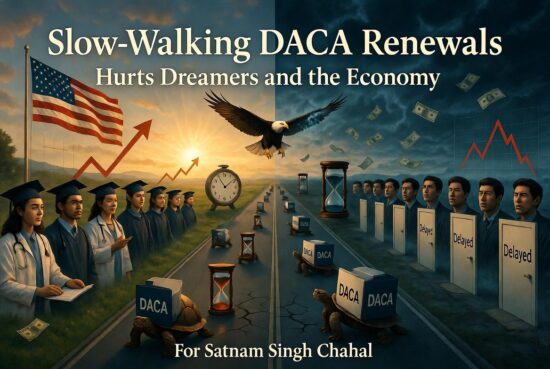
 Across the United States, delays in processing Deferred Action for Childhood Arrivals (DACA) renewals are creating growing uncertainty for hundreds of thousands of young immigrants who have lived most of their lives in the country. While DACA remains a critical protection from deportation and a pathway to work authorization, administrative backlogs and processing delays are increasingly undermining its purpose—leaving Dreamers in limbo and employers struggling to retain stable workers.
The DACA program was designed to provide temporary relief for individuals brought to the country as children, allowing them to study, work, and contribute openly to society. However, when renewals are not processed in a timely manner, beneficiaries risk losing their legal work authorization, often through no fault of their own. Even short gaps in renewal status can result in job loss, suspension of driver’s licenses, and interruptions in education and healthcare access.
These delays also have broader economic consequences. Dreamers are deeply integrated into the U.S. labor force, working in essential sectors such as healthcare support, education, hospitality, logistics, and technology. Employers who rely on DACA recipients face sudden labor disruptions when renewals are delayed, forcing businesses to retrain staff or operate understaffed. In a tight labor market, such instability creates avoidable inefficiencies that ripple across local and national economies.
For the United States economy, the stakes are significant. Studies have consistently shown that DACA recipients contribute billions in taxes and spending power each year. When renewals are delayed, this economic participation is disrupted—not because of policy changes, but because of administrative inefficiency. That translates into reduced productivity, lower tax revenue, and increased uncertainty for industries already facing workforce shortages.
Beyond economics, the human cost is equally serious. Many Dreamers report heightened anxiety as their renewal deadlines approach, unsure whether their applications will be processed in time. Families are forced to make contingency plans for potential loss of income or relocation, despite having lived in the country for decades. This uncertainty undermines the stability that DACA was meant to provide.In United States, immigration processing efficiency plays a crucial role in ensuring that policy goals translate into real-world outcomes. When systems intended to protect vulnerable populations become delayed or inconsistent, the result is not only administrative failure but also erosion of trust in the immigration system itself.
Policy experts and advocacy groups argue that addressing the backlog in DACA renewals is not merely a bureaucratic fix but an economic necessity. Streamlining adjudication, increasing staffing capacity, and ensuring automatic extensions during processing delays are among the solutions frequently proposed to prevent lapses in work authorization.Ultimately, slow-walking DACA renewals weakens both individual livelihoods and the broader economy. Dreamers remain ready to contribute, but without timely renewals, the system itself becomes the barrier to the stability it was designed to provide.
DACA Policy Explained: Hope, Legal Battles, Delays, and Economic ImpactDeferred Action for Childhood Arrivals (DACA) remains one of the most significant and controversial immigration programs in the United States. Launched on June 15, 2012, by the Obama administration, DACA provides temporary relief to hundreds of thousands of young immigrants known as “Dreamers” who were brought to America as children. While it does not offer a path to citizenship or permanent legal status, the program has allowed eligible individuals to live, study, and work openly without the immediate fear of deportation.DACA grants renewable two-year protection from deportation along with work authorization through an Employment Authorization Document (EAD). Recipients can also obtain a Social Security Number, apply for driver’s licenses in most states, and since late 2024, access health insurance through the Affordable Care Act Marketplace. However, the program is temporary and remains vulnerable to changes in policy or court decisions.
To qualify for DACA, individuals must meet strict criteria: they must have arrived in the U.S. before turning 16, lived continuously in the country since June 15, 2007, and been under 31 years old as of June 15, 2012. They must be currently in school, have graduated high school or obtained a GED, or have served in the U.S. military, and must have no serious criminal record.
Since its creation, DACA has faced intense legal challenges. In 2017, the Trump administration tried to end the program, but the U.S. Supreme Court blocked the rescission in 2020, ruling it was “arbitrary and capricious.” The Biden administration later codified the program through a 2022 Final Rule, but Texas and other states sued in federal court. In a major January 2025 ruling, the Fifth Circuit Court of Appeals declared the program largely unlawful, though it allowed existing recipients to continue renewing their status nationwide for now. New first-time applications remain blocked due to ongoing litigation.
As of June 2026, renewals for current DACA holders are still being processed, but significant delays often taking 4 to 7+ months have created widespread problems. This “slow-walking” of applications has led to employment gaps, financial hardship, and uncertainty for many Dreamers and their families.DACA recipients are deeply integrated into American society. They work as doctors, nurses, teachers, engineers, entrepreneurs, and essential workers across many industries. Economic studies consistently show they contribute tens of billions of dollars annually in taxes and boost the U.S. economy. However, the combination of legal uncertainty and processing delays continues to hurt both Dreamers and the broader economy.
Disclaimer: This article and accompanying images are for informational and illustrative purposes only. Some visuals may be AI-generated or digitally enhanced and may not depict actual events or persons.Views expressed are based on publicly available information and analysis.