
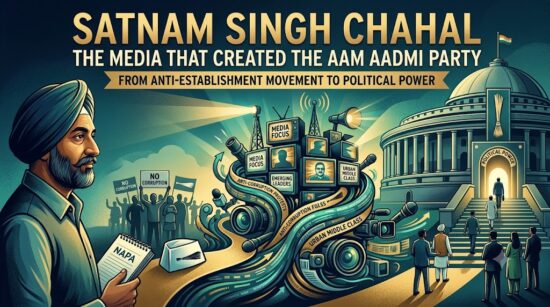
 The rise of the Aam Aadmi Party (AAP) remains one of the most remarkable political stories in modern India. While the party’s leaders often credit grassroots activism, anti-corruption campaigns, and public support for their success, many political observers argue that a significant factor behind AAP’s rapid ascent was the unprecedented attention and support it received from sections of the media. The relationship between the media and AAP has been the subject of intense debate for more than a decade, with supporters describing it as recognition of a new political force and critics calling it one of the most successful examples of media-driven political branding in Indian history.
AAP emerged from the anti-corruption movement led by social activist Anna Hazare in 2011. At a time when allegations of corruption against the then United Progressive Alliance (UPA) government dominated national headlines, television news channels devoted extensive coverage to the movement. Round-the-clock broadcasts from protest sites, live debates, and prime-time discussions transformed the anti-corruption campaign into a national phenomenon. Several key faces of the movement, including Arvind Kejriwal, became household names long before the formation of a political party.
When AAP was formally launched in 2012, it entered a political landscape dominated by established parties such as the Congress and the Bharatiya Janata Party (BJP). Unlike most new political outfits that struggle for visibility, AAP received extraordinary media attention. Every press conference, protest, allegation, and policy announcement generated headlines. The party’s leaders became regular fixtures on television debates, helping them connect with urban middle-class voters who were increasingly consuming political content through electronic and digital media.
The media’s fascination with AAP was driven by several factors. The party projected itself as an alternative to traditional politics, promised transparency, and employed unconventional methods of communication. Journalists found its leaders accessible, articulate, and willing to engage directly with the press. In an era when television news increasingly favored confrontation and dramatic narratives, AAP’s aggressive anti-corruption stance provided compelling content that attracted viewers and boosted ratings.
Critics, however, argue that the media’s enthusiasm often crossed the line from reporting to promotion. They point out that many controversies involving the party received relatively softer treatment compared to those involving its rivals. According to these critics, the extensive coverage helped create an image of AAP as a movement of ordinary citizens fighting against a corrupt political establishment, even though political realities were often more complex. Some commentators have gone so far as to claim that without sustained media exposure, AAP would have found it difficult to expand beyond a regional political force.
The party’s first major electoral breakthrough came in the 2013 Delhi Assembly elections. Despite being a newly formed organization with limited resources, AAP won 28 seats and dramatically altered Delhi’s political landscape. The victory reinforced the perception that media visibility could translate into political support when combined with effective grassroots mobilization. Two years later, AAP achieved an even more spectacular success by winning 67 out of 70 seats in the Delhi Assembly elections, establishing itself as a dominant political force in the national capital.
The growth of social media further strengthened AAP’s political reach. The party was among the first in India to effectively use platforms such as Facebook, Twitter, YouTube, and WhatsApp for political communication. Digital campaigns allowed it to bypass traditional political structures and communicate directly with supporters. This strategy complemented mainstream media coverage and helped create a highly engaged support base, particularly among younger voters and urban professionals.
Over time, the relationship between AAP and the media evolved. As the party gained power and faced governance challenges, some media organizations became more critical of its policies and decisions. Allegations of political favoritism, internal disputes, administrative controversies, and governance issues increasingly became subjects of media scrutiny. The same media environment that had helped amplify AAP’s rise also became a platform for criticism and accountability.
The debate over whether the media “created” AAP ultimately depends on one’s political perspective. Supporters argue that the media merely reflected public frustration with corruption and gave voice to a genuine political movement. Critics contend that extensive and often favorable coverage accelerated the party’s growth far beyond what would normally be possible for a new political organization. The truth likely lies somewhere in between. Media attention alone cannot create a successful political party, but it can significantly influence public perception, shape narratives, and provide visibility that translates into electoral opportunities.
The story of AAP demonstrates the growing power of media in modern democracies. In an age where television channels, digital platforms, and social media networks influence political discourse daily, the ability to capture media attention can be as important as traditional political organization. Whether viewed as a success story of democratic participation or an example of media-driven politics, the rise of AAP remains a case study in how communication, perception, and political messaging can reshape the political landscape of a nation.
Disclaimer: This article and accompanying images are for informational and illustrative purposes only. Some visuals may be AI-generated or digitally enhanced and may not depict actual events or persons.Views expressed are based on publicly available information and analysis.