
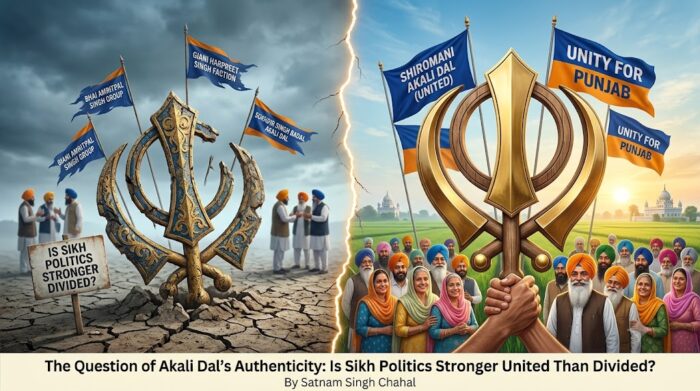
 The Shiromani Akali Dal has historically been one of Punjab’s most influential political organizations. Founded to represent Sikh aspirations and safeguard Punjab’s interests, the party played a significant role in shaping the state’s political, religious, and social landscape. However, in recent years, the Akali movement has become fragmented, leading many observers to question which faction can genuinely claim to be the authentic successor of the original Akali legacy.
At present, Sikh politics appears to be divided among three prominent Akali factions. One faction is led by Sukhbir Singh Badal, who currently heads the Shiromani Akali Dal organization that has traditionally been recognized as the main Akali Dal. Another emerging faction is associated with Giani Harpreet Singh and leaders seeking a renewed direction for Sikh politics. A third force has emerged around Bhai Amritpal Singh, Member of Parliament from Khadoor Sahib, whose political influence has attracted significant support among sections of Sikh youth and Panthic-minded voters.
The political reality, however, presents a challenging picture for all three groups. The Akali Dal led by Sukhbir Singh Badal, despite its long history and organizational structure, has suffered a major decline in electoral strength. The party currently has only one Member of Parliament and no Member of the Legislative Assembly in Punjab. This represents a dramatic fall for a party that once governed Punjab multiple times and was considered the principal political voice of the Sikh community.
On the other hand, the political camp associated with Bhai Amritpal Singh has demonstrated growing public support. With two Members of Parliament and one MLA aligned with its broader political vision, it has shown an ability to mobilize voters dissatisfied with traditional political parties. Nevertheless, despite this momentum, it remains far from possessing the organizational network, resources, and statewide presence required to independently form a government in Punjab.
Similarly, the group associated with Giani Harpreet Singh has generated discussion among sections of the Panth and civil society. Supporters argue that it offers an opportunity to rebuild Sikh politics on principles of transparency, accountability, and Panthic unity. However, like the other factions, it faces significant challenges in transforming goodwill and moral authority into a powerful electoral organization capable of winning a majority mandate.
The fragmentation of Akali politics has created a situation where multiple leaders claim to represent Sikh interests, but none possess sufficient political strength to emerge as the dominant force in Punjab. This division has arguably weakened the collective bargaining power of Sikh political institutions and has reduced the effectiveness of Panthic politics in addressing key issues facing Punjab.
Punjab today faces numerous challenges, including economic stagnation, agricultural uncertainty, youth migration, unemployment, drug abuse, declining industrial growth, water disputes, and concerns regarding the preservation of Punjabi language and culture. These issues require strong political leadership and a united vision. Many voters increasingly feel that internal rivalries among Panthic groups have distracted attention from these pressing concerns.
Supporters of Akali unity argue that the time has come for all factions to engage in serious dialogue. Rather than competing against one another for a limited political base, leaders from all three groups could explore the possibility of creating a common platform based on shared principles. Such an initiative would not require any faction to surrender its identity immediately, but it could establish a framework for cooperation on issues affecting Punjab and the Sikh community.
A united Akali Dal would not automatically guarantee electoral success. Rebuilding public trust would require honesty, internal democracy, accountability, and a willingness to acknowledge past mistakes. Punjab’s voters have become increasingly demanding and are unlikely to support any political formation solely because of its historical legacy. The electorate expects performance, transparency, and practical solutions to everyday problems.
The central question is not which faction owns the Akali name, but which leadership can best serve the interests of Punjab and the Sikh community. History shows that divided political movements often struggle to achieve their objectives, while unity can create strength and credibility. If the various Akali factions continue to operate separately, they may further divide their support base and reduce their political relevance. Conversely, if they can find common ground and work together, they may be able to revive the Panthic political tradition that once played a defining role in Punjab’s governance.
Ultimately, the future of Akali politics will depend not only on its leaders but also on the aspirations of Punjab’s people. The demand for unity is growing among many sections of society who believe that a divided Akali movement cannot effectively address Punjab’s challenges. Whether the three factions choose cooperation over competition may determine the next chapter in the history of Sikh politics.
Disclaimer: The photographic elements used in the accompanying graphic are for symbolic and illustrative purposes only. The individuals depicted do not imply actual endorsement, involvement, or association with substance