
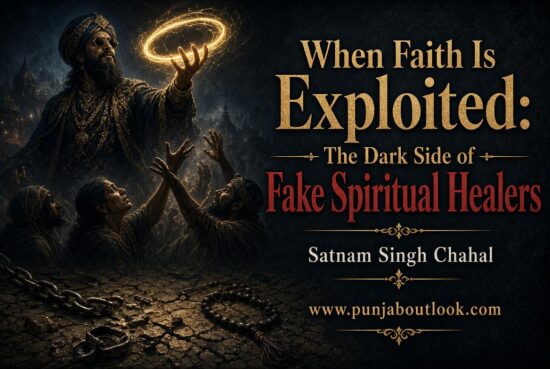
Author’s Editorial and Ethical Statement:The author has made every effort to prepare this article in accordance with accepted journalistic and editorial ethics. The purpose of the article is to highlight issues of public interest and encourage informed discussion, and not to target, defame, insult or unfairly malign any individual, community, religious institution or organisation.The information and observations presented in this article have been written in good faith and with the intention of maintaining accuracy, fairness and balance. Wherever allegations, disputed claims or matters involving identifiable individuals are discussed, they are presented in their proper context and should not be understood as a finding of guilt unless such guilt has been established by a competent court or other lawful authority.The author recognises the importance of the presumption of innocence and has therefore avoided presenting allegations as facts. The article distinguishes, wherever reasonably possible, between verified information, reported allegations, opinions, analysis and commentary. No statement is intended to prejudge any ongoing investigation, legal proceeding or judicial determination.The author has also taken care to avoid language that could promote hatred, discrimination, religious intolerance or hostility toward any community. References to religious or spiritual figures, institutions or traditions are made solely in the context of the subject being examined and are not intended to question or diminish the faith, beliefs or religious sentiments of any community.
The article is intended to examine a broader social and public-interest issue rather than make a blanket judgment about an entire religious, social or professional group. The author fully acknowledges that the misconduct of particular individuals, if established, must not be used to discredit those who sincerely serve their communities and uphold ethical and religious values.Every reasonable effort has been made to ensure that the article is responsible, factually grounded and legally cautious. If any factual error, omission or unintended ambiguity is subsequently identified, the author remains willing to consider credible evidence and make appropriate corrections or clarifications.The author therefore submits this article in good faith, with respect for journalistic integrity, freedom of expression, the dignity of individuals, religious sensitivities and the public’s right to receive information on matters of legitimate public concern.-Author
India, Pakistan and the wider South Asian diaspora are deeply religious societies. Faith is not merely a private belief or a ritual observed on particular occasions; for millions of people, it is woven into everyday life, family relationships, traditions, festivals, marriage, illness, grief and death. For countless families, religious and spiritual traditions provide comfort, moral guidance, community support and hope during difficult periods. This sincere and deeply rooted faith is one of the most important aspects of South Asian society and deserves respect and protection. At the same time, precisely because faith can be so personal and powerful, it can also become vulnerable to exploitation by individuals who misuse religious or spiritual authority for money, influence, sexual exploitation or other criminal purposes.
This article is not an attack on Islam, Hinduism, Sikhism, Sufi traditions, shrine culture or genuine religious and spiritual teachers. On the contrary, its purpose is to distinguish genuine faith and spiritual service from individuals who allegedly or demonstrably misuse religious authority to exploit vulnerable people. A criminal does not become representative of an entire religion simply because he claims religious authority, just as the alleged misconduct of an individual should never be used as a basis for condemning millions of sincere believers. South Asia has a long and respected tradition of genuine saints, scholars, philosophers and spiritual teachers who have provided moral guidance, charity, education, community support and personal inspiration. Their contribution should never be confused with the conduct of people who turn spiritual influence into a personal business, a source of political power or a mechanism for controlling followers.
The problem begins when spiritual authority becomes personal authority and the teacher gradually becomes more important than the religious teachings he or she claims to represent. A genuine religious or spiritual teacher can command respect without demanding unquestioning personal loyalty. A responsible religious organisation should be able to tolerate questions, maintain appropriate boundaries and explain how donations are used. Serious warning signs can emerge when followers are encouraged to believe that questioning a leader is itself a spiritual offence, that leaving an organisation will result in divine punishment, or that the leader possesses extraordinary powers that place him beyond ordinary moral or legal accountability. Such behaviour should not be confused with the strength of a religious tradition. Where it occurs, it may indicate the misuse of spiritual influence for personal power.
One recurring concern in some controversial spiritual organisations has been the accumulation of substantial wealth and property around a single leader. Large religious and charitable organisations can legitimately own significant land and buildings because schools, hospitals, places of worship, community kitchens and welfare programmes require resources. Wealth or a large religious complex by itself is therefore not proof of wrongdoing. The concern arises when there is a serious unexplained contradiction between claims of spiritual detachment and evidence of lavish personal lifestyles, opaque financial arrangements, misuse of donations or property obtained through allegedly improper means. Transparency and accountability are therefore important not only for protecting the public but also for protecting legitimate religious institutions from suspicion.
The Dera Sacha Sauda complex in Sirsa, associated with Gurmeet Ram Rahim Singh, illustrates the enormous scale that a personality-driven spiritual organisation can reach. Following Singh’s 2017 conviction, authorities conducted a major search of the approximately 700-acre complex. Contemporary reports described the discovery of cash, vehicles and other material, while authorities examined the organisation’s property and assets. The significance of the case lies not in the size of the religious complex itself but in the importance of ensuring that organisations controlling substantial resources have transparent governance, proper accounting and compliance with the law.
The case of Gurmeet Ram Rahim Singh is among the most prominent examples of criminal proceedings involving a self-styled spiritual leader in India. In August 2017, a special CBI court convicted Singh of raping two women followers in cases dating back to 2002 and sentenced him to two consecutive 10-year prison terms, amounting to 20 years. The verdict was followed by widespread violence by some of his followers in Haryana and Punjab, resulting in numerous deaths, injuries and extensive property damage. The case attracted enormous national attention because of Singh’s large following and his considerable public and political influence.
The Singh case also demonstrates why responsible journalism must distinguish between different criminal cases rather than treating every allegation as established fact. In March 2026, the Punjab and Haryana High Court acquitted Singh in the murder case concerning journalist Ram Chander Chhatrapati, holding that the prosecution had failed to prove the criminal-conspiracy charge beyond reasonable doubt. This ruling is an important reminder that an individual can be convicted in one case while being acquitted in another. Responsible reporting must therefore accurately identify whether a matter concerns an allegation, an investigation, a trial, a conviction or an acquittal.
Another major case is that of Asaram Bapu. In April 2018, an Indian court convicted Asaram of raping a 16-year-old girl at his Jodhpur ashram and sentenced him to life imprisonment. Asaram denied the allegations, while the case proceeded through the judicial system. The case became significant because it involved a highly influential spiritual figure and a young follower who alleged that the religious authority exercised over her had been abused. Whatever the wider debate surrounding the accused, the legally established fact in this case is the criminal conviction.
Other cases involving self-styled spiritual figures require similar care. Virendra Dev Dixit, for example, became the subject of investigations and court proceedings after serious allegations were made concerning women and girls at his ashrams. Authorities conducted searches and rescued women from the premises, while the Delhi High Court examined the allegations and the Central Bureau of Investigation registered criminal cases. Such matters should be described as investigations and allegations unless and until a court establishes criminal guilt. This distinction is essential because responsible journalism must protect both victims and the principle of due process.
The exploitation of vulnerable people is one of the most disturbing dimensions of spiritual fraud. People who seek spiritual assistance are not necessarily naïve, uneducated or foolish. They may be grieving the death of a loved one, struggling with infertility, facing illness, experiencing marital difficulties, suffering financial hardship or simply searching for hope and meaning. Many may have tried conventional solutions and found themselves disappointed. A person in such circumstances can become particularly vulnerable to someone who confidently promises a solution to problems that may have no simple answer.
These vulnerabilities are ordinary human conditions rather than character weaknesses. Genuine religious and spiritual teachers should respond to them with compassion and care. The danger arises when an individual sees another person’s desperation as a commercial opportunity or as a means of obtaining personal control. Promises of miraculous cures, supernatural protection, guaranteed success or special spiritual powers can become particularly harmful when vulnerable people are encouraged to spend money or abandon professional medical, legal or financial advice.
Psychological dependency can also develop gradually. A new follower may initially receive extraordinary warmth, hospitality and acceptance. The person may be told that he or she has discovered a special spiritual family or community. There is nothing inherently wrong with religious communities offering friendship and belonging. The danger emerges when such relationships are used to isolate followers from family members, discourage independent thinking or increase dependence upon a particular leader.
A particularly serious warning sign appears when followers are told that relatives who question the organisation are enemies, that leaving will result in supernatural punishment, or that the leader’s instructions should take precedence over family responsibilities, personal conscience or the law. Such methods can create an environment in which followers become increasingly dependent upon the organisation and increasingly disconnected from people outside it. Families dealing with such circumstances should generally respond with patience rather than ridicule because humiliation may push the individual further into the organisation.
Financial exploitation is another major concern. Religious donations themselves are entirely legitimate and form an important part of many communities. Mosques, gurdwaras, temples, churches, shrines and charitable organisations depend upon donations to support worship, education, welfare and community services. The issue is not the existence of donations but the manner in which money may sometimes be obtained or used. Serious concerns arise when vulnerable people are pressured to make large payments in exchange for promised miracles, cures, supernatural protection or special spiritual benefits, or when an organisation refuses to provide reasonable information about how substantial donations are being managed.
Families should be particularly cautious if a spiritual figure pressures someone to sell property, surrender savings, transfer land or incur substantial debt in the name of religious devotion. Transparent accounting, independent governance and clearly defined charitable purposes can protect both believers and legitimate religious organisations.Sexual exploitation represents an even more serious abuse of spiritual authority. Religious or spiritual status does not give anyone permission to violate another person’s physical or sexual boundaries. Claims that private meetings, physical contact, secret rituals or other intimate conduct are necessary for spiritual healing should never be used to override consent or personal safety. When a spiritual leader has enormous authority over followers, the imbalance of power can make it extremely difficult for victims to resist, report abuse or persuade others to believe them.
Survivors of sexual abuse may face additional social pressures. Families can fear reputational damage, followers may refuse to believe accusations against a respected leader, and victims may fear retaliation, social isolation or threats. These circumstances make independent investigation and access to justice particularly important. At the same time, allegations must still be handled according to law, with the accused presumed innocent unless guilt is established through the judicial process.
Children require an even higher level of protection. Parents may place extraordinary trust in religious schools, ashrams, seminaries, shrines, spiritual centres and community institutions. That trust must never replace proper safeguarding procedures. No religious title or spiritual reputation should give an adult unsupervised and unaccountable access to children. Religious institutions caring for children should have appropriate safeguarding policies, reporting mechanisms, responsible supervision and independent procedures for handling complaints. Protecting children is not opposed to religious education; it is an essential moral responsibility.
Pakistan has its own rich traditions of Islamic scholarship, Sufism, pirs, shrines and spiritual practices. Millions of Pakistanis find religious meaning, charity, community and personal guidance through these traditions. Therefore, criminal cases involving individuals who describe themselves as pirs or faith healers should not be interpreted as an indictment of Islam, Sufism or Pakistan’s shrine culture. The appropriate approach is to examine each case individually and rely on documented police investigations, court proceedings and convictions.
One example reported in Pakistan in 2026 involved Hafiz Ali Ahmad, also referred to in reports as Ali Ahmed. According to a Dawn report, the National Cyber Crime Investigation Agency arrested him in Lahore after allegations that he had operated online as a spiritual healer offering istikhara and amulet services through social-media platforms. Authorities alleged that he charged money, sexually exploited women and subsequently used recorded photographs and videos for blackmail. Investigators reportedly said that preliminary findings indicated that around 400 people, mostly women, may have been affected. A case was registered under relevant provisions of Pakistan’s cybercrime law. Because the matter involved an arrest and investigation, the allegations should be described as allegations unless a court subsequently establishes guilt.
Another Pakistani case resulted in a conviction. Dawn reported that a Lower Dir district and sessions judge sentenced Mohammad Nisar, who had presented himself as a pir or faith healer, to 30 years in prison after finding him guilty of assaulting an 18-year-old woman. According to the report, the man had taken money from the woman while claiming that he could help reunite her with a lover working abroad. The conviction provides a clear example of why claims of spiritual authority cannot be allowed to place an individual beyond legal accountability.In Bhakkar, police arrested Allah Bakhsh, also known as Kala Peer, over allegations involving sexual exploitation and blackmail. Police said that explicit material had been recovered and that a criminal case had been registered. Since an arrest is not itself a conviction, the allegations should be reported as allegations unless a court later determines guilt. This distinction is particularly important when publishing names of identifiable individuals.
Similarly, in Rawalpindi, police arrested a man identified as Pir Khurram after a woman reportedly sought his assistance following a social-media video in which he claimed to provide spiritual treatment. Police alleged that he demanded a fee and engaged in inappropriate physical contact while claiming to treat her for jinn possession. These allegations should remain clearly attributed to police or the complainant unless established in court..
Pakistan has also witnessed cases in which individuals operating under the description of faith healers were convicted by courts. In one Karachi case, Abdul Haq received a 14-year prison sentence after being convicted of sexually assaulting a teenage girl while claiming to transfer spiritual powers and using nude photographs for blackmail. Such a conviction can be reported as an established judicial finding rather than an unproven allegation..
In another Pakistani case, an anti-terrorism court sentenced a faith healer to life imprisonment after finding her guilty in a case involving the burning of a mentally challenged girl during an alleged exorcism or supernatural treatment. Such cases illustrate the potential danger when claims of supernatural power are allowed to replace medical judgment, personal safety and the rule of law.
These individual cases are deeply disturbing, but they should not be used to make sweeping claims about religious traditions or religious communities. The common thread is not Islam, Hinduism, Sikhism or Sufism. The common thread is the alleged or proven misuse of authority. A person may use the title of pir, baba, healer, preacher or spiritual teacher, but the title itself does not establish either moral authority or criminal guilt.
The same principle applies across religious communities. Muslim communities should be able to condemn a criminal who misuses the title of pir without believing that Islamic or Sufi traditions are under attack. Hindu communities should be able to expose fraudulent spiritual figures without believing that Hindu spirituality itself is being condemned. Sikhs should be able to challenge individuals who misuse religious influence without confusing those individuals with Sikh teachings or the Sikh tradition. Every faith community has the right to protect its sincere believers from exploitation.
South Asia’s spiritual heritage contains many examples of teachers whose authority rested on character, service, scholarship and moral example. Guru Nanak, Kabir, the great Sufi saints, respected Hindu philosophers and many other religious teachers belong to distinct and diverse traditions that cannot be reduced to a single category. Their teachings and histories are complex, but one broad principle is relevant to this discussion: genuine spiritual authority should not depend upon coercion, criminality or exploitation.
Families seeking spiritual guidance should therefore look for teachers whose conduct is consistent with their teachings, whose organisations have reasonable financial transparency, who respect personal boundaries, who do not demand blind obedience and who do not discourage followers from maintaining healthy relationships with family and wider society. Extraordinary claims should invite careful questions rather than automatic acceptance. A spiritual leader should not be treated as beyond accountability simply because large numbers of people respect him.
The same caution should apply to diaspora communities. South Asian communities in the United States, Canada, the United Kingdom, Australia and other countries maintain strong religious and cultural networks. Visiting spiritual figures can attract large gatherings and significant donations. Diaspora communities should therefore apply appropriate standards of transparency and safeguarding to visiting religious personalities as well as local organisations.
Before making large donations, families and community organisations can reasonably ask who controls the organisation, how donations are administered, whether there is independent governance, whether financial records are properly maintained, whether children are protected and whether complaints can be made without fear. Asking such questions is not hostility toward religion. It is responsible community behaviour.
When a family member becomes deeply involved with a questionable organisation, the first response should ideally not be anger or ridicule. The person’s faith should be respected even when concerns exist about the organisation or an individual leader. Maintaining communication, asking calm questions, encouraging independent medical and legal advice, and seeking assistance where credible evidence of abuse or criminal conduct exists can be more effective than attacking the person’s beliefs.
If there is evidence of sexual assault, blackmail, physical violence, unlawful confinement, child abuse or financial fraud, appropriate authorities should be contacted and independent legal advice should be considered. Where children or vulnerable adults are at immediate risk, safety must take priority.Religious organisations themselves also have an important responsibility. They can strengthen public confidence by maintaining transparent financial systems, independent complaint mechanisms, child-protection policies and clear boundaries between spiritual counselling and private personal access. Community leaders should neither automatically defend allegations because an accused person is influential nor automatically declare someone guilty merely because allegations have been made. Both extremes can damage justice.
The appropriate principle is straightforward: allegations should be investigated, evidence should be examined, victims and witnesses should be protected, and courts should determine criminal guilt according to law. This approach protects both the public and the rights of accused persons.The exploitation of faith is among the most serious forms of betrayal because people who seek spiritual guidance are often opening their hearts at moments of vulnerability. They may be searching for comfort, healing, meaning or hope. Taking advantage of that trust for financial gain, sexual access, personal control or political influence can cause enormous physical, emotional and financial damage.
But believers who have been exploited should never be portrayed as foolish. They are often ordinary people who trusted someone whom they believed could help them. Their trust should be respected even when the person they trusted allegedly abused it.The answer to religious fraud is therefore not less faith. It is greater accountability, better safeguarding, financial transparency, respect for the law and the courage to question individuals who demand unquestioning obedience while making extraordinary claims about themselves.The fight against religious fraud is not a fight against religion. It is a fight against the exploitation of religion. It is a defence of ordinary believers who deserve to practise their faith without being subjected to fraud, sexual abuse, coercion, blackmail or manipulation. It is also a defence of genuine religious teachers and institutions whose reputations can be damaged when individuals misuse spiritual language for personal gain.
Faith should inspire conscience, not surrender it. Spiritual guidance should provide dignity, not dependency. Religious service should protect vulnerable people, not exploit them. And no individual who claims to speak in the name of God should be regarded as above the law.Protecting believers from fraud and abuse does not weaken genuine faith. It protects it.
Disclaimer: This article and accompanying images are for informational and illustrative purposes only. Some visuals may be AI-generated or digitally enhanced and may not depict actual events or persons.Views expressed are based on publicly available information and analysis