
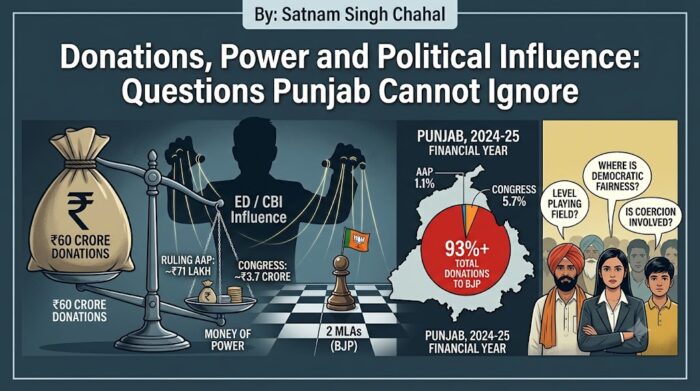
 A recent report has sparked a major political debate in Punjab. According to figures cited by the Association for Democratic Reforms (ADR), the BJP, despite having only two MLAs in the 117-member Punjab Assembly, reportedly received more than 93% of the total political donations made in Punjab during the 2024-25 financial year. Out of approximately ₹64.7 crore in donations, the BJP received over ₹60 crore, while the ruling Aam Aadmi Party received only around ₹71 lakh and the Congress about ₹3.7 crore.
These figures naturally raise questions among ordinary citizens. How can a party with such a limited electoral presence in Punjab receive such a massive share of political donations? Is this simply a reflection of donor preference, or does it indicate a deeper imbalance in India’s political funding system?
Critics argue that the answer lies not in public support but in the growing concentration of power at the Centre. Across the country, concerns have been repeatedly raised about the role of central investigative agencies such as the Enforcement Directorate (ED) and the Central Bureau of Investigation (CBI). Opposition parties have frequently alleged that these agencies are used to create pressure on businessmen, industrialists, and political opponents. While such allegations remain politically contested, the perception itself has become widespread enough to influence public debate.
Many observers question whether businesses donate voluntarily or whether they feel compelled to support the party that controls the levers of power in New Delhi. In a political environment where companies may fear investigations, tax raids, regulatory hurdles, or legal scrutiny, some critics believe that political donations can become less about ideology and more about self-preservation.
Punjab has a long history of resisting political pressure and standing up for democratic rights. From the farmers’ movement to various struggles for federal autonomy, Punjabis have repeatedly demonstrated that they value independence and fairness. For many people in the state, the donation figures are therefore not merely financial statistics; they represent a larger question about the health of democracy itself.
Democracy functions best when political parties compete on ideas, performance, and public trust. However, when one party accumulates overwhelmingly greater financial resources than its rivals, concerns emerge about whether the political playing field remains level. Large donations can translate into greater advertising, stronger organizational structures, more extensive campaigns, and increased political influence.
Supporters of the BJP may argue that donors are simply backing a party they believe will remain politically influential at the national level. Critics, however, see the figures as evidence of a system where economic power and political power are becoming increasingly intertwined.
The real issue is not which party receives donations, but whether citizens can be confident that those donations are being made freely and transparently. Political funding should strengthen democracy, not create doubts about fairness or equal opportunity.
Punjab’s people deserve clear answers. If donations are being made voluntarily, transparency will help build public confidence. If there are concerns about coercion or misuse of power, those concerns must be addressed through stronger democratic safeguards and independent oversight.
The debate triggered by these donation figures is therefore much bigger than party politics. It is about the future of democratic accountability, political equality, and public trust in institutions. These are questions that every citizen not just in Punjab but across India has a right to ask.
Disclaimer: The photographic elements used in the accompanying graphic are for symbolic and illustrative purposes only. The individuals depicted do not imply actual endorsement, involvement, or association with substance