
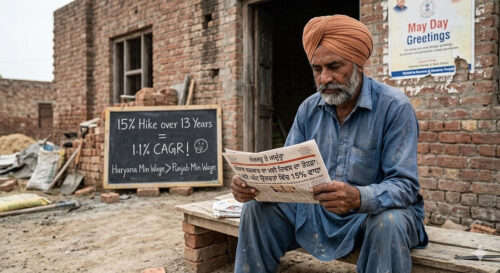
 Punjab’s Labour Day “gift” to its workers makes for a striking headline, but a less flattering story once the arithmetic is done. The state’s decision to raise minimum wages by 15 per cent on 1 May 2026—after a gap of 13 long years since the last base revision in 2012—is certainly better than continued neglect, but it is hardly the breakthrough it is being projected to be.
The arithmetic behind the announcement
Spread over 13 years, the 15 per cent increase translates into a compound annual growth rate of barely about 1.1 per cent. Put simply, if the wage base was 100 in 2012 and has now become 115, the annualised growth rate is so modest that it barely registers as meaningful progress over such a long period.
That number matters because it strips away the drama of the announcement. On paper, the government appears to be celebrating labour; in reality, Punjab’s record looks, with due apologies to the Bard, closer to Love for Labour Lost—an abundance of sentiment, but very little urgency when it came to protecting the value of workers’ wages.
Why the real wage has fallen
No serious assessment of wages can stop at nominal numbers. A 15 per cent increase over 13 years may sound respectable in isolation, but it does not keep pace with inflation over that period. In real terms—that is, after adjusting for the rising cost of living—the minimum wage has almost certainly declined.
The state may point out that dearness allowance continued to rise during these years. But DA is not a substitute for revising the wage base itself. It is meant to cushion inflation temporarily, not to justify freezing the base rate for over a decade. When the base remains stagnant and prices keep rising, the worker falls behind year after year even if the government can technically claim that some adjustment has been made.
Haryana offers a sharper contrast
The arithmetic looks even less flattering when Punjab is compared with Haryana. Punjab’s revised minimum wage for unskilled workers now stands at ₹13,486 per month, with corresponding figures of ₹14,383 for semi-skilled workers, ₹15,414 for skilled workers and ₹16,601 for highly skilled workers. Haryana, by contrast, has notified minimum wages with effect from 1 April 2026 at about ₹15,220 per month for unskilled workers, ₹16,781 for semi-skilled workers, ₹18,501 for skilled workers and ₹19,426 for highly skilled workers.
The comparison with Haryana is therefore instructive in more ways than one. Haryana has moved much more decisively in revising minimum wages and has treated statutory wage revision as a live policy issue, while Punjab allowed it to drift for more than a decade. The broad contrast is unmistakable: Haryana has built a significantly higher wage floor across categories, while Punjab has only partially made up lost ground after thirteen years of official indifference.
That matters not only economically but politically. Two neighbouring states with linked labour markets cannot afford to send radically different signals about the value of labour. Punjab’s revision may therefore be welcomed as a delayed step, but it cannot honestly be described as bold.
The fiscal excuse is not convincing
The most striking part of this story is that the long delay cannot easily be defended on grounds of fiscal impossibility. The Punjab revision itself has been carried out under the Code on Wages, 2019, following the recommendations of the state’s Minimum Wages Advisory Board. Key wage-linked public programmes, especially MGNREGA, also operate within a framework where notified wage rates are periodically revised, and for 2025–26 Punjab’s MGNREGA wage has already been raised to ₹346 per day, while Haryana’s has risen to ₹400 per day.
This means that updating wage rates does not automatically impose an unbearable or transformative burden on the state exchequer. There is, of course, some additional cost. But the larger truth is that successive governments found it easier to postpone revision than to confront the issue honestly. In that sense, what failed Punjab’s workers was not only economics but governance.
Lip service and labour policy
That is why this episode deserves to be seen in a wider political context. For years, governments of different parties have paid ritual tribute to the “hardworking labourer” while neglecting the most basic legal instrument meant to protect him: a realistic minimum wage. The invisibility of informal, migrant and contract labour has made this neglect easier, because those who suffer most from a frozen wage floor are often least able to shape the political conversation.
The current government deserves credit for doing what its predecessors did not. But one overdue decision does not erase thirteen years of drift. A Labour Day announcement cannot substitute for a time-bound, transparent, inflation-sensitive system of statutory wage revision. Until that happens, much of Punjab’s public rhetoric on labour will continue to resemble Love’s Labour Lost—earnest in tone, but thin in substance.
What should come next
Punjab now needs to move beyond symbolic announcements and create a predictable revision mechanism. Minimum wages should be reviewed regularly, linked transparently to inflation and living costs, and insulated as far as possible from political convenience. Workers should not have to wait for more than a decade, and then be told to celebrate an increase that does not even restore what inflation has already taken away.
Labour Day, also known as May Day, was meant to commemorate the historic struggle for fair wages and humane working conditions. At the current pace, however, it risks morphing into a very different kind of “mayday” — a distress signal from workers trapped between stagnant wages and relentlessly rising prices. If Labour Day is to mean anything in policy terms, it must mark not an occasional gesture but a durable commitment. The real tribute to labour lies not in speeches, resolutions or self-congratulation, but in ensuring that the wage floor rises with economic reality and with the dignity of work itself.