
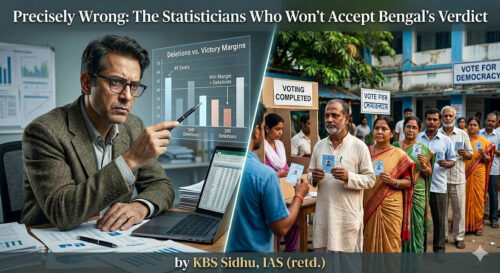
 The votes have been counted, the mandate delivered, and the people of West Bengal have spoken with unmistakable clarity. Yet a cottage industry of statisticians, psephologists, political scientists, and television anchors refuses to accept this verdict — preferring instead to retreat into spreadsheets and construct elaborate post-mortems dressed up as rigorous analysis. The “SIR Shadow” narrative — the claim that Special Summary Revision deletions from electoral rolls tilted the Bengal election — is the latest exhibit in this deeply troubling genre. It deserves to be examined, and then firmly set aside.
Specious Assumptions Masquerading as Axioms
The infographic doing the rounds tells us that in 49 assembly seats, the winning margin was less than the number of SIR deletions. BJP won 26 of these, TMC 21, Congress 2. The implicit — sometimes explicit — conclusion drawn is that the deletions were wrongful, that the deleted voters would have voted, that they would have voted overwhelmingly for one particular party, and that this party was therefore robbed.
Count the assumptions buried in that single sentence.
First, these analysts assume that every deleted voter would have turned up to vote. Voter turnout, even among validly enrolled electors, is never 100 per cent. Second, they assume that every deleted voter would have voted for one party — overwhelmingly TMC. This is not analysis; this is advocacy dressed in the language of arithmetic. Third, and most fundamentally, they assume that every single SIR deletion was wrongful, illegal, or motivated. This is the assumption that collapses the entire edifice.
49 seats where SIR deletions exceeded victory margins — BJP won 26, TMC 21, Congress 2. Real figures, specious assumptions, and a predetermined conclusion: the perfect recipe for manufacturing a stolen election narrative.
Why Were They Deleted? Ask the Law.
Electoral rolls are living documents. They are periodically revised precisely because the electorate changes — people die, people migrate, people acquire residence elsewhere, people register in multiple constituencies. Ordinary residence in a constituency is not a technicality; it is a condition precedent to enrolment under the Representation of the People Act. The SIR process exists to ensure that the roll reflects reality, not the accumulated fiction of years of non-revision.
Some deletions would have been of deceased electors. Some of migrants who had moved out of the constituency, or out of the state entirely. Some would have been of persons who could not establish that they were citizens of India — a requirement that is constitutional, not bureaucratic. And some would have been of persons with multiple registrations across constituencies, a form of electoral fraud that every democratic system must weed out.
To treat all of these as wrongful deletions — to place them in the debit column of a losing party’s account — is not statistics. It is mischief.
If the Deletions Were Wrong, Where Are the Challenges?
Here is the question that the SIR Shadow theorists consistently refuse to answer: if these deletions were wrongful, why were they not challenged?
The law provides a clear remedy. Aggrieved persons — or organisations acting on their behalf — can file claims and objections before the Electoral Registration Officer. Appeals lie to designated appellate authorities and, ultimately, to civil courts. This is not a Kafkaesque labyrinth; it is a transparent, accessible process.
The more honest and intellectually rigorous question to ask is this: of the appeals that were filed against SIR deletions, what proportion succeeded? In how many cases did the appellate tribunals hold that the deletion was wrongful and restore the voter to the roll? And in how many cases was the deletion upheld as correct? That data — not the raw deletion numbers — is the only legitimate basis for any argument about electoral integrity.
The silence on this question is telling.
The Real Problem: Due Process, Not the Deletions
There is, to be fair, one genuine grievance worth acknowledging. Some appeals against deletions may have been filed in time but could not be decided before the election. If a voter filed a timely objection, had a prima facie valid claim, but was unable to vote because the appellate tribunal had not disposed of his case, that is a process failure worth examining and correcting.
But this is a very different argument from the one being made. It is an argument for faster appellate disposal, for pre-election timelines, for administrative reform — not an argument that the election result was fraudulent or that the mandate should be questioned.
The distinction matters enormously. One is a demand for better governance. The other is a refusal to accept democracy.
Better Approximately Right Than Precisely Wrong
There is an old statistician’s maxim, attributed to John Tukey: “It is better to be approximately right than precisely wrong.” The SIR Shadow analysts have inverted this wisdom spectacularly. They are being precisely wrong — with exact numbers, elaborate charts, and confident percentages — while making assumptions so heroic that no honest analyst could defend them in a seminar room, let alone in public discourse.
The people of Bengal went to the polls. They exercised their franchise. The Election Commission of India — a constitutional body with seven decades of institutional credibility — conducted the exercise. The results were declared. That is democracy.
A Word to Everyone in the Room
The outgoing Chief Minister, party strategists, television anchors, political economists, exit poll impresarios, and the full gallery of commentators who have made careers from never accepting a verdict they dislike — all of them owe the people of Bengal something simple: respect.
To impute the verdict to deleted voter rolls is to say, in effect, that the people who did vote — the millions who stood in queues, showed their voter ID cards, and pressed the button — got it wrong. That their judgment is explained away by a number in a spreadsheet. That is not analysis. That is contempt.The verdict of the people is not a dataset to be interrogated. It is the foundational act of a republic. Accept it.