
 In “Party Games,” the 1984 Christmas Special that closed out Yes Minister and set up its sequel Yes, Prime Minister, a sitting British Prime Minister’s sudden resignation triggers a frantic Whitehall scramble for the succession, with the affable, unthreatening Jim Hacker manoeuvred into Downing Street less through ambition than through being everyone’s least objectionable second choice. Four decades on, the satire reads less like comedy and more like prophecy. The uncanny part is the choreography: cabinet ministers quietly testing the wind, a leadership vacancy engineered through procedural means rather than open declaration, and a frontrunner who insists, almost to the last, that he is not really seeking the job at all. The obvious difference is the mood. Hacker’s ascent was bloodless farce, conducted over sherry and euphemism. What is unfolding around Keir Starmer is neither private nor gentle — it is being fought in public, in real time, across cabinet meetings, by-election counts and front-page briefings, with none of the parties involved much interested in maintaining the pretence of decorum.
Starmer’s leadership crisis has entered a sharper, more dangerous phase — and the aftershocks will travel well beyond Westminster, into the gurdwaras, Hindu temples and living rooms of Neasden and Leicester, and the WhatsApp groups of the Indian diaspora in Britain, Sikh and Gujarati alike. The question for readers of The KBS Chronicle is no longer whether Starmer is in trouble. He plainly is. The question is how this succession battle reshapes the political terrain that Britain’s Indian diaspora will have to navigate next.
I. A Premiership Under Siege
Andy Burnham, the long-serving Mayor of Greater Manchester known as the “King of the North,” has won the Makerfield by-election by a resounding margin — a result that was never really about Makerfield at all. A sitting Labour MP, Josh Simons, stood down specifically to vacate the seat and clear Burnham’s path back into Parliament. It was preparation dressed up as procedure.
Burnham left no ambiguity about his intentions. “Everyone knows that politics isn’t working,” he told supporters on victory night. “Tonight could, just could, be the turning point.” Starmer, for his part, has abandoned any pretence of conciliation. A senior Downing Street source has said his message is unambiguous — a leadership contest would damage party and country, but “if there is one, he’s ready to fight it.” Wes Streeting, who resigned as Health Secretary in May accusing the leadership of operating in a “vacuum,” has also declared he will stand if a contest is called, turning what looked like a two-horse race into something messier.
Formally, the mechanics have not changed: a challenger needs the backing of around 81 Labour MPs — roughly 20% of the parliamentary party — to force a contest. Politically, the calculus has already moved well past that threshold. More than 100 Labour MPs are now reported to have told Starmer directly that his time is up, and reporting from more than fifteen cabinet ministers suggests a clear majority now regard a Burnham succession as all but inevitable, even as Starmer refuses to concede the point publicly. Britain, commentators now note, may be facing its sixth prime minister in seven years, and the transition — if it comes — looks set to be contested rather than choreographed.
II. The Mechanics of What Comes Next
Burnham’s return to Westminster forces him to vacate the Greater Manchester mayoralty, triggering a major contest in a region of over two million voters, expected by late July. That race will function as an early proxy verdict on both Labour’s direction and Burnham’s own standing — a test before the real test.
Separately, if Starmer survives this round but emerges weakened, marginal-seat Labour MPs may start calculating that continued loyalty to him is itself an electoral risk. Makerfield has shown that a single, well-timed by-election can function as an instrument of internal pressure. Whether that becomes a repeatable tactic — or whether Starmer’s combative response forecloses it — is now the live question inside the party.
III. Why the Diaspora Should Be Watching Closely
Labour’s relationship with Britain’s Indian diaspora has been a deliberate repair project since the Corbyn years, when the party’s positioning on Kashmir and its tolerance of anti-India currents within its base caused lasting damage. Starmer moved early in his leadership to declare that Labour would not interfere in Kashmir or other Indian internal affairs — a position designed specifically to rebuild that trust.
The picture with Sikh voters is layered, and it extends well beyond any single grievance. Among the issues that have accumulated over the years is the long-standing demand, voiced periodically by Sikh organisations, for a fuller account of Britain’s role around the 1984 attack on the Golden Temple — a demand that resurfaces at moments like this one without yet having produced a settled outcome either way.
More immediate, and arguably more politically live, are concerns closer to home. Sikh community leaders have reported a marked rise in hate crime in recent weeks, including incidents of verbal and racial abuse linked to the aftermath of a high-profile murder case in Southampton, with some community figures stating that gurdwaras have had to arrange their own protection after feeling the government’s outreach to Sikhs lagged behind support extended to other communities. Separately, the long-running grooming gangs scandal — a serious failure of policing and child protection that has affected victims across communities, Sikh families among them — has become a flashpoint exploited by far-right groups, even as some Sikh organisations have pressed for a fuller accounting of how these failures were allowed to persist. Both issues sit uneasily alongside Labour’s broader promises on community safety and equal protection under the law, and any new leadership will inherit the question of whether Sikh communities are being heard on them with the same seriousness as others.
A change at the top of Labour — or Starmer’s survival in a weakened, more defensive posture — will be read by the diaspora through several lenses:
— Community safety and equal protection. Whether Sikh concerns about hate crime, policing responsiveness, and the fallout from the grooming gangs scandal receive the same priority as those raised by other communities.
— The 1984 question. Whether a successor, or a chastened Starmer fighting for his political life, treats this as worth revisiting at all.
— Kashmir and non-interference. Whether the current line holds under new leadership, or whether older instincts resurface as a new leader looks to build coalitions.
— Khalistan-linked extremism. How the next phase of Labour leadership handles the discomfort caused by past episodes of party figures amplifying or tolerating extremist content.
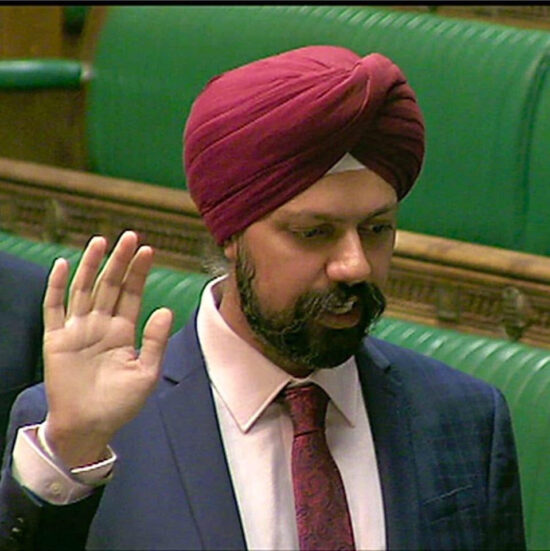
Tan Dhesi: Febuary 2022 photo from his Facebook page.
There is also a barometer worth watching inside the Parliamentary Labour Party itself: Tanmanjeet Singh “Tan” Dhesi, the Slough MP and Britain’s first turbaned MP, who currently chairs the Commons Defence Committee — the most senior institutional position held by any Sikh in the House of Commons. Dhesi has not staked out a position in the succession fight, and there is no indication he intends to. But his standing makes him a natural reference point for how seriously any new Labour leadership treats diaspora concerns in practice rather than in rhetoric: whether his committee role and influence are reinforced or quietly sidelined under new management will tell its own story, independent of whatever is said from the despatch box.
There is a foreign-policy dimension too. UK-India relations are mid-negotiation on trade and security cooperation. Sustained instability in Downing Street complicates that timeline regardless of who eventually leads Labour — a weakened incumbent has limited room to close deals, and any incoming leader will need time to establish credibility in New Delhi from scratch.
IV. The Diaspora’s Actual Leverage
Britain’s Hindu and Sikh communities have no vote in Labour’s internal contest. But they hold something more durable: influence over marginal seats at the next general election. Whichever way this resolves — Starmer fighting off the challenge, Burnham prevailing, or Streeting emerging as a third force — the underlying test for Labour remains unchanged: whether symbolic gestures toward India, Punjab and Gujarat, and toward Hindu and Sikh communities at home, are backed by substance on safety, fairness, and respect, or whether they remain just that — symbolic.