
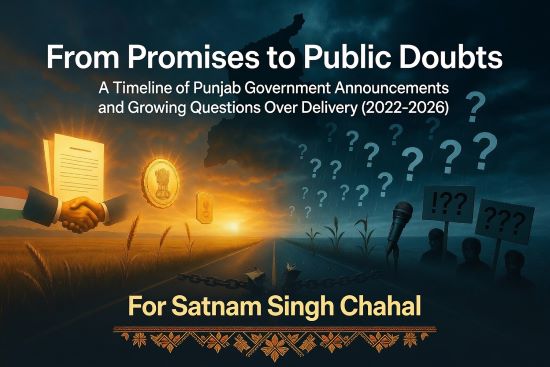
 When the Aam Aadmi Party (AAP) formed the government in Punjab in March 2022 under Chief Minister Bhagwant Mann, it entered office with very high public expectations. The party had promised a new model of governance based on anti-corruption, job creation, drug eradication, free electricity, women’s financial support, and overall administrative reform. These promises created a strong wave of hope among the people of Punjab who were looking for major change in the state’s political and administrative system.
In the initial phase of 2022, the government announced several priorities including strict action against corruption, campaigns against drugs, improvements in governance, and expansion of welfare schemes. Among the most widely highlighted promises were ₹1,000 monthly financial assistance to women aged 18 and above, large-scale government recruitment, free electricity up to 300 units, and elimination of VIP culture. However, within a short period, opposition parties and sections of civil society began raising questions about the gap between announcements and actual implementation on the ground.
During 2023, the government continued to emphasize its anti-drug campaigns, recruitment drives, and governance reforms. Several operations against drug networks and corruption were publicized, and the administration projected progress in multiple sectors. At the same time, criticism increased regarding delays in recruitment, continuing unemployment, and the slow pace of delivery of key welfare promises. Various employee groups and youth organizations staged protests demanding clarity on pending jobs and unresolved recruitment processes.
By 2024, political debate in Punjab became more focused on governance outcomes rather than announcements. Opposition leaders accused the government of failing to fully deliver on major commitments made in 2022. Issues such as unemployment, recruitment controversies, court cases related to job selections, farmer distress, and rising administrative expenditure gained prominence. While the government defended its performance by citing structural reforms and long-term policy changes, critics argued that public expectations had not been fully met.
In 2025, the government announced several new development initiatives, including major investments in infrastructure, energy reforms, and intensified anti-drug campaigns. The “Yudh Nashian Virudh” campaign was highlighted as a major step in tackling drug abuse. However, concerns were also raised regarding rising state borrowing, flood management challenges, compensation delays, and whether key welfare promises—especially financial assistance schemes—had reached the intended scale and effectiveness. Opposition parties alleged that governance was becoming increasingly announcement-driven rather than result-oriented.
By 2026, Punjab’s political landscape had become sharply divided between government claims and opposition criticism. The government released performance reports claiming progress in areas such as free electricity, drug enforcement, welfare schemes, and infrastructure development. However, critics continued to raise concerns over unemployment, drug abuse, rising debt reportedly exceeding ₹4 lakh crore, recruitment delays, and ongoing governance disputes. The difference between official claims and ground realities became a central topic of political debate in the state.
Alongside policy debates, several controversies also shaped public discussion. The CM–Akal Takht-related controversy triggered strong reactions from various Sikh organizations and political observers, raising questions about protocol, institutional respect, and political conduct. In another development, allegations regarding manipulation or fabrication of forensic reports in a politically sensitive case further intensified debate over transparency and integrity within investigative processes. While these matters remain subject to ongoing investigation and differing claims, they have contributed to growing public scrutiny of governance and institutions.
Over the entire 2022–2026 period, several key issues have repeatedly dominated Punjab’s political discourse. These include the drug crisis, unemployment, state debt, recruitment controversies, farmer distress, flood relief management, inter-state water disputes, and broader concerns about institutional credibility and transparency. Each of these issues has been viewed differently by the government and opposition, creating contrasting narratives about the state’s progress.
In conclusion, the governance journey in Punjab since 2022 reflects two parallel perspectives. On one hand, the government highlights welfare schemes, infrastructure development, free electricity, and anti-drug initiatives as evidence of progress. On the other hand, critics argue that many announcements have not fully translated into consistent ground-level improvements, particularly in employment, drugs, fiscal stability, and governance transparency.
As Punjab moves forward, the central question remains whether public judgment will be based on announcements and intentions or on measurable outcomes and lived realities.The final assessment of this period will ultimately rest with the people of Punjab as the political debate continues to evolve.
Disclaimer: This article and accompanying images are for informational and illustrative purposes only. Some visuals may be AI-generated or digitally enhanced and may not depict actual events or persons.Views expressed are based on publicly available information and analysis.