
 Editor’s Note:
For the first time since the Ram Mandir embezzlement controversy erupted, a national public figure has directed his allegation not at the donation-counting room but at the construction of the temple itself. Congress President Mallikarjun Kharge’s charge — made at a public event in Bengaluru on 22 June 2026 and reported in The Hindu — changes the terrain of this controversy entirely. It places under scrutiny the Rs 1,800 crore construction project overseen by Nripendra Misra, former Principal Secretary to PM Modi and Chairman of the Ram Mandir Construction Committee for six years. This piece examines why that scrutiny is now both inevitable and overdue.
The Trigger: Kharge’s Allegation Changes the Terrain
Until 22 June 2026, the Ram Mandir controversy had been framed entirely around one question: who stole from the hundis? The SIT, the FIR, the resignations of Champat Rai and Dr. Anil Mishra, the public statements of Nripendra Misra — all of it revolved around the donation-counting room, the cash boxes, the missing gold and silver, the deleted CCTV footage.
Then Congress President Mallikarjun Kharge — Leader of the Opposition in the Rajya Sabha — said something that changed the terrain entirely. Speaking at the installation of new Karnataka Congress president B.K. Hariprasad in Bengaluru, Kharge stated: “Nobody gave any account of the money collected after L.K. Advani’s Rath Yatra. Now, after the construction of the temple, Rs 5,000 crore has been misused. The priests are robbing the money. Ram naam japna, paraya maal apna.”
The sequencing of that sentence is everything. Kharge was not talking about the chadhava — the donations dropped into the boxes by devotees. He was talking about the construction itself. The money raised from the Rath Yatra era, the funds mobilised for building the temple, the Rs 1,800 crore official construction cost and the broader financial corpus around it — that is what he was pointing at. For the first time, a national-level public figure of the Leader of the Opposition’s stature has made an explicit allegation directed at the construction phase, not the donation-counting room.
The Rs 5,000 crore figure is Kharge’s political assertion, not an established or SIT-sourced fact — it should not be presented as verified. But the allegation itself is of an entirely different order from what has gone before, and it opens a door that had remained firmly shut in the public discourse until now. The SIT’s probe, sourced reporting has already confirmed, has been extended to cover the Trust’s land purchases and the procurement of building materials. The allegation has political motivation; the institutional questions it raises do not.
And those questions point, with a precision that can no longer be avoided, at one man: Nripendra Misra, Chairman of the Ram Mandir Construction Committee from 19 February 2020 to the completion of construction in July 2026.
Who Is Nripendra Misra?
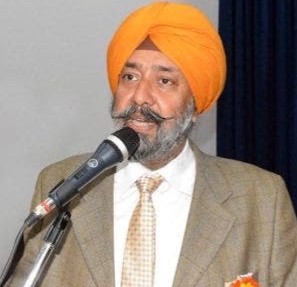
Nripendra Misra is a 1967-batch IAS officer of the Uttar Pradesh cadre, one of the most decorated techno-bureaucrats of his generation. He served as Chairman of the Telecom Regulatory Authority of India. He served as Principal Secretary to Prime Minister Narendra Modi from 2014 to 2019 — the most trusted position in the Indian bureaucratic firmament, held for the full term of PM Modi’s first government. He was appointed Chairman of the Ram Mandir Construction Committee at the Trust’s very first meeting on 19 February 2020, on an entirely honorary and unremunerated basis, and served for over six years — through the Bhoomi Pujan in August 2020, through the Covid lockdown during which he drove from Delhi to Ayodhya, through the Pran Pratishtha in January 2024, and through the completion of construction when L&T and Tata Consulting Engineers handed over the site. By virtue of that chairmanship, he holds ex-officio membership of the Trust, without voting rights.
He is the single most senior, most experienced, and most publicly accountable institutional figure in the entire construction enterprise — the man who oversaw every rupee of the Rs 1,800 crore official construction budget, who approved L&T’s and TCE’s appointments, and who chaired the committee that took every major construction decision across six years. His personal integrity and voluntary, unremunerated stewardship are not in question here. What is in question is institutional process — and that question now has a new and more urgent political context following Kharge’s allegation.
What He Said: Three Interviews, on the Donation Controversy
When the chadhava embezzlement controversy erupted in June 2026, Nripendra Misra gave three substantial television interviews — to Aaj Tak, India TV, and a third channel — in addition to written interactions with The Hindu and ThePrint. He drew a sharp line: “My responsibility is only to monitor the construction work. I only look at construction and nothing else.”
Within that self-defined lane, he spoke with remarkable candour about the donation side. He described the Trust’s entire management as informal — 1,500 people, no written orders, no accountability, no service manual, a “mini city” run on verbal instructions. He said the SOP for cash counting was never followed: “Koi bhi anupalana nahin hua.” He said SBI implemented its MOU with the Trust “in the most non-serious manner.” He identified the deliberate deletion of CCTV footage as the most damaging forensic problem. He gave Champat Rai an “unqualified certificate” of character while saying those around him committed bheeshon durupyog — grievous misuse — and backstabbing of his trust.
On PM Modi: “no direct signal” received; senior colleagues were gathering information and would “probably discuss it with the PM on his return.” On his own role: “I only look at construction and nothing else.” That sentence — repeated, deliberate, carefully placed — is precisely what Kharge’s allegation now puts under the spotlight.
The Construction Questions — Now More Urgent Than Ever
What follows contains not the remotest insinuation of personal dishonesty or wrongdoing on Nripendra Misra’s part. His long public service, his voluntary and unremunerated stewardship of this project, and his evident personal integrity are not in question. What is in question is institutional process — the kind of accountability that attaches to any public office, and to none more legitimately than to the chairmanship of a committee that spent Rs 1,800 crore of public donations on the construction of India’s most significant religious monument.
These questions have always existed. They existed before Kharge spoke. But his allegation — whatever its political motivation — has transformed them from analytical observations into political demands. The space for proactive, voluntary disclosure is narrowing rapidly. If and when the CBI, ED or a court-supervised investigation is ordered — and that is now being demanded by BJP functionaries, RSS members, the VHP, the opposition, and a petition before the Supreme Court — these questions will be posed compulsorily rather than voluntarily. Nripendra Misra controls the terms of this conversation now. He may not for much longer.
Why nomination, not tender?
Larsen & Toubro was appointed Design and Build contractor and Tata Consulting Engineers as Project Management Consultant, both in November 2020, both by nomination. No Notice Inviting Tender was published. No pre-qualification process, no bid evaluation committee, no comparative financial assessment is on the public record. The stated justification is that L&T offered its design and project management services “free of cost.” But the Rs 1,800 crore in actual construction costs — the sandstone from Rajasthan, the granite from Telangana and Karnataka, the labour, the sub-contracts — was procured by L&T and paid from public donations. The absence of competitive tendering for professional fees does not address whether the rates at which L&T placed its sub-contracts were competitive. That question has no public answer. If Kharge’s allegation is to be conclusively refuted, it is precisely this question that must be answered.
Were CPWD Schedule of Rates applied?
The CVC’s procurement principles — open tender, widest competition, transparency in rate-setting, independence of the certifying authority — do not formally bind an autonomous charitable trust. But a project of this scale, built from public donations, constituted by Central Government gazette notification, with construction overseen by a committee chaired by the Prime Minister’s former Principal Secretary, carried every moral obligation to voluntarily adopt those standards. Were CPWD Schedule of Rates used as a benchmark? Were non-scheduled items — and in a Nagara-style sandstone temple there would have been many — independently rate-analysed? By whom? Was that analysis placed before the full Construction Committee and minuted? Were the minutes published?
On the certifying consultant.
TCE, appointed to independently supervise and certify L&T’s bills, is a wholly-owned Tata Group enterprise. L&T is structurally separate — no common ownership. But both were appointed by nomination to the same project. TCE’s role as certifying consultant is the single most important financial check on Rs 1,800 crore of public money. Was any independent third-party review of TCE’s certifications ever commissioned? Did the Construction Committee receive periodic certified reports from TCE that were formally tabled and minuted?
Why no haste argument works here.
Urgency is frequently invoked to justify procurement shortcuts. But a temple built after half a millennium’s wait, which will stand for all time, was not a project that required emergency procurement shortcuts. The Bhoomi Pujan was 5 August 2020; the Pran Pratishtha was 22 January 2024 — three and a half years of construction time. That is not a rushed project. The question is not whether L&T built magnificently — it did. The question is whether the public, whose money paid for it, can verify that it received value for money. It presently cannot. If the answer is yes, the documentation exists. Let it be placed in the public domain.
The deepest symmetry.
Nripendra Misra has said, with justified anger, that the SOP for cash counting was sound on paper but not followed — “Koi bhi anupalana nahin hua.” The public is entitled to ask: were the equivalent standards of process — transparent procurement, competitive tendering, independent rate analysis, formal committee minutes — followed in the construction domain? If the absence of SOPs in the counting room is a scandal, the absence of equivalent rigour in the construction domain is a question of identical weight. The devotees whose offerings were mishandled in the counting room are the same devotees whose donations built the temple. Their entitlement to a full account extends to both.
On land purchases.
The SIT’s probe has reportedly been extended to cover the Trust’s land purchases — and sourced reporting has already flagged alarming discrepancies: land worth Rs 2 crore sold for Rs 18 crore, land worth Rs 9 crore transacted for Rs 24 crore. These are not donation-counting room questions. They are questions about the broader financial management of the Trust during the construction era — the era of Nripendra Misra’s chairmanship.
On the CCTV and physical infrastructure.
The Construction Committee oversaw the CCTV installation. Seven to eight months of footage was deliberately deleted — not the 45-day auto-erasure Misra himself cited, but active concealment. Was the 45-day retention limit ever reviewed by the committee as adequate? Was a longer archival period recommended or rejected, and by whom?
The Reassuring Intermediary — and Its Limits
Nripendra Misra’s multiple interviews functioned, whether by design or simply by his proximity to PM Modi, as the most senior reassuring voice in a controversy that required the Prime Minister to say nothing. PM Modi has maintained complete silence throughout. His former Principal Secretary filled that silence with calm, professional commentary. The Statesman captured this precisely: “When Mishra raised questions over accountability and compliance, they reflected concerns of the topmost in the government.”
That may be right. But those concerns — if they are the topmost’s concerns — now logically encompass the construction domain, not only the counting room. The Federal has headlined its coverage “Nripendra Mishra passing the buck.” The Wire notes his “shifting defences.” The Federal’s analysts have asked publicly: “The man who oversaw the temple’s construction has himself admitted that the system was never built to be accountable. So is the SIT probe the start of genuine reckoning — or the beginning of a carefully managed clean-up?”
These are no longer fringe questions. They are mainstream editorial observations in credible publications. And Kharge’s allegation — however politically motivated — has now elevated them to the level of a formal political charge made by the Leader of the Opposition, reported in The Hindu.
Proactive Disclosure: The Case for Speaking Now
Nripendra Misra has described the construction domain as exclusively his own — “I only look at construction and nothing else.” That is precisely why the questions in this piece are his to answer, and his alone. Not because anyone alleges personal wrongdoing, but because transparency in public institutions is not a concession offered under pressure — it is a duty that comes with authority.
The narrative around this embezzlement case is moving fast, and it has now expanded beyond the counting room to encompass the construction itself. Once distortion takes hold in the public mind — once the Rs 5,000 crore figure circulates without refutation, once the land-purchase discrepancies remain unexplained, once the absence of published BoQs and rate analyses is interpreted as concealment rather than oversight — it is difficult to dislodge. The time for Nripendra Misra to speak clearly about his own domain — the procurement process, the rate analysis, the bill certifications, the committee minutes, the land purchases, the CCTV decisions — is now, while he still controls the terms of that conversation.
A public charitable trust, built on the faith of billions, owes its answers not to convenience but to those whose offerings made it possible. The counting room is not the only room in that temple. And the people’s questions — as the Congress President has now made unmistakably clear — do not stop at its door.