
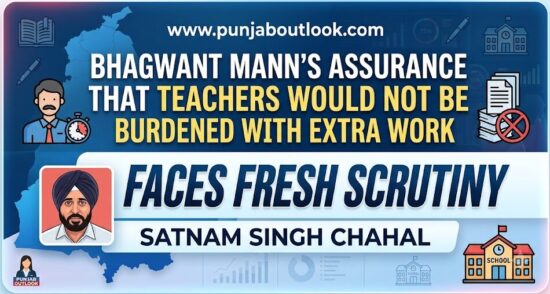
Author’s Note:The tragic death of primary school teacher Gurpreet Singh in Gurdaspur is a stark reminder of a broken political promise. Upon taking office, Punjab Chief Minister Bhagwant Mann repeatedly assured the public and the teaching fraternity that government teachers would exclusively concentrate on teaching work and never be burdened with non-teaching duties. He stated unequivocally that his government had [notified a policy ensuring educators would not be deployed for administrative exercises like censuses, welfare rollouts, or electoral registries.
Yet, reality on the ground tells a completely different story. Government teachers across Punjab continue to be assigned exhausting booth-level officer (BLO) duties. The ongoing Special Intensive Revision (SIR) exercise, defined by unrealistic deadlines, lack of proper training, and the looming threat of disciplinary action, has pushed frontline educators to the brink of psychological collapse.
Had Chief Minister Bhagwant Mann strictly honored his own guarantee to keep “nation builders” in the classroom rather than treating them as corporate data operators for civil administration, this devastating loss of life could have been entirely avoided. The state government must immediately withdraw teachers from all non-educational assignments before another tragedy occurs.
When the Aam Aadmi Party (AAP) sought a mandate in the 2022 Punjab Assembly elections, education was presented as one of its flagship priorities. Bhagwant Mann repeatedly assured teachers that they would be treated as educators rather than as an easily available government workforce for miscellaneous administrative assignments. His message was simple: teachers should teach, while non-academic work should be minimized so that Punjab’s children receive quality education. Those assurances generated enormous goodwill among government school teachers, many of whom had long complained that successive governments routinely assigned them duties unrelated to education.
The issue of non-teaching duties was not new. For years, teachers had been deployed for election work, census operations, surveys, welfare scheme verification, data collection, public awareness campaigns, and numerous departmental assignments. Teachers’ unions consistently argued that these responsibilities consumed valuable classroom time and diluted the quality of education. During the election campaign, AAP criticized this practice and promised a system where teachers would remain primarily in classrooms rather than government offices.
Following the party’s sweeping victory in March 2022, the Bhagwant Mann government launched several widely appreciated reforms in the education sector. Government schools received infrastructure upgrades, smart classrooms were introduced, Schools of Eminence were established, thousands of teaching positions were filled, and teachers were sent abroad for advanced professional training. These initiatives significantly enhanced the public image of Punjab’s education system and were projected as a model for other states.
However, while infrastructure and training improved, another debate quietly continued. Teachers’ organizations repeatedly alleged that the burden of administrative work had not disappeared. They claimed that teachers were still required to undertake voter-related assignments, surveys, digital data entry, documentation, verification drives, enrollment campaigns, and other government responsibilities in addition to their regular classroom duties.
An important development occurred in March 2023 when Punjab School Education Minister Harjot Singh Bains formally wrote to the Chief Secretary, explicitly referring to Chief Minister Bhagwant Mann’s promise that teachers should not be assigned non-educational work. The minister requested the constitution of a committee to examine the issue and formulate a policy that would ensure teachers remained focused on teaching. The letter itself amounted to an official acknowledgement that the concern existed and deserved policy attention.
The matter resurfaced again in October 2025 when Harjot Singh Bains reiterated that teachers should not be deployed for routine administrative assignments such as monitoring stubble burning. Referring to Section 27 of the Right of Children to Free and Compulsory Education Act, 2009, the minister emphasized that teachers should be assigned only those non-teaching duties specifically permitted under law, such as elections, census operations, or disaster relief. He described classroom teaching as “non-negotiable” and sought clear instructions to prevent unnecessary deployment of teachers for miscellaneous government work.
Despite these official interventions, teachers’ unions have continued to argue that implementation has remained inconsistent. According to union representatives, many schools continue to receive frequent directions requiring teachers to complete online data entry, conduct field verification, prepare reports, participate in government campaigns, and perform duties extending well beyond classroom teaching. Union leaders contend that digital governance, while improving monitoring, has simultaneously increased the volume of paperwork and reporting expected from teachers.
The debate has gained renewed attention following reports from different parts of India concerning the pressure associated with election-related duties performed by teachers serving as Booth Level Officers and other election personnel. These incidents have prompted broader national discussions regarding occupational stress, workload, and the mental health of educators who simultaneously shoulder academic and administrative responsibilities.
In recent days, social media posts have circulated claiming that Punjab witnessed its first teacher death allegedly linked to Special Intensive Revision (SIR) work pressure after the death of a teacher from Gurdaspur. At present, however, no official investigation or widely verified report from established news organizations has conclusively established such a connection. Therefore, it would be inappropriate to attribute the death to SIR duties or government workload without verified evidence. If an inquiry later confirms such allegations, it would inevitably intensify demands for comprehensive reforms in the deployment of teachers for non-academic assignments.
Irrespective of the outcome of any individual case, the larger policy question remains relevant. Can a modern education system achieve excellence if teachers continue to spend substantial portions of their working hours on administrative responsibilities? Education experts have long argued that learning outcomes improve when teachers are allowed to devote maximum attention to lesson preparation, classroom instruction, student mentoring, and professional development rather than paperwork and repetitive reporting.
Supporters of the Punjab government point out that unprecedented investments have been made in education since 2022. They highlight new schools, improved facilities, teacher training programs, transparent recruitment, and better learning outcomes as evidence that the government has delivered on many of its commitments. Critics, however, maintain that educational reforms cannot be judged solely by infrastructure or rankings. They argue that the government’s own promise regarding relief from non-teaching duties should also be measured against the everyday experiences of teachers working in classrooms across the state.
The contradiction between policy announcements and ground-level implementation has therefore become the central issue. While ministers have publicly acknowledged that teachers should not be burdened with unnecessary administrative work, teachers’ organizations continue to report that many such duties remain a regular feature of school life. Bridging this gap between intent and implementation may prove essential if the government wishes to fully realize its vision of educational transformation.
Ultimately, the debate is not merely about one government or one political party. It concerns the future of public education in Punjab. Every hour a teacher spends completing administrative paperwork is an hour that cannot be devoted to preparing lessons, helping struggling students, or improving classroom learning. If Punjab genuinely seeks to build one of India’s strongest school education systems, reducing unnecessary non-teaching responsibilities may become just as important as constructing new classrooms or introducing modern technology.
The promise made before the 2022 Assembly elections was straightforward: teachers should teach. More than four years later, the continuing concerns raised by teachers’ organizations suggest that this promise remains a work in progress. Whether the government can fully translate that commitment into everyday administrative practice may become one of the defining questions for Punjab’s education policy in the years ahead.
Disclaimer: This article and accompanying images are for informational and illustrative purposes only. Some visuals may be AI-generated or digitally enhanced and may not depict actual events or persons. Views expressed are based on publicly available information and analysis.