
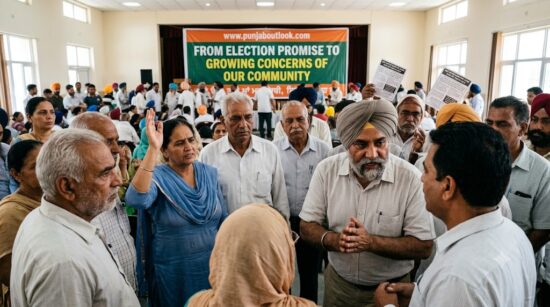
When Bhagwant Mann campaigned for the 2022 Punjab Assembly elections, one of the recurring themes of the Aam Aadmi Party’s education agenda was that teachers should be allowed to teach rather than be burdened with excessive non-teaching assignments. The party criticized previous governments for diverting teachers from classrooms to administrative and government-related work, promising that education would become the government’s top priority and that teachers would receive the respect and working conditions they deserved.
After assuming office in March 2022, the Mann government launched several high-profile education initiatives, including upgrading government schools, establishing Schools of Eminence, recruiting teachers, improving infrastructure, and sending selected teachers and principals for international training programs. These reforms were widely publicized as evidence of Punjab’s educational transformation.
Despite these initiatives, teachers’ unions continued to express concern that classroom teachers were still being assigned numerous duties beyond teaching. Union leaders alleged that teachers remained engaged in voter-related work, surveys, data verification, digital reporting, enrollment drives, administrative documentation, and other departmental assignments. They argued that these responsibilities reduced teaching time and increased mental stress, particularly during periods when multiple government campaigns overlapped.
Throughout 2023 and 2024, various teachers’ organizations organized demonstrations demanding relief from non-teaching work, faster recruitment to fill vacant posts, improved service conditions, and a reduction in paperwork. Union representatives repeatedly maintained that the shortage of clerical staff forced teachers to spend considerable time completing administrative responsibilities that should have been handled separately.
In 2025 and 2026, the debate over teacher workload intensified nationally as reports emerged from other states linking election-related responsibilities and administrative pressure to severe stress among teachers serving as Booth Level Officers (BLOs). One widely reported case involved a government school teacher in Gujarat who allegedly died by suicide after expressing extreme stress over Special Intensive Revision (SIR) duties connected with electoral work. The incident prompted demands from teachers’ unions for reforms in the assignment of election duties and greater attention to educators’ mental well-being.
Social media posts have recently claimed that Punjab witnessed its first teacher death allegedly linked to SIR-related work pressure in Gurdaspur. However, as of now, no widely verified reports from established news organizations confirming those claims were located. Therefore, it would be premature to conclude that the incident has been officially linked to election duties or government work pressure. Any such determination should await the findings of the relevant authorities and the outcome of any official investigation.
The broader issue, however, remains significant. Teachers’ organizations in Punjab have consistently argued that governments of every political party have increasingly relied on teachers to perform non-academic functions because of their extensive presence across villages and towns. While such assignments may be legally required during elections or public administration, unions contend that the cumulative burden affects classroom teaching, increases stress, and diminishes the quality of education.
The discussion therefore extends beyond one government or one political party. It raises an important policy question: should professionally trained teachers spend a substantial portion of their working time on administrative and election-related responsibilities, or should governments create dedicated administrative systems to ensure that teachers remain focused primarily on educating students? As Punjab continues to invest heavily in educational reforms, addressing this long-standing concern may prove just as important as improving school buildings, technology, and teacher training.
Disclaimer: This article and accompanying images are for informational and illustrative purposes only. Some visuals may be AI-generated or digitally enhanced and may not depict actual events or persons.Views expressed are based on publicly available information and analysis.