
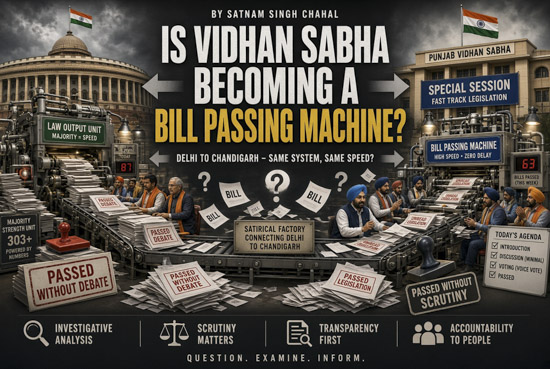
 Nine Bills passed in a single day. Important legislation pushed through at the end of the session. Opposition demanding more time for scrutiny. And the biggest question remains unanswered: When did the Punjab Vidhan Sabha stop being a place for serious debate and become a place for simply passing Bills?
What the BJP-led government is frequently accused of doing in Parliament—rushing legislation through with limited discussion—is now being mirrored by the Aam Aadmi Party government in Punjab. The political language may be different, the slogans may be different and the parties may fight each other outside the House, but when it comes to legislative procedure, the difference increasingly appears to be one of political colour rather than democratic practice.
On August 10, the Punjab Vidhan Sabha passed nine Bills, several of them dealing with important areas such as education, employment, taxation, rural development and infrastructure. The scale and speed of the legislative exercise have raised serious questions about whether elected representatives had sufficient opportunity to examine the proposed laws, consult stakeholders, understand their implications and suggest meaningful amendments.
The problem is not that nine Bills were passed. A legislature can legitimately pass several Bills in a day if they have been properly circulated, studied and debated. The real issue is whether the process gave legislators enough time to understand what they were being asked to approve. Legislation is not a race. The quality of a law cannot be measured by how quickly the Speaker’s gavel falls.
A Bill can run into dozens or even hundreds of clauses. It can affect government employees, students, private institutions, farmers, businesses, taxpayers, local bodies and ordinary citizens for years. Yet if such legislation is introduced and passed within a compressed legislative timetable, the fundamental purpose of parliamentary democracy—deliberation before decision—is weakened.
Opposition members have already raised precisely this concern. Congress MLA Sukhpal Singh Khaira sought an extension of the Assembly session, arguing that lawmakers needed adequate time to scrutinise six newly introduced Bills, consult stakeholders, seek departmental clarification and propose amendments.
This is where Punjab must ask a much larger question.Is the Assembly being treated as a law-making institution or merely as a voting machine?
The Constitution gives legislatures a crucial role beyond voting. MLAs are elected not simply to press a button or raise their hands when the government presents legislation. They are expected to question, examine, challenge, amend and improve laws. The opposition is not an obstacle to democracy; the opposition is one of democracy’s mechanisms for preventing mistakes and abuse of power.A government with a majority naturally has the numbers to pass its legislation. But having the numbers is not the same thing as having the argument.This distinction is fundamental.
If the ruling party says, “We have the majority, therefore we can pass the Bill,” democracy becomes reduced to arithmetic. But if the ruling party says, “We have the majority, therefore we will hear every argument before making the final decision,” democracy becomes meaningful.Punjab deserves the second model.There is an uncomfortable similarity emerging between the politics of New Delhi and Chandigarh. At the national level, opposition parties frequently accuse the BJP government of limiting debate, rushing legislation and using its majority to push Bills through Parliament. Now the AAP government in Punjab appears vulnerable to precisely the same criticism.AAP cannot demand more discussion in Delhi while accepting less discussion in Chandigarh.
It cannot argue that Parliament must give the opposition adequate opportunity to debate Bills while its own government is criticised for introducing multiple Bills toward the end of a legislative session.Democracy cannot have one standard in Delhi and another in Punjab.
The same principle applies to the BJP. If BJP leaders believe that legislation should receive adequate scrutiny in Parliament, they should apply that principle consistently in Punjab. If AAP believes that opposition voices deserve time and space in Parliament, it should demonstrate that commitment inside the Punjab Vidhan Sabha.The issue, therefore, should not be reduced to AAP versus BJP.It is about democracy versus legislative haste.The Punjab Vidhan Sabha represents 117 constituencies and millions of citizens. Every Bill passed inside that House ultimately becomes part of the legal framework governing the people of Punjab. That responsibility demands patience, scrutiny and intellectual seriousness.
A half-day of discussion may be enough for a routine procedural matter. But when multiple substantive Bills with long-term consequences are placed before the House, legislators should have the opportunity to examine the fine print. Experts should be consulted where necessary. Stakeholders should be heard. Committees should be used effectively. Opposition amendments should be considered on merit rather than rejected merely because they come from the opposition benches.The majority should decide the outcome; it should not decide whether debate is necessary.
The Speaker’s chair has an especially important responsibility in this process. The Speaker is not merely the presiding officer of the ruling party. The Speaker is the custodian of the House. The dignity of the Assembly depends upon ensuring that both government and opposition receive the space necessary for meaningful legislative functioning.A strong Speaker does not protect the government from criticism. A strong Speaker protects the institution from becoming irrelevant.Punjab has already witnessed growing frustration among opposition legislators over the manner in which legislative business is conducted. If this continues, the public may eventually begin asking a disturbing question: Why should citizens expect accountability from a government if the Assembly itself does not have sufficient time to hold that government accountable?There is also a larger danger.
When laws are passed hurriedly, mistakes do not disappear after the vote. They return later as court cases, amendments, administrative confusion, public protests and demands for repeal. The government then spends years repairing legislation that could have been improved through a few additional days of serious debate.Good legislation takes time. Bad legislation takes even more time to repair.Punjab does not need a faster Vidhan Sabha. Punjab needs a more serious Vidhan Sabha.The Assembly should not measure its success by the number of Bills it passes in a day. It should measure its success by the quality of the laws it produces, the seriousness of the debates it conducts and the extent to which public concerns are reflected in legislation.
Nine Bills in one day may look like legislative efficiency on paper.But if elected representatives did not receive adequate time to read, understand, question and challenge those Bills, then what appears to be efficiency may actually be democratic exhaustion.The message to every political party should therefore be simple:What is wrong when the BJP does it in Parliament cannot suddenly become right when AAP does it in Punjab.Democracy is not a party manifesto.It is a principle.
And that principle demands that every government—whether in Delhi or Chandigarh—give Parliament and the Vidhan Sabha enough time to debate the laws that will govern the people.Punjab’s legislature must never become a factory where Bills enter in the morning and laws come out by evening.The Punjab Vidhan Sabha is the House of the people—not a bill-passing machine.
Disclaimer: This article and accompanying images are for informational and illustrative purposes only. Some visuals may be AI-generated or digitally enhanced and may not depict actual events or persons.Views expressed are based on publicly available information and analysis