
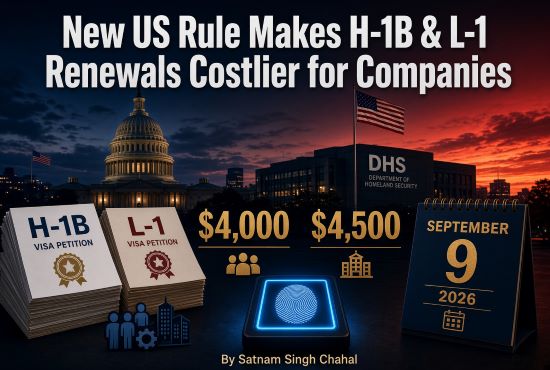
 Washington, DC – The Department of Homeland Security has finalised a rule that will force certain U.S. employers to pay a longstanding special fee every time they renew H-1B or L-1 status for foreign workers — even when the employee stays with the same company. Starting September 9, 2026, “covered employers” must pay the 9/11 Response and Biometric Entry-Exit Fee on all extension-of-status petitions. The amounts remain $4,000 for each qualifying H-1B petition and $4,500 for each L-1 petition.
The fee is paid by the employer, not the worker. Covered employers are those with 50 or more employees in the United States where more than half the U.S. workforce holds H-1B, L-1A, or L-1B status. Many large technology and consulting firms that rely heavily on skilled foreign professionals fall into this category. Until now, the fee generally applied only to initial employment petitions or changes of employer. Same-employer extensions were typically exempt when the separate fraud-prevention fee did not apply. DHS says the new rule simply corrects its earlier interpretation of the 2015 statute and aligns the fee more closely with Congress’s original intent.
Amended petitions that do not request an extension of authorised stay remain exempt.DHS estimates the change will generate an additional $37.9 million in fiscal year 2026 and about $40 million in fiscal year 2027. Officials note that fee collections had dropped sharply in recent years and argue the broader application is needed to support biometric entry-exit systems at U.S. ports. The department rejected concerns that the added cost could discourage companies from retaining H-1B talent or disadvantage workers stuck in long employment-based green-card backlogs. It described the fee as modest relative to salaries and other hiring expenses and said overall demand for H-1B visas is unlikely to decline. Indian-origin professionals, who make up a large share of H-1B holders, and the employers that sponsor them are expected to feel the biggest practical impact, as many of the largest visa-dependent companies are in the technology and IT services sector. The rule was published in the Federal Register on August 10 and takes effect 30 days later.