
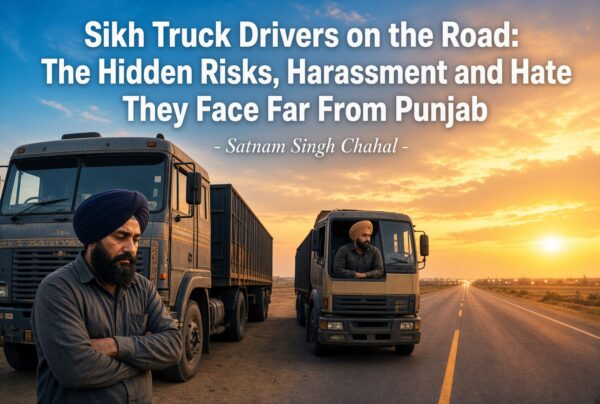
For thousands of Punjabi and Sikh families, trucking has become much more than a profession. It is a means of economic survival, a pathway to independence and, for many immigrants, one of the principal ways of building a new life abroad. Sikh truck drivers can be found travelling enormous distances across the United States and Canada, transporting food, agricultural products, machinery and essential goods.
Yet behind the image of the hardworking trucker is a reality that deserves far greater public attention. Many drivers spend days away from their families, sleep in their trucks, work through difficult weather and road conditions, and face the constant pressures of an industry in which fatigue, isolation, financial uncertainty and safety concerns are already serious challenges.For Sikh truck drivers, another problem has increasingly entered that equation: harassment, intimidation, discrimination and, in some cases, physical attacks and hate crimes.
A truck driver may leave California, British Columbia or another major transportation hub and spend days travelling across unfamiliar states and provinces. The journey can take the driver through remote highways, isolated truck stops, rest areas and industrial locations where help may not always be immediately available.For Punjabi Sikh drivers, the isolation can be particularly difficult for newcomers. Many are immigrants whose families remain in Punjab or elsewhere, while others are supporting parents, spouses and children thousands of miles away.
Long working hours, loneliness, irregular sleep, weather extremes and the pressure to deliver loads on time can take a heavy physical and emotional toll. Reporting on Punjabi immigrant truckers has documented workweeks reaching as high as 70 hours, along with the immigration uncertainty and personal sacrifices experienced by some drivers.The profession therefore demands extraordinary patience and resilience.
Sikh drivers are also highly visible. The turban, beard and other articles associated with Sikh identity make many Sikh men immediately identifiable.That visibility should never become a reason for discrimination.But community advocates say it can make Sikh truckers particularly vulnerable when anti-immigrant or anti-Sikh sentiment rises. The Sikh Coalition maintains dedicated resources for Sikh truck drivers who experience workplace discrimination because of their religious identity, including assistance in Punjabi and English.The problem is not limited to verbal insults. There have been reports of Sikh drivers being subjected to intimidation, being removed from facilities and experiencing physical harassment.
In 2025, following the fatal Florida truck crash involving Harjinder Singh, the Sikh trucking community reported a significant increase in harassment and anti-Sikh rhetoric. The Associated Press reported that community representatives received reports of Sikh drivers being harassed, including an incident in which a Sikh man was reportedly ejected from an Oklahoma truck stop when he attempted to use a shower.That distinction is critical: an allegation against one individual driver should never become a justification for targeting an entire religious or ethnic community.
The Florida crash became a national political controversy, but its consequences extended far beyond the courtroom and the individuals directly involved.Sikh truckers across America found themselves facing questions, hostility and suspicion because of their identity and occupation. AP reported that members of California’s Sikh trucking community described increased anti-Sikh rhetoric following the crash and expressed concern that the entire community was being unfairly judged because of the actions of one person.This is a dangerous pattern.
When a crime or accident involves an individual from a particular ethnic or religious community, responsibility must remain with the individual alleged to have committed the act. Collective punishment, racial stereotyping or religious profiling undermines the basic principles of justice.A Sikh truck driver should be judged by his or her conduct—not by a turban, beard, surname, nationality or religion.
Truck driving is already a dangerous profession. Drivers face collisions, extreme weather, mechanical failures, road rage, fatigue and long periods of isolation.Hate should not be added to that list as if it were simply another occupational hazard.When a driver is verbally abused because of his turban, threatened because of his ethnicity, physically attacked because of his religion or deliberately humiliated because he is perceived to be an immigrant, the incident should be taken seriously.The FBI data discussed in 2026 reporting indicates that anti-Sikh hate crimes in the United States reached a troubling level in 2025 even while overall reported hate crimes declined.That development should concern not only Sikhs but everyone who believes that religious freedom and equal protection under the law must apply to every community.
Not every problem facing Sikh truckers is necessarily a hate crime.There is a broader range of issues that can affect drivers: employment discrimination, unfair treatment, licensing complications, immigration-related uncertainty, wage disputes, unsafe working conditions, inadequate rest facilities, language barriers and difficulties obtaining legal assistance.Recent regulatory changes in the United States have added another layer of anxiety for immigrant truck drivers. Reporting in 2025 described major commercial-driver-license issues affecting immigrant drivers in California and elsewhere, with Sikh and Punjabi drivers among those affected. Advocacy organizations responded by providing legal and informational assistance.These matters should be addressed through transparent laws and fair administrative procedures rather than through political rhetoric or assumptions about an entire immigrant community.
It is also important to remember what Sikh truck drivers contribute.They are not merely people behind the wheel.They are part of the supply chain that keeps supermarkets stocked, farms connected to markets, factories supplied and communities functioning. Sikh and Punjabi truckers have established a particularly strong presence in the American trucking industry, especially on the West Coast. Industry and community organizations have highlighted their contribution to transportation and highway safety.
For many Sikh immigrants, trucking has provided an opportunity to earn a living while maintaining religious practices such as wearing a turban and keeping an uncut beard. The profession can also provide a degree of independence that some immigrants may not find easily in other sectors.The industry and the broader public therefore have an interest in ensuring that these drivers can work without fear.
The concerns are not confined to the United States.Punjabi and Sikh truck drivers are also an important part of Canada’s transportation sector. Canadian trucking provides employment to large numbers of South Asian immigrants, but drivers can encounter long hours, isolation, road safety pressures, workplace disputes and discrimination.Recent incidents involving Sikh men have again demonstrated that anti-Sikh racism remains a serious concern in Canada. Where an incident involving a Sikh truck driver is reported, authorities must distinguish carefully between an ordinary dispute, workplace conflict, assault motivated by another factor and an actual hate-motivated offence.That determination should be based on evidence—not social-media speculation.At the same time, when evidence establishes a hate motive, the response must be firm.
Truck stops are effectively workplaces for long-haul drivers. Drivers eat, shower, sleep, refuel and rest there.They should therefore be treated as places where everyone has the right to safety and dignity.Truck-stop operators should have clear anti-harassment policies, functioning security systems, adequate lighting, accessible reporting mechanisms and procedures for dealing with threats or assaults.Drivers should not have to wonder whether stopping for a shower, meal or night’s rest could expose them to abuse.Sikh organizations, trucking associations and community leaders also have an important role.Drivers need accessible information about:
How to report hate crimes.
How to document harassment.
Employment and licensing rights.
Immigration-related legal assistance.
Insurance and accident procedures.
Emergency contacts.
Mental-health and family-support resources.
What to do after an assault or threat.
How to distinguish a routine traffic dispute from discriminatory targeting.
The Sikh Coalition’s creation of a Punjabi-language trucker helpline demonstrates the importance of making assistance available in a language drivers are comfortable using.One of the greatest dangers is under-reporting.A driver who is threatened may decide that reporting the incident will create more trouble. Another may believe that the police will not take the matter seriously. A newcomer may not understand the legal system. Someone working under financial pressure may simply continue driving.That silence can allow harassment to become normalized.Every credible complaint deserves to be documented and appropriately investigated.At the same time, allegations should not automatically be labelled as hate crimes without evidence. Responsible advocacy requires both zero tolerance for genuine discrimination and respect for due process.
Governments in the United States and Canada should recognize the special vulnerability of long-haul immigrant drivers.Law-enforcement agencies should ensure that officers understand Sikh identity and can recognize potential anti-Sikh bias when investigating assaults or threats.Transportation authorities should ensure that regulatory enforcement is fair and transparent.Employers should protect workers from discrimination.Truck-stop operators should maintain safe environments.And political leaders should understand the consequences of rhetoric that turns an individual case into an attack on an entire community.
There is another dimension to this issue that should not be overlooked.Punjab has sent generations of hardworking people around the world. Many young Punjabis enter trucking after migrating to North America because it offers a comparatively accessible route to economic independence.Their families in Punjab often depend upon their earnings.When a Punjabi truck driver is assaulted, harassed, threatened or killed thousands of miles away, the consequences are felt not only by the driver but by an entire family back home.Punjab’s diaspora organizations, elected representatives and community institutions should therefore maintain stronger communication with overseas truck-driver communities.
The next time a large truck passes on an American or Canadian highway, it is worth remembering that there is a human being sitting behind that wheel.He may have left his wife and children thousands of miles away. He may have been driving since before sunrise. He may be carrying food that will reach our grocery stores or agricultural products that will feed communities.He deserves the same dignity and protection as every other worker.Being a Sikh, wearing a turban, speaking Punjabi or having an immigrant background should never make a person a target.Sikh truck drivers have contributed enormously to the transportation economies of North America. They deserve recognition for that contribution—but more importantly, they deserve safety, equality, dignity and justice.The road ahead is already difficult enough.No driver should have to travel it carrying the additional burden of fear because of who he is.
Disclaimer: This article and accompanying images are for informational and illustrative purposes only. Some visuals may be AI-generated or digitally enhanced and may not depict actual events or persons.Views expressed are based on publicly available information and analysis