
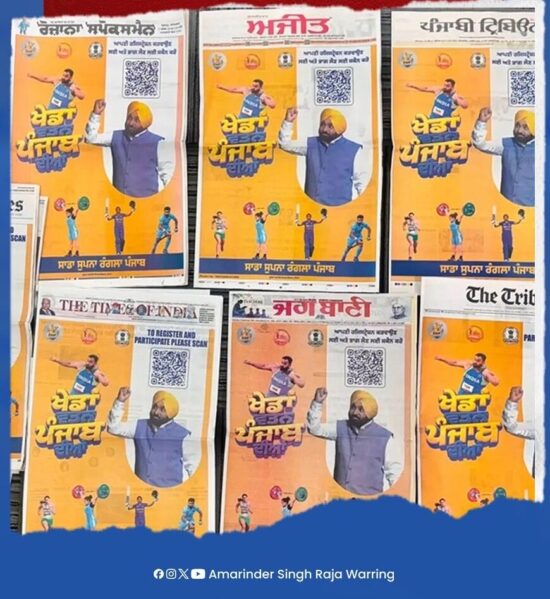
 Punjab Congress president Amarinder Singh Raja Warring has used a sharply worded political poster to target the Bhagwant Mann-led Punjab government over its spending priorities. The poster highlights government advertisements appearing prominently across newspapers, while raising the question of why the government often cites financial constraints when it comes to meeting the demands of employees and other sections of society.
The central message of the poster is simple but politically powerful: “DA ਦੇਣ ਵੇਲੇ ਪੈਸਾ ਨਹੀਂ ਤੇ ਇਸ਼ਤਿਹਾਰਾਂ ਵੇਲੇ ਖਜ਼ਾਨਾ ਭਰਿਆ” — if there is no money when it comes to paying Dearness Allowance, how does the government find money when it comes to advertisements? The Congress appears to be using this contrast to question the government’s financial priorities rather than merely its ability to spend.
The visual impact is deliberate. Instead of making a long political argument, Warring has displayed multiple newspapers carrying the same government publicity material. The message is that public money is being used to project government schemes and political achievements through advertising, while employees and other claimants continue to raise questions about pending payments and financial commitments.
The poster also opens a larger debate about the purpose and scale of government advertising. Government publicity is legitimate when it informs citizens about welfare schemes, public services or important programmes. But when advertising becomes highly repetitive and dominates newspapers, television and other platforms, taxpayers are entitled to ask whether the expenditure is proportionate to the public benefit.
For the Congress, this is an attempt to turn a financial issue into a political accountability issue. Warring is effectively asking the government to explain its priorities: is the treasury genuinely under pressure, or is the government choosing where it wants to spend? The opposition’s argument is that financial difficulties cannot be selectively invoked depending upon the demand being made.
At the same time, the government has an opportunity to respond with facts. It can disclose the total expenditure on advertising, the amount spent on individual campaigns, the purpose of the campaigns and the payments made or pending towards DA and other employee-related commitments. Such figures would allow the public to judge whether Warring’s criticism is justified or is simply political rhetoric.
The larger issue goes beyond Congress versus AAP. Punjab’s treasury belongs to the people of Punjab, not to any political party. Whether the money is spent on advertisements, salaries, DA, pensions, infrastructure or welfare schemes, every rupee deserves scrutiny.
Raja Warring’s poster may therefore be viewed as more than another political attack. It raises a question that deserves a clear answer from the Punjab government: when the government says there is a shortage of money, where exactly is the money going—and what are the spending priorities?
Punjab Outlook Comment:
The strongest response to such a poster should not be another poster. It should be numbers. If the government believes the Congress allegation is misleading, let it publish the advertising expenditure alongside outstanding DA and other employee liabilities. In a democracy, the best political reply to an accusation involving public money is transparency.