
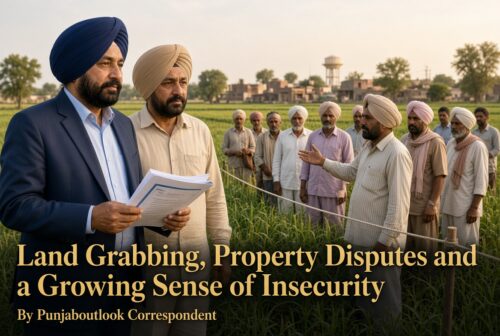
For generations, Punjabis living in the United States, Canada, Britain, Australia and other countries have maintained a powerful emotional and financial connection with Punjab. They build homes in their villages, maintain agricultural land, support relatives, finance marriages and religious institutions, invest in businesses and return every year to visit their ancestral homes. But alongside this emotional connection has grown a disturbing list of concerns: land grabbing, disputed revenue records, illegal occupation, family property conflicts, fraud, extortion, physical attacks and, in some cases, murder.
The problem is not that every NRI faces these difficulties. Nor should every property dispute be described as criminal land grabbing. But the number and persistence of complaints have made security and property protection major concerns for the Punjabi diaspora.
The Vulnerability of Absentee Property Owners
An NRI who lives thousands of miles away may have limited ability to monitor farmland or a house. A dispute can therefore begin with a relatively simple question: who is cultivating the land, who is collecting rent, whose name appears in the revenue record, or who has possession of the property, and eventually develop into years of litigation.
In 2022, Punjab NRI meetings repeatedly heard complaints about alleged land grabbing and manipulation of revenue records. At one such meeting in Ludhiana, hundreds of NRIs raised grievances, with land grabbing described as a major concern. Government data cited in 2024 also showed that the Ministry of External Affairs had received 11 property-dispute complaints from Punjab NRIs between January 2021 and June 2024. These were complaints reaching the Union ministry and therefore should not be interpreted as the total number of property disputes in Punjab.
Five-Year Timeline: 2021–2026
2021 — Property disputes remain an established diaspora concern:
The period beginning in 2021 saw NRI property complaints continue to reach government authorities. Ministry of External Affairs figures later showed 11 Punjab-related NRI property complaints from January 2021 through June 2024.The larger issue, however, extends beyond complaints reaching Delhi. Punjab’s NRI police system continued receiving property, family and criminal complaints from people living abroad.
April 2022 — Canada-return NRI shot dead:
On April 24, 2022, 25-year-old Jatinderpal Singh, who had returned from Canada only about a week earlier, was shot dead in Tarn Taran district while travelling toward Amritsar. Police registered a murder case against unidentified assailants.The incident reinforced concerns among overseas Punjabis that returning home does not automatically mean returning to a safe environment.
December 2022 — Land grabbing emerges as a major NRI grievance:
At NRI meetings in Punjab, land grabbing and alleged tampering with revenue records were among the principal complaints. Officials discussed safeguards involving girdawari and land records.A separate report noted that Ludhiana district had received 756 NRI-related complaints during 2022, with property disputes forming a substantial share.
March 2023 — Canada-return NRI killed during Hola Mohalla visit:
Pardeep Singh, a 24-year-old Canadian NRI, was killed during a brawl at Anandpur Sahib while visiting Punjab for the Hola Mohalla festival. Police registered a murder case and investigated the circumstances.The case highlighted another vulnerability: NRIs returning for religious festivals and family visits can become victims of ordinary criminal disputes or violence unrelated to their overseas status.
July 2023 — NRI murder linked by police to property dispute:
Baninderdeep Singh, 42, who had returned from Canada, was hacked to death near Lalton Kalan in Ludhiana. Police later arrested six people, including a minor, and said the investigation indicated a property dispute involving one of the accused.This case was particularly troubling because it connected two major concerns property disputes and physical violence.
August 2024 — US citizen shot inside Amritsar home:
Sukhchain Singh, who had recently returned from the United States, was shot inside his residence in Daburji, Amritsar. Police said two men entered the property and fired at him while family members were present. He survived.
2024 — NRI property vulnerability exposed beyond Punjab:
Chandigarh Police arrested eight people in a case involving alleged illegal occupation of an NRI woman’s property. Investigators said the probe pointed toward an interstate network and possible targeting of other NRI properties.Although Chandigarh is a separate Union Territory, the case illustrates the wider property-security problem faced by overseas Punjabis in the region.
January 2025 — Elderly NRI attacked in Faridkot:
An elderly NRI was reportedly attacked inside his home in Kammiana village, Faridkot, with sharp-edged weapons. The case was reported to be connected to a land dispute, although the investigation and legal process determine the final facts.
June 2025 — Firing at NRI family home in Jalandhar:
Unidentified attackers opened fire outside the home of an NRI family in Aman Nagar, Jalandhar, shortly after an extortion call, according to police and media reports. No one was injured. A Pakistan-based gangster claimed responsibility on social media, an allegation that investigators would need to establish through evidence.
July 2025 — NRI land-grabbing case in Jalandhar:
Punjab Police’s NRI Wing registered two FIRs against five people in connection with alleged cheating, trespassing, forgery and criminal conspiracy involving property belonging to elderly NRIs settled in the United States and United Kingdom.The case illustrated why absentee owners can be vulnerable to forged documents, disputed possession and manipulation of property transactions.
September 2025 — Canadian NRI and woman found murdered:
The bodies of 65-year-old Canadian NRI Santokh Singh and Manjit Kaur, who cared for his house, were found in Moranwali village, Hoshiarpur district. Police suspected they had been murdered with sharp-edged weapons and began an investigation.
February 2026 — US-based family cancels Punjab visit:
A US-based NRI family cancelled a planned visit to its native village in the Goraya area after unidentified persons vandalised their ancestral house. Police investigated the incident; authorities said no extortion demand or threat call had been established at that stage.The significance was psychological as well as physical: fear changed the family’s decision to visit its own ancestral village.
February 2026 — Gunfire outside former NRI’s house:
In Nangal Lubana village in Kapurthala district, gunshots were fired outside the residence of former NRI Devinder Singh. Police named a US-based former business associate in the FIR based on the complainant’s allegations; two unidentified shooters were also named. The investigation was ongoing.
September 2026 — NRI grievances continue:
At an NRI meeting in Amritsar in September 2026, 75 NRIs from Amritsar, Tarn Taran, Pathankot and Gurdaspur raised grievances involving property disputes and matrimonial matters. One NRI alleged that the girdawari of his 25-acre property had been changed and that relatives had taken ancestral land; these were complaints presented to officials, not judicial findings.
Why Are NRIs Particularly Vulnerable?
There are several recurring factors.First, distance. An owner living in California, Toronto or London cannot easily visit a field in Punjab every week.Second, family dependence. Many overseas Punjabis leave their properties under the care of relatives, tenants or acquaintances.Third, revenue records and possession. A dispute over cultivation, tenancy, girdawari or possession can become complicated and expensive.Fourth, slow litigation. Even where an NRI ultimately succeeds, years may pass before the property is recovered.Fifth, criminal exploitation. In the worst cases, property disputes can allegedly become connected with intimidation, extortion or violence.
The Emotional Cost
There is also a deeper issue.For many Punjabis abroad, the village house is not merely real estate. It represents parents, grandparents, childhood memories and family history.When an NRI is forced to sell ancestral farmland because of a prolonged dispute, or stops visiting Punjab because of security concerns, the loss is not merely financial.It weakens the emotional relationship between Punjab and its global diaspora.
What Should Change?
Punjab needs a stronger, transparent and time-bound system specifically designed for NRI property and security complaints.First, every NRI property complaint involving alleged forgery or illegal occupation should receive a documented tracking number.Second, revenue records involving NRI-owned land should be protected through transparent digital notifications so that owners abroad can immediately know when a mutation, girdawari or ownership entry is changed.Third, police complaints involving threats, extortion or violence against visiting NRIs should be investigated without regard to the victim’s social status.Fourth, property disputes should not automatically be labelled criminal cases. Genuine civil disputes must remain within the legal process, while alleged forgery, trespass, intimidation and violence must be investigated as potential crimes.Fifth, Punjab’s NRI Wing should publish periodic, district-wise statistics on complaints received, FIRs registered, investigations completed, property recovered and cases pending.
A Relationship Punjab Cannot Afford to Lose
Punjab’s diaspora sends money, builds homes, supports families, invests in businesses and contributes to charitable and religious institutions.But a relationship based on emotion cannot survive indefinitely on emotion alone.An NRI should be able to return to Punjab without wondering whether an old property dispute will become a security threat.A family living overseas should be able to trust that ancestral land cannot simply disappear through forged papers or manipulated records.
And Punjab must send a clear message:
The overseas Punjabi is not an outsider. He or she is a stakeholder in Punjab’s future.Protecting NRIs does not mean giving them special treatment. It means ensuring that distance from home does not become an invitation to exploitation.The ultimate test is simple: Can a Punjabi living thousands of miles away still feel that his home, his land, his family and his life are secure in Punjab?That is a question Punjab’s institutions must answer.
Disclaimer: This article and accompanying images are for informational and illustrative purposes only. Some visuals may be AI-generated or digitally enhanced and may not depict actual events or persons.Views expressed are based on publicly available information and analysis