
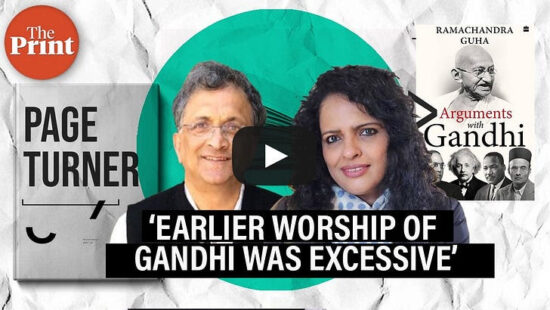
 There is an occupational hazard in writing yet another book about Mahatma Gandhi: the reader may reasonably ask whether anything remains to be said.Rama Lakshmi, ThePrint’s Editor, Opinion & Ground Reports, asks precisely that at the start of her conversation with historian Ramachandra Guha about Arguments with Gandhi. His answer is the reason the forty minutes repay watching. He describes the book, which is not another biography, as a moral and political history of the modern world with Gandhi at its centre, as seen by his contemporaries, his adversaries, later generations and movements far beyond India.The conversation ranges over caste, race, women, violence, industrialisation, Subhas Bose, Bhagat Singh, Savarkar, Ambedkar and the contemporary Hindu Right. What follows is what one viewer carried away.
From Worship to Demonisation
Guha’s first proposition is generational. The India in which he grew up excessively venerated Gandhi; the Mahatma of the schoolroom was saintly, wise and almost beyond criticism. Then came successive critiques from Marxists, Ambedkarites, modernisers and the Hindu Right, and Guha believes we have now travelled too far the other way, from excessive veneration to excessive demonisation.
The interview gets its sharpest political edge here. The ecosystem of the ruling party and the Sangh Parivar, he argues, publicly attacks Pandit Nehru, but the person it “really detest[s]” is Gandhi. He gives two reasons: Gandhi’s insistence on equal rights for Muslims, and a commitment to non-violence that sits uneasily with a more muscular nationalism.
One may or may not accept the conclusion, but it deserves to be argued with, not merely applauded or dismissed.
The Absent Adversary
The most elegant idea in the conversation comes from a visual puzzle. Guha encounters Bhagat Singh, Subhas Bose and V.D. Savarkar placed together. What could unite three such different men?
His answer is Gandhi, the absent adversary. Bhagat Singh found him insufficiently socialist, Bose insufficiently militant, Savarkar insufficiently Hindu. Three very different conceptions of India define themselves against the same man, which explains his durability. One need not agree with Gandhi to be compelled to argue with him.
A Man Capable of Changing His Mind
Guha admires Gandhi, but not uncritically. He acknowledges troubling early attitudes on race and serious limitations in Gandhi’s thinking about women. What he finds remarkable is the capacity to evolve.
On race, the change was dramatic. On caste, arguments with Pandit Nehru and, more importantly, with Ambedkar pushed him to a more radical position. On gender, the record stayed unsatisfactory and frequently contradictory.
Gandhi met people who disagreed with him, argued with them, befriended some and sometimes changed his mind because of them. Social media rewards the opposite habit: the Left reads the Left, the Right reads the Right, and the algorithm assures each that it was correct all along.
Ahimsa, But Not Everywhere
The discussion of non-violence is free of absolutism. Guha concedes that Gandhian methods would not have succeeded against Hitler’s Germany, and cannot be assumed to prevail against fully totalitarian states.
His claim is narrower and more practical. Where there is some political space, institutional restraint or public conscience (British India, or the United States of the civil-rights years), non-violent mass mobilisation can be both morally superior and strategically more effective than armed struggle. The concession strengthens the case.
Why Colonialism Yielded, but Caste Did Not
The most uncomfortable exchange concerns a comparison. Gandhi appealed to the conscience of the British against colonial rule, and to the conscience of upper-caste Hindus against untouchability. Why did the first help end an empire while the second left caste discrimination standing?
Guha’s answer is that Britain contained liberals, Labour politicians, sympathetic intellectuals and men such as C.F. Andrews who challenged imperialism from within. There was an audience capable of responding to moral pressure. Against untouchability, Gandhi was far more isolated. Congress never made its eradication sufficiently central, and after Independence the Gandhian movement itself let the campaign slacken.
Guha calls this a real failure. Gandhi is neither acquitted nor condemned.
Bose Cannot Conveniently Be Turned Against Gandhi
Bose disagreed fundamentally with Gandhi over Congress leadership, methods of struggle and the route to Independence. Yet disagreement never became repudiation.
Guha recalls that Bose named INA brigades after Gandhi and Pandit Nehru, acknowledged Gandhi’s role in awakening India, and famously addressed him as the “Father of the Nation”. Bose, he suggests, would have been deeply uncomfortable with attempts to elevate him by diminishing Gandhi. History rarely accommodates the neat rival camps that present-day politics wishes to construct for it.
Wrong on Some Economics, Prescient on the Environment
Guha does not defend Gandhi’s economics wholesale: India could not have developed through the village economy alone. Yet the warnings against copying the West’s resource-hungry industrialisation look far less eccentric today. In economics Gandhi should be a moderating influence, not the defining one; on Hindu-Muslim relations and non-violence, Guha considers his relevance far more fundamental.
Three Arguments from Punjab
Guha is right about the demolition squad. The pedestal, however, is still standing, and from it any criticism of the Mahatma is treated as something close to sacrilege. From Punjab, at least three arguments remain on the record.
In 1936, when Dr B.R. Ambedkar was seriously weighing Sikhism for himself and his followers, Gandhi publicly opposed the move, calling it “a dangerous proposal”; the plan was dropped within two years. In March 1931 he pleaded with Lord Irwin for Shaheed Bhagat Singh’s life but did not make commutation a condition of the pact he signed that month, and Punjab has never been persuaded that he argued hard enough. He also wanted Devanagari as the common script for every Indian language, Punjabi included, and urged “enlightened Sikhs” to adopt it, though he knew the Sikh scriptures are written in Gurmukhi.
These are arguments with Gandhi of the kind Guha’s title invites.
Argue With Him
The conversation ends where a serious discussion of Gandhi should, in argument.
Rama Lakshmi presses Guha on Gandhi’s incrementalism, his tendency to ask the victims of caste, racial and gender injustice to wait for society to change. Guha concedes that Gandhi could be paternalistic, even patronising, towards those suffering injustice.
But he defends incrementalism itself. In a vast, plural and deeply divided country, gradual change, negotiation, protest and compromise nurtured democratic habits that revolutionary politics might easily have destroyed.
The Gandhi most worth recovering may be this one, who can be disagreed with, criticised, sometimes rejected, and still not ignored. Pandit Nehru may remain the easier public target. Guha’s contention is that Gandhi presents the deeper ideological challenge.