
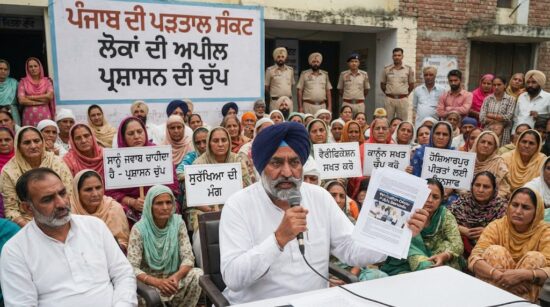
Concerns over public safety, identity verification and the monitoring of people living and working in Punjab are becoming increasingly serious. Residents, village representatives and concerned citizens are appealing to the government and police to take effective action against individuals suspected of criminal activities. Many people fear that the situation is becoming more difficult to control, while the administration has yet to provide convincing answers about the effectiveness of existing verification and law-enforcement systems.
The growing concern is not about people coming to Punjab from other states to earn an honest living. Punjab has always depended on the contribution of workers from different parts of India in agriculture, construction, factories, transport and other sectors. Honest workers deserve dignity, security and equal treatment under the law. The real concern is whether the identities and backgrounds of people are being checked wherever required, whether credible criminal complaints are investigated promptly, and whether individuals involved in unlawful activities are being identified and brought to justice.
Residents are increasingly asking why identity verification cannot be made more systematic, why authorities sometimes appear to act only after a serious incident, and who will be held accountable if credible warnings are ignored. These questions deserve clear answers from the Punjab government, district administrations and senior police officials.
Public Appeals Must Not Fall on Deaf Ears
Across concerned communities, people are calling for stronger verification procedures for tenants, employees and individuals taking up residence in villages and towns. Their demand is that the authorities should know who is living in their areas through lawful and appropriate procedures, maintain effective channels for reporting suspicious activity and act quickly when credible information about a possible crime is received.
However, it is important to distinguish between an unverified identity and a criminal record. A person whose documents have not yet been checked is not automatically a criminal, and a migrant worker should never be treated as a suspect simply because of their place of origin. The administration must focus on evidence, lawful verification and individual responsibility rather than generalisations about entire communities.
The government should explain what verification arrangements are currently in place, how effectively they are being implemented and whether any shortcomings have been identified. If the system is functioning properly, the authorities should publish relevant information. If it is failing, the government must identify the reasons and take corrective action without delay.
Hoshiarpur Tragedy Raised Serious Questions
One of the most disturbing cases that intensified public concern occurred in Hoshiarpur in September 2025, when a five-year-old child was abducted, sexually assaulted and murdered. Police arrested Nanke Yadav, also reported as Manke Yadav, a migrant labourer from Uttar Pradesh, in connection with the crime. The incident caused widespread grief and anger and prompted village representatives to demand stronger identity and residential verification procedures.
In September 2026, a fast-track court sentenced the accused to death after convicting him in the case. The sentence remains subject to confirmation by the Punjab and Haryana High Court and the applicable appeal process. The case demonstrates the devastating consequences of serious violent crime and the importance of protecting children, investigating complaints effectively and ensuring that justice is delivered through the courts.
The tragedy also prompted difficult questions about preventive policing, the monitoring of credible complaints and the responsibilities of local authorities. These questions deserve serious examination, but the crime cannot reasonably be used to label every migrant worker as dangerous. Public safety measures must be based on evidence and applied fairly.
September 2025: Village Representatives Demand Stronger Checks
Following the Hoshiarpur case, representatives from around two dozen villages in the area discussed demands for stricter verification of people residing in their communities. The calls reflected widespread anxiety and a desire for stronger safeguards against serious crime.
The public response highlighted an important issue: residents want to know whether existing procedures are sufficient and whether landlords, employers and local authorities are complying with applicable rules. The government should respond by explaining the requirements, improving implementation where necessary and ensuring that people can report concerns without fear.
Such demands should lead to lawful administrative action rather than informal punishment or confrontation. Verification is a responsibility that must be handled by authorised agencies, with due regard for privacy, dignity and the rights of all residents.
October 5, 2026: Incident at a Gurdwara in Ludhiana
Another incident drew attention to tensions involving local residents and migrant workers on October 5, 2026, at Gurdwara Sri Manji Sahib in Alamgir, Ludhiana. According to published reporting, an altercation was followed by alleged stone-pelting at the langar hall involving five migrant men. Police registered a case, while the Shiromani Gurdwara Parbandhak Committee urged the public not to circulate fake or AI-generated images and unverified claims.
The incident requires a fair and impartial investigation. Anyone found responsible for violence must face the law, irrespective of their background. At the same time, rumours and allegations circulating on social media must not be presented as established facts without verification.
The incident raises questions about how disputes are handled, how quickly the police intervene and how authorities prevent local disagreements from escalating into wider hostility. It also demonstrates why timely official communication is essential when inaccurate claims can spread rapidly and increase tensions.
Is Punjab’s Administration Responding Effectively?
The central question is whether the Punjab government and its administrative machinery are responding adequately to public concerns. Residents want more than statements promising action. They want to see functioning verification procedures, prompt responses to complaints, transparent investigations and accountability when officials fail to perform their duties.
The government should direct district administrations and police departments to review the implementation of applicable tenant and employee verification requirements. It should publish district-wise information about checks completed, complaints received, investigations initiated and corrective measures taken. Where an inquiry establishes negligence or deliberate failure to act on credible warnings, appropriate departmental or legal action should follow.
Police stations should also provide accessible reporting mechanisms so residents can share information about suspected criminal activity without resorting to confrontation. Complaints must be assessed on their merits, and action should be taken according to the law. People should not have to wait for a serious crime before their concerns are examined.
A Crime Timeline Is Necessary, but It Must Be Evidence-Based
The September 2025 Hoshiarpur case, the subsequent public demands for stronger verification and the October 2026 incident at Alamgir are important points in understanding the development of public concern. However, these incidents are different cases, and there is no evidence presented here establishing a connection between them.
A comprehensive timeline of criminal incidents involving people whose identities or backgrounds were allegedly not properly verified would require dated police records, FIRs, court judgments and credible news reports. Each incident should include the date, location, nature of the alleged offence, police action, arrest details where confirmed and the latest judicial status.
Such a record would help the public assess whether the problem is increasing, whether the authorities are responding effectively and whether particular administrative failures require investigation. It would also prevent unverified social media claims from being mistaken for established criminal cases.
Punjab Needs Accountability, Not Administrative Silence
The Punjab government cannot afford to allow public confidence in law enforcement to deteriorate. When residents repeatedly raise concerns about safety, the administration has a responsibility to listen, investigate and explain what action has been taken. Silence or vague assurances can deepen frustration and create an environment in which rumours and mistrust flourish.
The answer is not to target people because they come from another state. The answer is to enforce the law consistently, improve identity verification where required, investigate credible complaints, protect vulnerable residents and act firmly against individuals who commit crimes.
Punjab needs a transparent system in which every complaint receives appropriate attention, every investigation is conducted fairly and every official is accountable for their responsibilities. The government should publish a clear action plan and report measurable progress to the public.
The message to the Punjab administration is clear: public safety cannot be treated as a secondary concern. Residents deserve answers, victims deserve justice, honest workers deserve protection, and anyone found guilty of criminal activity must face the consequences under the law.
Until the government demonstrates that verification procedures are effective, complaints are being addressed and administrative shortcomings are being corrected, concerns over public safety will continue to demand attention. Punjab needs decisive, lawful and transparent governance before public anxiety develops into a deeper crisis of confidence.