
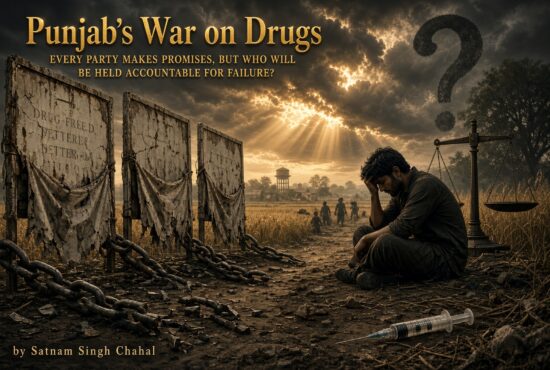
Punjab Outlook Investigative Analysis-The people of Punjab deserve a concrete roadmap, a fixed deadline and consequences for unfulfilled promises not another election slogan.
The drug crisis in Punjab has become one of the most serious concerns affecting its youth, families and social fabric. As the 2027 Punjab Assembly elections approach, political parties are once again making the elimination of drugs a central issue in their campaigns. The BJP has announced a pledge to eradicate the trade in chitta by December 31, 2029, if voted to power. The Congress, Shiromani Akali Dal (SAD) and Aam Aadmi Party (AAP) have also made drug control a major part of their political arguments, with each side questioning the record of its rivals. The continuing prominence of this issue raises an essential question: why should the people trust another promise without a transparent and independently verifiable plan?
From election promises to measurable results
Punjab has heard strong anti-drug commitments before. During the 2017 Assembly election campaign, Congress leader Captain Amarinder Singh promised to eliminate drugs within four weeks of taking office. In 2022, AAP campaigned on ending the drug menace and taking action against major traffickers. The present government has since reported extensive enforcement action, while the opposition continues to question whether the drug trade has been eliminated or sufficiently controlled. In 2026, the BJP announced a fresh deadline for eliminating the trade in chitta. These developments are documented in reporting by The Indian Express and Hindustan Times. The lesson is clear: announcing arrests, conducting rallies and making public pledges are not, by themselves, proof that the crisis has been resolved.
Where is the detailed roadmap?
Every party seeking a mandate to govern Punjab must explain exactly how it intends to achieve its promises. Will it identify the major trafficking networks, their financial links, interstate connections and sources of supply? How will it prevent drugs from reaching villages, towns, schools and colleges? What measures will it take to investigate allegations of protection for traffickers, regardless of their political connections?
A credible roadmap must establish measurable targets for the first 100 days, the first year and the full term of government. It must explain how police investigations will be strengthened, how intelligence will be shared with central and neighbouring-state agencies, and how the movement of illegal drugs across borders and through interstate supply chains will be disrupted. It must also explain how seized assets will be traced through due legal process and how cases against major traffickers will be pursued to their lawful conclusion.
The public should not be asked to judge success by the number of FIRs registered or people arrested alone. The government must also publish verified information about major trafficking networks dismantled, convictions secured, repeat offenders prosecuted, drug availability trends, overdose deaths and access to treatment. Independent audits and regular public reports should make it possible to distinguish genuine progress from political publicity.
Will the government treat addiction as a health issue?
A comprehensive anti-drug policy cannot rely exclusively on police action. People suffering from addiction need accessible medical treatment, counselling, rehabilitation and opportunities to return to education and employment. Families should be able to seek help without fear of stigma or harassment.
At the same time, those who organise trafficking, finance illegal supplies or knowingly facilitate the drug trade must face lawful investigation and prosecution. The policy must distinguish between people who need treatment and those who profit from the exploitation of vulnerable young people. Punishing users while failing to dismantle supply networks would not meet the public’s expectations.
The most important question: What punishment will politicians accept for failure?
If a party promises to eliminate the drug trade within a declared period and fails to meet that target, what consequences will its leaders accept? Will the chief minister publish a formal explanation before the state Assembly? Will the government commission an independent review, release its findings publicly and present a corrective action plan with fresh milestones? Will ministers responsible for the policy face political accountability for demonstrable failures?
These are legitimate questions in a democracy. No party leader should be allowed to treat an election promise as a slogan that can be forgotten after votes are secured.
However, the consequences must be defined honestly. Failure to meet a policy target does not automatically constitute a criminal offence, and elected representatives cannot simply be subjected to arbitrary punishment for an unsuccessful policy. Criminal liability must depend on evidence of an offence and due process. Political accountability, meanwhile, can include public reporting, legislative scrutiny, resignation where warranted, party-level consequences and the electorate’s judgment at the next election.
The parties should therefore commit to a public accountability framework before asking Punjab’s people for their votes. If they believe their plans are achievable, they should be prepared to specify the targets, publish the progress and explain the consequences of missing them.
Punjab cannot afford another cycle of promises
The drug crisis should not become a competition in which parties accuse one another while families continue to suffer. The BJP must explain how it will meet its newly announced deadline. The Congress must account for its earlier commitments and explain what it would do differently. The SAD must present a practical, transparent plan and address questions arising from its previous periods in government. AAP must publish independently verifiable results of its existing campaign and explain what remains to be achieved.
Every party should answer the same questions, under the same standards, before the people of Punjab.
The final question is simple: if you promise a drug-free Punjab, what is your roadmap, what is your deadline, how will your success be independently verified, and what will you do if you fail?
Punjab’s youth cannot afford another election cycle in which promises are made before the election and excuses are offered afterwards. The people deserve evidence, measurable progress and accountability not merely declarations of intent.
Sources for the article
– The Indian Express — Punjab’s drug crisis and the politics surrounding the 2027 elections
– Hindustan Times — BJP’s pledge to eradicate the drug trade in Punjab by December 31, 2029
– The Indian Express — Punjab’s drug crisis needs policy, not slogans