
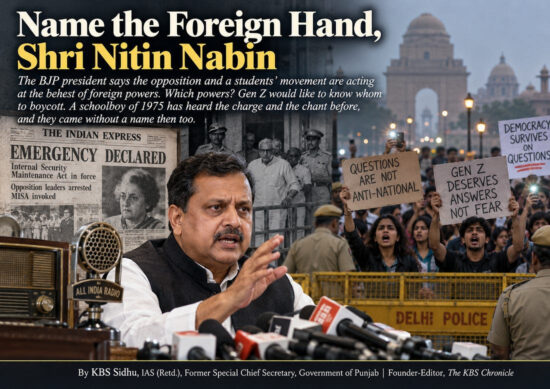
The BJP president says the opposition and a students’ movement are acting at the behest of foreign powers. Which powers? Gen Z would like to know whom to boycott. A schoolboy of 1975 has heard the charge and the chant before, and they came without a name then too.
On Saturday, 10 October 2026, at about a quarter to eleven in the morning, Shri Nitin Nabin, National President of the Bharatiya Janata Party (BJP), sat before the news agencies’ microphones and named two “अराजकतावादी समूह”, anarchist groups, at work in the country. One is the INDI alliance led by Rahul Gandhi. The other is the Cockroach Janta Party (CJP), which he called an associate of Arvind Kejriwal. Both, he said, act “विदेशी ताकतों के इशारे पर”, at the behest of foreign powers.
He invoked those foreign powers three times in one statement and named none. I watched the clip more than once. The words were a warning, but to my eye the body language lurked somewhere between mild fear and assumed resolve.
The full statement, posted by the BJP’s official handle on X and attributed to Shri Nabin, should be read in the original Hindi.
Which Country, Please?
The citizens of India, and Gen Z more than anyone, are entitled to the obvious question. Who are the foreign powers? Which country, which government, which leader, which agency, which foundation?
Reticence here cannot be passed off as diplomatic courtesy. India names Pakistan in every forum it enters. It has said hard things about Canada and sent Canadian diplomats home. Shri Nabin presides over a party that has governed for twelve years, with the Intelligence Bureau, the Enforcement Directorate and the Foreign Contribution (Regulation) Act, 2010 at its government’s disposal. If a foreign hand is paying for stones in Delhi, somebody in North Block knows whose it is.
So why is this vital information being kept from the people of India? Name the country, and shame it. We shall then do our humble part. We shall not holiday there. We shall not send our children to its universities. We shall look for its label on the goods we import and think twice about what we sell it. A generation that fills in visa forms and university applications by the lakh would like to know which ones to tear up.
Lesser voices have been less shy. In June a Union Minister, Shri Kiren Rijiju, spoke of the CJP seeking support from Pakistan. Odisha’s Law Minister, Shri Prithiviraj Harichandan, spoke of “radical groups” in Bangladesh and Khalistani leaders in Canada. Is that the list? Then let the party president read it out, and let the Ministry of External Affairs summon the envoys. The CJP’s founder, Abhijeet Dipke, came home from Boston. Is the United States the foreign power? Nobody in authority will say so.
Small mercies. Mr Elon Musk, an actual foreigner, complained on X on 7 October that Starlink was being “blocked by certain oligarchs” in India, and nobody has yet named him a foreign hand. That distinction is reserved for students who want an examination conducted honestly and a voters’ list explained.
If no name follows, the reader may conclude that there is none to give. I have seen that before.I was five weeks short of fourteen on 26 June 1975, a student at Yadavindra Public School, Patiala. What I remember of that morning is a sentence on All India Radio: “आपात स्थिति की घोषणा कर दी गई है”, a state of emergency has been declared. We did not understand what it meant, and the same speech, repeated word for word, told us nothing more. So we turned the dial to the BBC, and learnt there that the leaders of the opposition had been thrown behind bars under the dreaded Maintenance of Internal Security Act, 1971 (MISA), a preventive-detention law under which there was no bail.
The speech was Mrs Indira Gandhi’s. There was, she said, a “deep and widespread conspiracy” against her government. “The forces of disintegration are in full play,” and there were those “inciting our armed forces to mutiny”. Two months later, on American television, she said that had the indiscipline continued there would have been “anarchy”. She and her colleagues spoke repeatedly, too, of powers abroad that wished to destabilise India. I do not recall one of those powers being named in a charge-sheet.
Shri Nabin’s text adds “बिकाऊ राजनीति”, politics for sale, and an “अर्बन नक्सल मानसिकता”, an urban Naxal mindset. Conspiracy, disintegration, anarchy, the foreign hand: the nouns have changed party and nothing else.
October 2026 is not June 1975. No proclamation has issued, and a day’s detention in a stadium is not the nineteen months Mr L.K. Advani spent in jail under MISA. The Constitution (Forty-fourth Amendment) Act, 1978 replaced “internal disturbance” with “armed rebellion” so that the door Mrs Gandhi walked through would stay shut. An AAP leader was calling today a “black emergency” by half past ten, which is as careless with history as Shri Nabin is with the word anarchist.
My subject is a habit of speech. Language is the scaffolding. It goes up before the building does, and it comes down so quickly afterwards that nobody remembers it was there. For a year before the night of 25 June, the country had been told that the opposition was a plot.
A Fortress for a Voters’ List
The quarrel this week is over the Chief Election Commissioner, Shri Gyanesh Kumar, and the Special Intensive Revision of the electoral rolls. On 6 October, 237 MPs from 19 parties set out from Parliament for Nirvachan Sadan to demand his resignation. They were stopped near Akashvani Bhawan, and several, Rahul Gandhi among them, were driven away in police buses.
The CJP, born on 16 May as an online satire and hardened at Jantar Mantar over the NEET-UG paper leak, called its own march for today. The police refused permission. By Friday night the capital was a fortress, with some 23,000 central armed police lent to Delhi for the week, about 45 metro stations shut and mobile internet switched off around Jantar Mantar. Some twenty minutes before Shri Nabin spoke, policewomen boarded a Mumbai–Delhi flight and took Mr Dipke off it. By mid-morning the police counted about 500 detained, and Newslaundry says three of its reporters were among those held.
The opposition gets the same scrutiny. Stones were thrown on 20 July and again today near Akashvani Bhawan, where PTI reports two policemen hurt. The Leader of the Opposition called the Prime Minister and the Home Minister “traitors” from a platform in Rae Bareli in May, and that word belongs to the vocabulary I am complaining of. But stone-throwing is a cognizable offence, to be met with an FIR and a trial, and it proves nothing about foreign paymasters.
“Urban Naxal” is a catchy phrase, and once the Prime Minister has used it, others rush in to borrow it. Take it apart, however, and it describes someone who lives in a city, leans left of centre and has had an education; a person who cannot think for himself, and for his country, does not qualify. Whom, then, are you trying to brand? Such people are to be argued with, intellectually, and not beaten on the streets.
Party President, Government Spokesman
“भारत सरकार इससे सख्ती से निपटेगी,” Shri Nabin said: the Government of India will deal with this strictly. And in the same breath, the BJP worker, out among the people, “आपके इन मंसूबों को रोकेगा”, will stop these designs.
Had the Union Home Minister said so, it might have been acceptable, justifiable, perhaps even sensible. He is, in any case, not shy of strong and sharp statements. But why the party president? Let him frame his party’s political priorities. Dealing with an unlawful assembly in the capital is a matter of law and order, and the chain of responsibility for it is settled: the Delhi Police, the Commissioner of Police, the Lieutenant Governor and the Union Home Minister, in that order. The president of a political party appears nowhere in it.
Shri Nabin holds no office under the Union. Yet he announced what the State would do and what his cadre would do alongside it, as though the two were one instrument with two handles. “India is Indira, Indira is India” was a party president’s line too, coined by Dev Kant Barooah of the Congress.
The BJP knows this history from the inside. It descends from the Jana Sangh, whose leaders were detained for opposing Mrs Gandhi, and since 2024 its government has marked 25 June as Samvidhan Hatya Diwas. Mr Advani’s political heirs now use on others the phrases that were used on him.
The Ballot Decides Who Governs, Not Who May Dissent
Shri Nabin’s strongest card is the mandate. The people, he says, have rejected these leaders; “लोकतंत्र ने इन्हें सजा दी”, democracy has punished them.
March 1977 is the usual reply, and it needs care. If the voters who turned Mrs Gandhi out were the judges of who may protest, Shri Nabin would win the argument, for they have returned his party at the Centre three times running. A mandate, however, is a licence to govern for five years. It carries no power to certify which citizens are loyal. Losing an election is not a conviction, and a party secure in its mandate has no cause to look uneasy while invoking it.
What the Schoolboy Kept
Thirty-seven years in the Indian Administrative Service followed that morning in Patiala, some of them spent keeping order in districts where the threat to the State was not rhetorical. Governments must act against violence. I learnt in the same years that the officer who cannot tell a protester from an insurgent ends by turning the first into the second.
My request to Shri Nabin is modest. Name the foreign power and place the evidence before a court, or withdraw the charge.
The government of the day is not the nation. The opposition of the day is not the enemy of the nation. And patriotism is not a privilege conferred by electoral victory.
The last word I borrow, with apologies to Shri Nabin, from a foreign hand. Mark Twain wrote in 1905 that “the true patriotism, the only rational patriotism, is loyalty to the Nation all the time, loyalty to the Government when it deserves it.”