
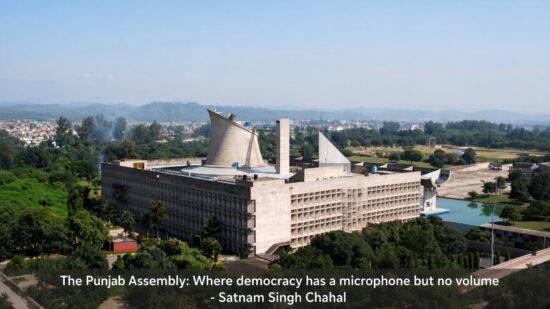
 The Punjab government’s decision to convene the 13th Session of the 16th Punjab Legislative Assembly has raised an important question about the use of public money. When a single day of an Assembly session is reported to cost approximately ₹80–85 lakh, the government and Assembly authorities have a responsibility to ensure that the time and money spent deliver meaningful results for the people of Punjab. The central question is not whether the Assembly should meet, but whether its scheduled business justifies the expenditure incurred.
According to the List of Business issued by the Punjab Vidhan Sabha for October 22, 2026, the sitting is scheduled to begin at 11:00 a.m. The listed business includes obituary references to former Punjab minister Chuni Lal Bhagat, former MP Sardar Varinder Singh Bajwa, former MLA Sardar Ranjit Singh and eminent doctor Rattan Lal Mittal. The agenda also includes questions and calling-attention notices concerning public issues in different constituencies.
The calling-attention notices listed in the document raise concerns about the poor condition of the road leading to Government Senior Secondary School in Hazara Singh Wala in Ferozepur Rural, the shortage of public transport on the Ferozepur–Jalalabad–Fazilka route, and the absence of canal-water supply in the Dera Bassi Assembly constituency. These are genuine public concerns that deserve attention. However, the published list raises a reasonable question about the extent of the substantive business scheduled for the October 22 sitting.
A reported estimate of ₹80 lakh for a day’s Assembly session was cited by Punjab Assembly Speaker Kultar Singh Sandhwan in October 2022. The figure of ₹80–85 lakh should not automatically be treated as the verified cost of a sitting in October 2026, because current expenditure figures have not been established here. The Assembly administration should publish the actual cost of the sitting, explain which expenses are included and provide taxpayers with an accurate account of the money spent.
Punjab is facing serious financial and administrative challenges, including mounting public debt, unemployment, drug abuse, farmers’ concerns and demands for improved roads, healthcare, education and public transport. At a time when the government must carefully prioritise public expenditure, every major administrative expense deserves scrutiny. The money spent on running the Assembly ultimately comes from public resources, and citizens have every right to ask whether it is being used effectively.
At the same time, the Assembly’s work cannot be judged solely by the number of items appearing on the first day’s list. Questions, obituary references and calling-attention notices are legitimate parts of parliamentary business, and the full programme of the session must be considered before concluding that the meeting is unnecessary. The session’s complete legislative agenda, the bills under consideration, the time allocated for debate and the work completed all matter when assessing its value.
The Punjab government should therefore explain the purpose of the October 22 sitting and identify the legislative and policy matters that require the Assembly to meet on that date. The Speaker and the Assembly’s Business Advisory Committee should ensure that available time is used productively, that legislators have an opportunity to raise public concerns and that the government responds meaningfully to questions about its performance.
The opposition, too, has a responsibility to use the Assembly to scrutinise government policies, question expenditure and propose practical solutions. Disruptions that prevent scheduled business from being conducted should be examined objectively, regardless of which side is responsible. The public interest requires both the government and the opposition to treat the legislature as a forum for accountability rather than merely a political platform.
The government should also publish a transparent report after each session showing the actual expenditure, the number of questions answered, the legislative business completed, the time devoted to debates and the decisions taken on important public issues. Such information would allow citizens to judge the performance of their elected representatives on the basis of facts rather than political claims.
The question before Punjab is straightforward: if a day’s Assembly sitting costs taxpayers an estimated ₹80–85 lakh, what concrete legislative work and public benefit justify that expenditure? The government should provide a clear answer supported by verified figures and the official record of business conducted. Public money must be spent responsibly, and every sitting of the Punjab Vidhan Sabha should contribute to better governance, effective oversight and the welfare of the people.
Punjab Outlook — Political Analysis
Source: Punjab Vidhan Sabha, List of Business for October 22, 2026. The ₹80–85 lakh figure is a reported estimate and should be verified against current official expenditure records before publication as the actual cost of the sitting.
Disclaimer: This article and accompanying images are for informational and illustrative purposes only. Some visuals may be AI-generated or digitally enhanced and may not depict actual events or persons. Views expressed are based on publicly available information and analysis