
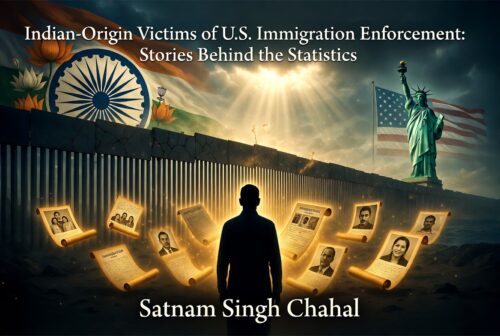
 For decades, the United States has attracted Indians seeking education, employment, safety, and economic opportunity. While many have built successful lives in America, others have encountered the harsh realities of immigration enforcement, detention, deportation, and legal uncertainty. Behind official statistics are stories of individuals and families whose lives were profoundly affected by immigration policies and procedures.
One of the most tragic recent cases involved Jaspal Singh, a 57-year-old Indian national who died in a hospital in Atlanta while awaiting deportation from the United States. According to U.S. Immigration and Customs Enforcement (ICE), Singh had been detained after illegally re-entering the country in 2023. His death drew attention to conditions within the immigration detention system and renewed concerns about the welfare of detainees awaiting removal proceedings.
Years earlier, another Indian national, Atul Kumar Babubhai Patel, died after being detained by immigration authorities at Atlanta airport. Patel reportedly suffered from health complications, including high blood pressure and diabetes. His death raised questions about medical care available to individuals held in immigration custody and became one of several cases cited by advocates seeking stronger protections for detainees.
Many Indians who enter the United States through irregular migration routes face lengthy periods in detention centers while their asylum or immigration claims are processed. Reports have documented cases of migrants from Punjab and other parts of India spending months or even years in detention facilities while attempting to establish claims for asylum or relief from deportation. The uncertainty of prolonged detention often places enormous emotional and financial strain on migrants and their families.
Human-rights organizations and immigrant-rights advocates have also highlighted allegations of mistreatment during deportation operations. In one widely reported case, South Asian migrants, including Indians, alleged that they were subjected to excessive force during deportation procedures. U.S. authorities disputed aspects of those claims, but the allegations nevertheless intensified scrutiny of immigration enforcement practices.
Some Indian-origin individuals have found themselves trapped in legal limbo despite spending much of their lives in the United States. Cases involving deportation orders, citizenship disputes, or immigration-status challenges can leave families separated and futures uncertain. In recent years, immigration attorneys have also reported instances in which elderly Indian green-card holders faced intense questioning at U.S. airports and were allegedly pressured to surrender their permanent-resident status after extended stays abroad.
The historical experience of Indian immigrants in America also contains examples of exclusion and discrimination. A landmark episode occurred in 1923 when the U.S. Supreme Court ruled in the case of Bhagat Singh Thind that Indians were not eligible for naturalization under the racial definitions then used in American law. The decision resulted in some Indian immigrants losing citizenship and property rights, marking one of the most significant setbacks in the history of Indian immigration to the United States.
Recent years have seen intensified immigration enforcement efforts. Reports indicate that thousands of Indian nationals have been deported or repatriated from the United States, while many others remain subject to removal proceedings. At the same time, advocacy groups continue to raise concerns about detention conditions, access to legal representation, family separation, and medical care for detainees. Studies and investigations have documented concerns about deaths and medical failures within immigration detention facilities, prompting calls for greater oversight and accountability.
The experiences of Indian-origin migrants affected by the U.S. immigration system illustrate the human consequences of immigration policy. Whether involving detention, deportation, citizenship disputes, or prolonged legal battles, these stories reveal the challenges faced by individuals pursuing security and opportunity in a foreign country. As debates over immigration continue in the United States, the experiences of Indian migrants remain an important reminder that immigration policy is ultimately measured not only by laws and statistics, but also by its impact on human lives.
Referances:NDTV,Guardian,Redit
Disclaimer: This article and accompanying images are for informational and illustrative purposes only. Some visuals may be AI-generated or digitally enhanced and may not depict actual events or persons. Views expressed are based on publicly available information and analysis.