
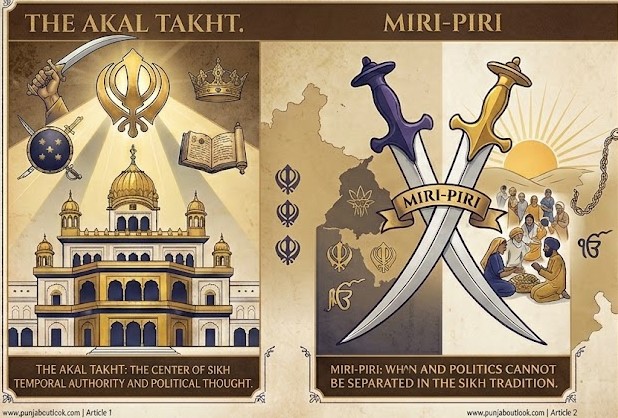
 The recent statement by SGPC President Harjinder Singh Dhami that religion and politics should not be mixed has sparked discussion within Sikh circles. While many faith traditions advocate a strict separation between religious and political affairs, Sikh philosophy has historically embraced a different approach. The Sikh faith is built upon the doctrine of Miri-Piri, a concept that recognizes spiritual and temporal responsibilities as inseparable aspects of a complete life. For Sikhs, religion is not confined to personal worship alone; it also carries a duty to engage with society, defend justice, and stand against oppression.
The foundation of this principle was laid by the Sixth Sikh Guru, Guru Hargobind, who introduced the concept of Miri-Piri in 1606. After the martyrdom of Guru Arjan Dev, Guru Hargobind recognized that spiritual guidance alone was insufficient when communities faced persecution and injustice. To symbolize the dual responsibilities of Sikhs, he wore two swords—one representing Piri (spiritual authority) and the other Miri (temporal or political authority). This act established a new direction for the Sikh community, emphasizing that devotion to God must be accompanied by a commitment to protect human rights and uphold justice.
Unlike traditions that separate church and state, Sikhism encourages believers to actively participate in public affairs. The Sikh Gurus consistently challenged tyranny, discrimination, and exploitation. Their teachings promoted equality, human dignity, and freedom of conscience. From the establishment of the Sikh Panth to the struggles against Mughal oppression, Sikh history demonstrates that spiritual values often required political action. The Gurus did not seek political power for personal gain; rather, they viewed political engagement as a means to defend righteousness and protect the vulnerable.
This philosophy became even more evident during the leadership of Guru Gobind Singh. Through the creation of the Khalsa in 1699, Guru Gobind Singh transformed Sikhs into saint-soldiers committed to both spiritual discipline and social responsibility. The Khalsa was expected to pray, meditate, and live according to high moral standards while also being prepared to confront injustice wherever it existed. This balance between spirituality and activism remains one of the defining characteristics of Sikh identity.
Historically, Sikh institutions themselves have reflected the integration of religion and public affairs. The Sikh Gurdwaras were not merely places of worship; they also served as centers of community organization, education, social welfare, and collective decision-making. The Akal Takht, established by Guru Hargobind opposite the Harmandir Sahib, symbolizes the temporal authority of the Sikh community. Decisions concerning social, political, and religious matters were often discussed and announced from this institution, demonstrating that Sikh tradition never viewed religion as isolated from societal concerns.
Throughout the colonial period and after India’s independence, Sikh organizations continued to engage in political issues affecting the community. Movements such as the Gurdwara Reform Movement, Punjabi Suba agitation, and campaigns for civil rights were motivated not solely by political considerations but also by religious principles. Many Sikh leaders viewed participation in public life as an extension of their religious duty rather than a departure from it.
Supporters of the Miri-Piri doctrine argue that separating religion entirely from politics could weaken the Sikh commitment to social justice. They contend that Sikh teachings require individuals to challenge corruption, defend the oppressed, advocate for equality, and work for the welfare of society. In this view, political engagement is not about partisan loyalty but about applying spiritual values to real-world problems. The objective is not to politicize religion for personal or electoral gains but to ensure that ethical and moral principles guide public life.
At the same time, many Sikhs caution against the misuse of religion for narrow political interests. Sikh history distinguishes between principled political engagement and the exploitation of religious sentiments for power. The Gurus emphasized truth, humility, and service, warning against ego and self-interest. Therefore, while Sikhism encourages involvement in social and political affairs, it also demands that such involvement remain rooted in ethical conduct and the collective good.
The debate surrounding the relationship between religion and politics is likely to continue, but Sikh history offers a clear perspective. The doctrine of Miri-Piri teaches that spiritual devotion and worldly responsibility are two sides of the same coin. For Sikhs, faith is not merely a private matter; it is a guiding force that inspires action against injustice and promotes the welfare of humanity. As a result, many scholars and community members maintain that religion and politics, when understood through the Sikh tradition, are fundamentally interconnected and must work together to uphold justice, freedom, and human dignity.