
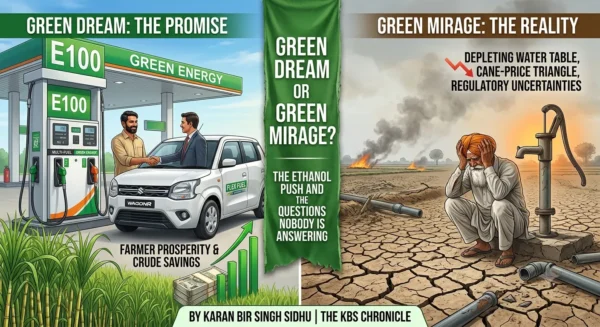
 India imports 87 per cent of its crude oil. That single number is the foundation on which Nitin Gadkari has built his most ambitious political project. Last week, in quick succession, he launched Hero MotoCorp’s flex-fuel Splendor and HF Deluxe motorcycles capable of running on 100 per cent ethanol, oversaw Maruti Suzuki’s unveiling of a flex-fuel WagonR, and announced that he had signed the file legally authorising E100 as a standalone automotive fuel. He did all this with the confidence of a man who has been proved right before. He was mocked when he first spoke of ethanol as the fuel of India’s future. He is no longer being mocked. (short video clip)
But celebration is premature. The question is not whether E100 is technically possible — Brazil demonstrated that decades ago. The question is whether India’s specific political economy, its cropping patterns, its water table, its OMC monopolies, and its fiscal architecture will permit the vision to survive contact with reality. On that count, the record of Indian policy announcements counsels scepticism.
I. The regulatory breakthrough and its fine print
Regulatory recognition of E100 as a primary transport fuel, not merely a blending additive, is genuinely significant. It shifts the entire legal and economic framework: pricing, taxation, safety norms, warranty standards, and emissions measurement now have to be addressed for ethanol as a standalone fuel. It gives automakers the comfort that if they invest in E100-capable platforms, the regulatory goalposts will not move abruptly. And it puts pressure on standard-setting bodies to accelerate certification protocols for high-ethanol operation.
India has, it should be acknowledged, delivered on its ethanol blending programme with remarkable speed. Blending rose from a negligible 1.53 per cent in 2013-14 to 20 per cent by 2025 — five years ahead of the original 2030 deadline. Ethanol production capacity grew from under 200 crore litres in 2014 to nearly 2,000 crore litres, and the programme has saved over Rs 1.84 lakh crore in foreign exchange. These are not trivial achievements. They represent disciplined, sustained administration of a complex multi-ministry programme. Gadkari is entitled to point to them.
But E100 is not E20 plus a little extra ambition. The jump from a blending additive to a standalone fuel is qualitative, not quantitative. Without corresponding fiscal clarity — what is the GST or excise incidence on E100, and how does it compare with petrol? — the legal authorisation risks remaining symbolic rather than transformative. The Government has recently waived central excise duty on petrol blended with 22 to 30 per cent ethanol, which is encouraging at the margin. The pricing signal for neat ethanol, however, remains undefined. That is the document that actually matters. It has not been signed yet.
II. The cane-price triangle: where the real test lies
The political promise of ethanol is seductive in its simplicity: India reduces its crude import bill and channels that saving to its own farmers by buying domestically produced ethanol. In a sugarcane-dominated belt, this is an electoral sweetener with genuine economic content.
The structural problem, however, is what I would call the cane-price triangle. State Advised Prices and Fair and Remunerative Prices for sugarcane are determined through a political process that bears little relationship to market realities. When global sugar prices are weak, mills accumulate arrears to farmers rather than take losses — a cycle that has repeated itself with depressing regularity in UP and Maharashtra. The ethanol programme has partially broken this cycle by giving mills an alternative revenue stream. But if OMCs, under pressure from their own price caps and energy-transition uncertainties, are unwilling to pay correspondingly higher procurement prices for ethanol, the arrears problem will simply migrate into the biofuel supply chain, dressed up in green rhetoric.
Conversely, if OMCs do pay higher prices to keep ethanol supply flowing, they will have a natural incentive to pass the cost through to fuel consumers. The promise that ethanol means cheaper fuel at the pump is not guaranteed. It depends on the relative movements of cane prices, global sugar prices, and crude oil — three variables that have historically moved in opposite directions at precisely the wrong moments. No minister’s speech can resolve that arithmetic.
III. The question Punjab must ask
Nitin Gadkari’s ethanol narrative is framed as a national story. But Punjab, which supplies a disproportionate share of India’s grain to the central pool, has a specific and urgent stake in its outcome — and not necessarily a comfortable one.
The Government has allowed the use of surplus FCI rice for ethanol production. Punjab and Haryana grow much of that rice. The policy has helped distilleries access feedstock and has supported blending targets. But producing one litre of ethanol from rice requires approximately 10,790 litres of water. Punjab’s water table is already declining at an average of 51 centimetres annually, with 65 per cent of monitored wells in the state registering a fall in water level. The Central Ground Water Board’s 2025 assessment has categorised hundreds of assessment units across the country as over-exploited, critical, or semi-critical. In the central districts of Punjab — Sangrur, Patiala, Moga, Barnala — the groundwater situation is already a slow-moving crisis.
The policy contradiction is stark. For decades, Punjab and Haryana have been rightly criticised for the groundwater damage caused by paddy cultivation, subsidised by free electricity and guaranteed procurement. The ethanol programme now proposes to use that same paddy — grown by that same cropping pattern, drawing from that same depleting aquifer — as an input for industrial-scale fuel production. The green branding does not alter the hydrology. Burning Punjab’s groundwater to save crude oil imports is not an energy transition. It is a subsidy transfer with a new label.
If Punjab is to benefit from the ethanol economy — and it should — the answer lies in maize, not rice. Maize requires roughly 4,670 litres of water per litre of ethanol, compared to over 10,000 litres for rice. The Panipat second-generation ethanol plant, which converts parali — the stubble that farmers burn every October, causing a public health emergency across North India — into ethanol, points to a far more sensible direction. It solves two problems simultaneously. But it requires active diversification support, pricing assurances, and procurement infrastructure that currently do not exist at scale. Without a deliberate push in that direction, the ethanol boom will deepen Punjab’s groundwater crisis while its farmers watch UP and Maharashtra capture the primary economic benefits.
IV. The chicken-and-egg problem, and why it is not yet solved
Nitin Gadkari’s simultaneous deployment of regulatory green light, Hero motorcycles, and a flex-fuel WagonR is a calculated attempt to break the classic coordination failure: OEMs reluctant to invest without assured fuel availability; OMCs with little incentive to build E85 and E100 infrastructure without a critical mass of compatible vehicles. The launch event is designed to signal that both sides of the equation are moving.
The signal is necessary. It is not sufficient. Adapting vehicles for higher ethanol blends is estimated to add Rs 40,000 to Rs 50,000 to ex-showroom prices. In a market where a Hero Splendor competes on every rupee, that premium requires either a consumer willingness to pay that does not yet exist, or a government subsidy. Dedicated E100 pumps require separate storage tanks, dispensing equipment, and safety protocols — hygroscopic fuel, corrosion risks, misfuelling hazards — in an OMC retail infrastructure that is already straining under energy-transition uncertainties. E100 is currently available at only 183 retail outlets, concentrated in Maharashtra, Karnataka, Uttar Pradesh, Tamil Nadu, and Delhi. That is not a distribution network. That is a pilot.
The Government must supplement the rhetoric with targeted fiscal instruments: GST relief for flex-fuel vehicles, registration fee waivers for early adopters, and time-bound capital subsidies for OMC retail stations upgrading to E100 dispensing. Without these, the coordination failure that Gadkari is trying to break will simply reassert itself, one quarter at a time.
V. The verdict
Let me state the conclusion plainly, because balanced surveys are not useful to anyone.
Nitin Gadkari’s E100 vision is worth pursuing, but on a narrower and more carefully specified track than the launch event suggested. The Panipat model — second-generation ethanol from agricultural residue, solving the parali problem while producing fuel — is the strategic core that deserves primary emphasis. Maize-based ethanol in Punjab and Haryana deserves pricing parity and procurement guarantees. The cane-based mainstream in UP and Maharashtra deserves a transparent pricing formula that does not depend on ministerial goodwill or OMC discretion.
What this vision cannot afford is the assumption that regulatory authorisation equals implementation, that launch events equal infrastructure, or that a flex-fuel WagonR in a showroom equals a functioning fuel ecosystem across 176,000 retail outlets.
India has been here before. In 2003, the ethanol blending mandate was announced with fanfare. By 2007, blending levels had collapsed to below 1 per cent because the pricing formula was wrong and the OMCs had no incentive to comply. It took another decade of sustained policy repair to recover that ground.
Nitin Gadkari has every right to celebrate what has been achieved. He has no right to assume that the hard part is over. The file he signed authorising E100 is the beginning of the policy work, not its culmination.
India’s groundwater cannot be recovered once it is gone. Punjab’s farmers cannot wait another decade for a pricing formula that actually works. The dream of energy self-reliance through biofuels is legitimate and worth pursuing. But a dream announced at a product launch is not yet a policy. The unglamorous work of fiscal harmonisation, feedstock diversification, and water-use accountability — that is the file that still needs to be signed.