
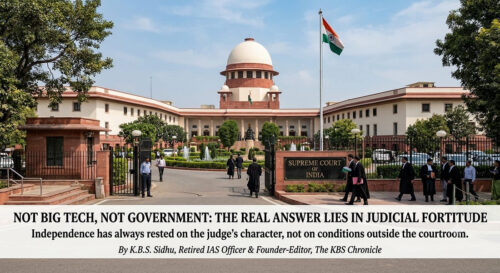
 Justice Joymalya Bagchi of the Supreme Court of India, speaking at the fifth Justice H.R. Khanna Memorial National Symposium organised by the Confederation of Alumni for National Law Universities on 1 August 2026, offered a diagnosis that deserves to be stated fully before it is examined. His submission: the gravest threat to judicial independence today comes not from the executive or the legislature — the adversaries the framers anticipated — but from the machine-learning algorithms of Big Tech, engineered to convert judicial proceedings into curated outrage for profit. Dispassionate adjudication, in his words, is “auctioned on the altar of likes.” A hashtag storm tests a judge’s resilience before an appeal is even heard. Live-streaming, whatever its transparency dividend, has spawned an economy of decontextualised clips in which tentative oral remarks are packaged as final verdicts. Approval, he warned, corrodes independence more quietly than fear ever did.
This is a serious argument, sincerely made, and not without foundation. No fair observer of the last decade can deny that social media has coarsened discourse around pending cases, that clips travel stripped of context, and that parts of the digital ecosystem profit from the very friction they manufacture around institutions, courts included. Justice Bagchi deserves credit for naming, with unusual precision, a phenomenon many recognise but few articulate.
II. Where the Diagnosis Needs Qualification
And yet, with respect due to a sitting judge of the highest court, the argument invites two qualifications — going to its completeness, not its sincerity.
First, algorithmic tools and the platforms built on them are irreducibly dual-use. The same engine that amplifies a sensational clip is the infrastructure by which legal researchers track case disposal across High Courts, by which reporters disseminate orders to a public that would otherwise have no access, and by which senior and junior advocates alike build the citation trackers and public-interest campaigns that have strengthened access to justice. Live-streaming itself runs on the same rails Justice Bagchi holds responsible for distorting it. To indict the algorithm is, in a sense, to indict the printing press for the pamphleteer’s sedition. The deficit is not in the tool but in gatekeeping norms and institutional literacy about how it is used against the judiciary — and, on occasion, by quarters close to it.
Second, and more fundamentally: independence, as our constitutional tradition understands it, is not a function of ambient noise. It is a function of character. A judge behind a hundred guards and a total media blackout can still be captured; a judge in the full glare of publicity has often remained wholly unmoved. The old school of the Bar and Bench — this writer, across four decades of watching judicial officers at close quarters, has heard the view from more than one now-retired senior — held to an austere discipline: a judge hearing a part-heard matter would not read even the morning paper’s account of the previous day’s proceedings, lest a headline colour a mind bound to arrive at its own conclusion from the record alone. That discipline was self-imposed, an act of will no different in spirit from what Justice Bagchi himself invokes when he says judges must “live and behave like hermits.” If that hermitage was achievable in the age of newsprint and All India Radio, the burden of showing it has become impossible in the age of the reel lies with those who make the claim — and it has not, with respect, been fully discharged.
III. Independence Resides in the Presiding Officer
This is not semantics; it is about where independence is located. Made contingent on the information ecosystem — on algorithms behaving, platforms self-regulating, the digital mob falling silent — independence becomes hostage to conditions permanently outside judicial control, in a world that will only grow noisier. Understood instead as residing in the broad shoulders of the presiding officer — the trained capacity to decide “uninfluenced by considerations extraneous to the record” — it remains exactly where the Constitution always placed it: within the judge, not the environment around the judge. The former framing, however unintentionally, risks converting a strength of character into a grievance against circumstance.

IV. The High-Profile Case: Where the Pressure Is Most Immediate
If the thesis is to be tested rather than admired, test it where pressure is greatest — and that is not always the Supreme Court. In sensational offences — a celebrity crime, a politically charged case, a communal or terror incident — prime time has repeatedly pronounced guilt before the chargesheet, sometimes before arrest, in open disregard of the presumption of innocence that is meant to attend an accused until conviction. The influence bites at three immediate points, not just at eventual appeal. On investigation, where a howling studio can visibly alter an Investigating Officer’s pace and choice of sections. On bail, most acutely, where a trial court or High Court judge applying the settled rule that bail is the norm and jail the exception must do so knowing the grant will be portrayed as indulgence rather than fidelity to law. And at sentencing, where public appetite for exemplary punishment narrows the space for individualised justice the Code contemplates.
This is, if anything, a sterner test of character than the one Justice Bagchi describes for constitutional courts, since trial court and even High Court judges typically lack the institutional distance and security that shield the Supreme Court. The jurisprudence to resist this already exists. Courts in India have, over the years, repeatedly signalled disquiet with what is loosely called trial by media — reportage capable of prejudicing a fair trial sits uneasily with due process, and coverage verging on scandalising the court has long been understood to attract the contempt jurisdiction, quite apart from the Sahara guidelines on postponement orders. What varies is the will to invoke it, which returns the argument to its starting point: the safeguard lies less in taming the algorithm than in fortifying the officer who must rule despite it.
V. A Word Offered With Deference
One hesitates before adding anything at all to the observations of a sitting judge of the Supreme Court, and nothing that follows is intended as comment upon Justice Bagchi personally, still less upon his office — an office this writer holds in the highest regard, and any suggestion of scandalising which would be as unintended as it would be unwelcome. The submission is narrower and is addressed to the proposition alone. Constitutional courts have, across seven decades, generally chosen to let their judgments answer their critics rather than to answer them directly, and that reticence has itself been a source of institutional strength. Viewed against that long practice, a public address on the pressures of the digital age — however thoughtfully framed, and however useful as a contribution to academic and policy discourse — is perhaps better received as exactly that: a valuable public reflection, not a complaint requiring redress. If the argument is taken a step further than intended, into a suggestion that the digital ecosystem now genuinely tests a sitting judge’s resolve, admirers of the institution may gently wonder whether the more traditional answer still serves best — namely, that the Bench need not engage with the noise at all, and that its silence in the face of it has always been the surer demonstration of independence than any description of the noise itself.
VI. Conclusion
None of this denies that Big Tech’s algorithms merit regulatory attention, or that media trials merit the reasonable restriction the Constitution permits in aid of justice. Justice Bagchi’s proposals on discretionary live-streaming and DPDP-compliant digital archiving are sound and deserve legislative consideration. But the architecture of judicial independence was built, by the framers and seven decades of jurisprudence since, on the presumption of a judge’s inner fortitude, not the outer weather. The dignity of the institution is best served, and no contempt invited, by saying plainly: the algorithm may shout, but the robe need not listen. That, after all, has always been the point of wearing it.