
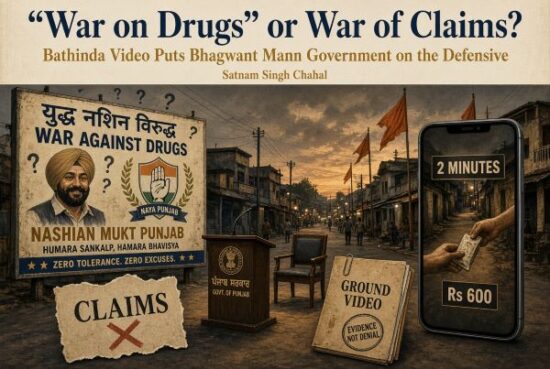
CHANDIGARH: Punjab’s battle against drugs has once again come under scrutiny after four deadlines announced by the Aam Aadmi Party (AAP) before and after coming to power failed to deliver the promised drug-free Punjab. With the 2027 Assembly elections approaching, the continuing drug crisis has raised serious questions about the effectiveness of government policies, enforcement agencies and repeated political assurances. The issue has gained renewed urgency following the killing of anti-drug activist Parvinder Singh Jhota in Mansa, who was reportedly shot by a chemist shop owner after accusing him of selling habit-forming pharmaceutical drugs. The investigation into the killing and the allegations surrounding the chemist must be assessed on the basis of evidence and the police inquiry. <Link url=”https://timesofindia.indiatimes.com/city/chandigarh/of-eradicating-drugs-in-punjab-4-deadlines-none-met/articleshow/134925520.cms” title=”Source: The Times of India”/>.
The timeline of promises highlights the scale of the challenge. Before the 2022 Assembly elections, AAP national convener Arvind Kejriwal promised that Punjab could be made drug-free within six months, while also suggesting the problem could be eliminated in three to four months. On August 15, 2023, Chief Minister Bhagwant Mann announced another target, promising to rid the state of the stigma of chitta by the following Independence Day. In April 2024, then minister Kuldeep Singh Dhaliwal said the new target was December 31, 2024. That date passed without the promised outcome. In March 2025, the government launched its Yudh Nashian Virudh campaign, setting May 31, 2025, as the deadline for eliminating the menace. That deadline also passed, and police authorities subsequently outlined a revised strategy. <Link url=”https://indianexpress.com/article/cities/chandigarh/punjab-drug-problem-aap-new-deadline-9272813/” title=”The Indian Express: April 2024 report”/>.
The government and police have publicised raids, arrests, drug seizures and action against alleged traffickers. These measures may be important components of enforcement, but the number of cases registered or people arrested cannot, by itself, establish that drug availability and addiction have been brought under control. The government must publish independently verifiable district-wise data showing changes in drug availability, overdose deaths, treatment access, rehabilitation outcomes, repeat offending and convictions. It must also explain how authorities are identifying major suppliers and dismantling networks rather than concentrating only on street-level sellers and users.
The crisis demands more than raids, publicity campaigns and announcements from political platforms. Drug addiction requires accessible treatment, sustained rehabilitation, mental-health support, prevention programmes in schools and colleges, and assistance for families struggling to help affected members. At the same time, trafficking networks must be investigated professionally, with accountability for any officials found to have facilitated the trade. People with addiction problems need treatment and dignity; traffickers must face the law through evidence-based investigations and fair trials.
The most uncomfortable question for Punjab’s political leadership is straightforward: if four deadlines have passed without achieving the promised goal, who is accountable for the gap between assurances and outcomes? The government should explain what went wrong, which targets were missed, what measurable progress has actually been achieved and what corrective steps are now being taken. Opposition parties, too, must be prepared to offer a credible, funded and measurable plan rather than simply issuing competing promises.
As Punjab moves towards the 2027 Assembly elections, voters should demand specific targets, transparent progress reports and independent assessments from every party claiming it can end the drug crisis. A drug-free Punjab cannot be delivered by slogans or deadlines alone. It requires sustained political commitment, competent policing, effective public-health services and accountability that continues long after the cameras leave. The people of Punjab deserve measurable results—not another date on the political calendar.
Disclaimer: This article and accompanying images are for informational and illustrative purposes only. Some visuals may be AI-generated or digitally enhanced and may not depict actual events or persons.Views expressed are based on publicly available information and analysis