
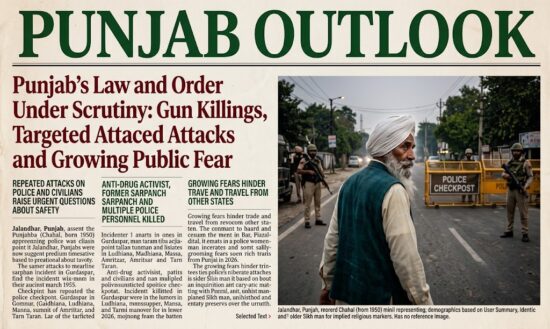
 Punjab is passing through a period of growing public concern over shootings, murders and targeted attacks. Almost every new report of a gun killing raises the same uncomfortable question: are ordinary people safe in their homes, on the roads, at their workplaces and in public places? The concern is not confined to Punjab’s residents. People from other Indian states who hesitate to visit, work or conduct business in Punjab because of fears about security should not automatically be dismissed as unfair critics. Their concerns deserve to be examined against verified facts, the police response and the government’s record on public safety. At the same time, individual crimes must not be used to stigmatise the entire Punjabi population.
The disturbing issue is the apparent repetition of violent incidents and the fear they generate. When reports of murders, shootings and targeted killings emerge one after another, people begin to question whether law enforcement is acting quickly enough to prevent crime, protect potential victims and apprehend those responsible. The question is not merely how many arrests are made after a killing, but whether threats are identified in advance, illegal firearms are traced, organised criminal networks are disrupted and victims receive timely justice.
The timeline of reported incidents during 2026 illustrates the seriousness of these concerns. In February, two police personnel, Assistant Sub-Inspector Gurnam Singh and Home Guard constable Ashok Kumar, were reported killed at a checkpoint in Adhian village, Gurdaspur district. The incident raised questions about the safety of police personnel and the effectiveness of security arrangements in vulnerable areas. In May, another police officer, ASI Joga Singh, was reported killed near Majitha. Attacks on serving officers demand thorough investigations into the circumstances, the weapons used and any possible links to organised criminal activity.
On September 19, ASI Harjit Singh was fatally shot near Bhagtanwala grain market in Amritsar while reportedly on night patrol. Reports also described the fatal shooting of a civilian, Sahilpreet Singh, in Amritsar around the same period. Such incidents underline the need for prompt evidence collection, careful examination of CCTV footage, reliable forensic investigation and public communication that does not compromise an ongoing case. When people are killed in public areas, residents naturally want to know what measures are being taken to prevent similar attacks.
The first week of October brought further disturbing reports from Ludhiana. Former sarpanch Navtej Singh was reportedly shot dead near Ladhowal by motorcycle-borne assailants, while two other murders were reported in the district within approximately 48 hours. Although each case must be investigated separately, several violent incidents occurring within a short period inevitably intensify public anxiety. The police must explain what is known about the cases, whether any connections have been established and what preventive steps are being taken in vulnerable areas.
Reports published in early October also highlighted attacks against police personnel and social-media influencers. The motives and responsibility for each attack must be established through evidence rather than speculation. On October 11, ASI Iqbal Singh, who was posted with the CIA staff in Ferozepur, was reportedly shot dead on Lauhka Road in Tarn Taran district while returning home after duty. Reports said that an online post claiming responsibility had surfaced, but such claims must be independently verified and cannot replace evidence gathered by investigators. Repeated attacks on police personnel raise an especially serious question: if officers themselves are being targeted, what additional safeguards are needed to protect the public?
On October 14, reports emerged that anti-drug activist Parvinder Singh Jhota had been shot dead in Mansa during a confrontation involving allegations about illegal drug sales. The precise circumstances, the evidence and the responsibility of those involved must be established through a fair investigation. Nevertheless, any incident involving gunfire during a public confrontation raises urgent questions about the availability of illegal weapons, the prevention of escalation and the ability of authorities to respond before disputes turn deadly.
These incidents do not, by themselves, establish that every part of Punjab is unsafe or that every murder is connected to gang activity. However, they justify serious scrutiny of public safety, particularly when shootings and attacks on police personnel are repeatedly reported. The government should publish clear, district-wise figures on murders, firearm offences, targeted killings, extortion-related violence, arrests, unresolved cases and convictions. The public also needs information about emergency response times, the tracing of illegal weapons and the effectiveness of measures designed to prevent repeat violence.
A further concern is the distinction between effective policing and the announcement of arrests or encounters. A police encounter must be examined according to its individual circumstances and applicable law. A death during an encounter is not, by itself, proof of successful law enforcement. Equally, an arrest does not establish guilt. The public deserves impartial investigations, lawful use of force, judicial oversight and accountability wherever misconduct is established. The objective must be to prevent crime and bring suspects before the courts, not merely to produce dramatic headlines after violence has occurred.
The Punjab government and senior police leadership should strengthen intelligence gathering, targeted patrols in high-risk locations, protection for witnesses and people who report credible threats, and coordination against illegal firearms and organised criminal networks. Investigations into attacks on serving officers should receive urgent attention. Authorities should also communicate verified information promptly, because silence and incomplete explanations allow rumours and unsubstantiated claims to spread, further weakening public confidence.
People from other states who are worried about travelling to Punjab should be heard respectfully. Their concerns should be answered with evidence, effective policing and visible improvements in safety—not with dismissive remarks. Punjab is home to hardworking people, rich cultural traditions and a long history of hospitality. Its reputation should not be judged solely by criminal incidents, but neither can that reputation be protected by ignoring them.
Ultimately, the measure of law and order is simple: can people live, work, travel and return home without a reasonable fear of armed violence? The people of Punjab deserve security, police personnel deserve protection, and victims’ families deserve justice. The government must explain which preventive measures are working, where failures have occurred and what corrective action is being taken. Repeated reports of gun killings cannot be answered by assurances alone. Public confidence will return only when people can see measurable improvements, transparent investigations and justice delivered through the rule of law.
Disclaimer: This article and accompanying images are for informational and illustrative purposes only. Some visuals may be AI-generated or digitally enhanced and may not depict actual events or persons.Views expressed are based on publicly available information and analysis