
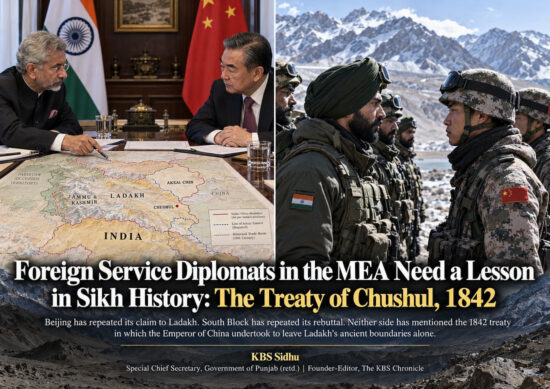
 On 2 October 2026 (Gandhi Jayanti, as it happens), the Ministry of Home Affairs announced that 28 lakes, peaks and other geographical features in eastern Ladakh had been given standard names on the official map of the Survey of India. Eleven days later, on Tuesday, 13 October, the Chinese Foreign Ministry’s spokesperson, Mao Ning, used a briefing in Beijing (relayed by Xinhua) to say three things. China has never recognised the Union Territory of Ladakh created in August 2019. India’s naming exercise is illegal, null and void. And the western section of the boundary, by which she plainly meant Aksai Chin, has always belonged to China.
New Delhi replied the same day. The MEA spokesperson, Randhir Jaiswal, said Ladakh is an integral and inalienable part of India. He added, crisply, that “no amount of denial by the Chinese side can change this established fact,” and that the MHA’s press release was self-explanatory.
The exchange was correct and proportionate, and it was also entirely predictable. We have heard this duet before. In October 2020, when Raksha Mantri Rajnath Singh opened 44 border bridges, Beijing’s spokesman said China did not recognise the “illegally set up” Ladakh UT. In December 2023, after the Supreme Court upheld the abrogation of Article 370, Mao Ning used almost the same formula. Each time Beijing asserts, New Delhi re-asserts, and the newspapers file the story under “Border Row”.
What the MEA said was right. My quarrel is with what it left out.
“Always Belonged” Is a Historical Claim. Answer It With History.
Beijing’s argument does not rest on the 2019 reorganisation of Jammu and Kashmir. That was an internal act of a sovereign republic, and China’s non-recognition of a Union Territory carries about as much legal weight as my non-recognition of a Chinese county. The operative words are always belonged. That is a claim about history, and a claim about history is best answered with a document older than the claimant’s own republic.
India has such a document. It was signed, sealed and witnessed in September 1842, and it was carried into the Ladakh–Tibet frontier by the army of the Khalsa Darbar of Lahore.
The Treaty the Briefing Room Forgot
Here is the background in brief; readers who want the long version can find it in my earlier Chronicle essay, The Peace Pact after the Sino-Sikh War (1841–42): The Treaty of Chushul, 1842.
General Zorawar Singh Kahluria, Raja Gulab Singh’s Dogra commander, took Ladakh for the Lahore Darbar between 1834 and 1840. In May 1841 he pushed east into Western Tibet. He reached Mansarovar, and in December he was killed at Taklakot in the snow. A Tibetan army then marched on Leh and laid siege to it. Diwan Hari Chand and Wazir Ratnu came up from Jammu, lifted the siege, and broke the Tibetan force in the open ground at Chushul in the late summer of 1842.
The peace that followed was concluded on the 2nd of Assuj, Sambat 1899 (16 or 17 September 1842). Read the preamble slowly, because the parties matter. On one side stood the officers of the Lhasa government. On the other stood representatives of the “Sri Khalsa ji Sahib” Maharaja Sher Singh and of Raja Gulab Singh. The text declares that peace and friendship shall remain established for ever between the Khalsa ji and Raja Gulab Singh on one part, and “the Emperor of China and the Lama Guru of Lhasa” on the other.
The Emperor of China is named in the treaty. That lifts it above a local truce between two hill chieftains: the Qing sovereign was a named beneficiary and, by necessary implication, a bound party.
The core clause is short. The Tibetan side undertook neither then nor in the future to “have anything to do or interfere at all with the boundaries of Ladakh and its surroundings as fixed from ancient times.” The trade in wool, shawls and tea was to continue by the Ladakh road according to old custom.
Let me put on an older hat. For two tenures as Financial Commissioner Revenue, I sat over disputes in which one party pleaded possession and the other pleaded title. Every revenue officer in Punjab learns early that possession, however long, does not by itself cure a defect in title. He also learns that the most persuasive entry in a land record is the one that says a boundary has stood from time immemorial. That entry, made with both neighbours present and assenting, is the hardest to dislodge.
The Treaty of Chushul is precisely such an entry, made in the jamabandi of the Himalaya. It records three things: a boundary “fixed from ancient times”, a neighbour (Lhasa, acting with the Emperor of China named) who accepted it, and a promise never to disturb it. When Beijing says the western sector “always belonged” to China, the 1842 record answers that in 1842 China’s own side accepted Ladakh’s ancient boundaries and promised not to meddle with them.
The record has a sequel too. After the Treaty of Amritsar (1846) transferred Jammu and Ladakh to Gulab Singh, the British proposed a joint demarcation. The Qing authorities declined, on the ground that the boundaries were already sufficiently known and should be left as they had stood of old. This is a second admission, five years after Chushul, from Peking’s own officials.
Where Our Argument Is Thin, and How to Thicken It
I would be doing the MEA no favour by overselling the treaty, and the Chinese side will certainly not let it be oversold. In the 1960 officials’ talks, Beijing’s negotiators argued that the 1842 document was a non-aggression pact which defined no boundary. They also argued that Aksai Chin abutted Xinjiang rather than Tibet, so a Ladakh–Tibet agreement could not govern it.
Both objections can be answered, but only by someone who has done the reading:
* The treaty need not draw a line to fix one. “Boundaries as fixed from ancient times” is a reference to an existing, known frontier, not an absence of one. Our case then rests on showing what that ancient frontier was. That means the Ladakhi revenue and trade records, the Dogra administration’s own papers, the 1847 correspondence, and the later Survey of India work (W.H. Johnson’s 1865 survey among it).
* “Ladakh and its surroundings.” The phrase is broad, and the Emperor of China, not merely Lhasa, is named in the preamble. The Xinjiang objection asks us to believe that the Qing bound themselves on Ladakh’s Tibetan flank while reserving a free hand on its Turkestan flank. That reading deserves to be tested in public, not conceded in silence.
* Candour about Aksai Chin. The treaty does not mention Aksai Chin by name, and we should say so before Beijing does. The treaty matters because it shows that a Chinese state, in 1842 and again in 1847, treated Ladakh’s frontier as old, known and settled. On that foundation the rest of India’s documentary case is built.
Why Sikh History Belongs in the Briefing Room
This treaty rarely features in the MEA’s talking points, for an unflattering reason. Our diplomatic memory of the northern frontier tends to begin with the British: the Johnson Line, the Macartney–MacDonald proposal, the McMahon Line. It then jumps to Pandit Nehru’s letters to Zhou Enlai. The Lahore Darbar sits awkwardly in that story. It was a Punjabi, Sikh-led state, and it is remembered in our textbooks mainly for its wars against the Afghans and the British.
Yet it was the Khalsa Darbar’s army, under a Dogra general and with Sikh contingents in the ranks, that carried the frontier to Chushul and obtained Tibet’s signature on it. India’s title to Ladakh runs in an unbroken chain: Ladakhi kingdom, Lahore Darbar, Dogra Maharajas under British paramountcy, the Instrument of Accession signed by Maharaja Hari Singh in October 1947. The 1842 treaty is the first link in that chain bearing a Chinese-side signature. A mandarin who skips it is starting our case halfway through.
Three Modest Suggestions for Jawaharlal Nehru Bhawan
First, cite it. When Beijing next says “always belonged”, the spokesperson’s reply should include one sentence: in 1842, in a treaty naming the Emperor of China, the Chinese side undertook not to interfere with Ladakh’s boundaries as fixed from ancient times. A single sentence repeated at every briefing will in time become part of the record.
Second, publish it. The MEA’s History Division, working with the Jammu and Kashmir State Archives (which hold a Tibetan-language copy), should issue an annotated edition of the treaty and the 1847 correspondence in English, Hindi and Mandarin. Beijing publishes white papers. We should too.
Third, name with intent. If the 28 names gazetted on 2 October do not already honour them, the next list should carry Zorawar Singh’s name on a feature near Pangong Tso, and Diwan Hari Chand’s on one near Chushul. Naming has become this year’s front line. India should use names that remind every reader of the map that we were there, and that Lhasa and the Emperor of China agreed we were there, eight decades before the People’s Republic existed.
Slowly, but Surely, to the Table
India is now the odd one out. Burma signed a boundary agreement with China in January 1960 and a full treaty that October. Nepal did the same in March 1960, with a treaty following in October 1961. Pakistan signed an “agreement” on 2 March 1963 in which it handed over the Shaksgam Valley, territory that was never Pakistan’s to give. Article 6 of that document concedes the arrangement is provisional until the Kashmir question is settled. Sooner or later, India too will be well advised to sit down to boundary negotiations in earnest, beyond the patrol protocols and disengagement arithmetic of the Special Representatives’ talks. We should go in with our eyes open and our files in order, trusting Beijing no further than its record warrants and proceeding slowly. A frontier that has been disputed for close on two centuries need not be wrapped up in a decade. The process, however, must begin, and the 1842 treaty should be the first file on India’s side of the table.