
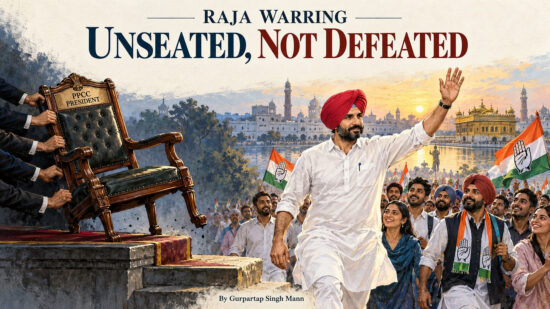
He is down but not out. Raja Warring has lost the presidency of the Punjab Congress. He has not lost his team, his followers, his workers, his political ambition or his willingness to fight. Those who joined hands to remove him should not be in a hurry to write him off. Getting a man removed from a post is one thing. Finishing him politically is quite another.
Since Pargat Singh’s appointment on October 2, Warring has congratulated him, attended his installation and assured him of support. The day after the October 11 installation, he joined Rahul Gandhi on the streets of Delhi with his supporters. He is hurt, and he has not entirely concealed it. At the installation, he remarked, “It is possible that (Sachin) Pilot saab may cut my ticket next time.” He nevertheless reaffirmed his loyalty to Rahul Gandhi and Congress. The hurt was evident, but he accepted the party’s decision and continued working. That deserves acknowledgment.
Why, then, was he removed? Was it because he occasionally spoke carelessly? Because he could not carry the senior leaders along? Or because what he was proposing for 2027 had begun to disturb too many established interests?The answer lies partly in the question of tickets. On February 20, 2025, Warring spoke of bringing 60–70 new faces into the next Assembly election. This was a substantial proposal for a state with 117 constituencies. It gave younger workers something to work towards. It also meant that many familiar claimants could no longer take their nominations for granted.
The issue became sharper in August 2026. Warring advocated “one family, one ticket” and questioned leaders who wanted one constituency for themselves and another for their sons. He invoked the party’s Udaipur declaration and circulated Rahul Gandhi’s earlier endorsement of the principle. He was publicly defending what he presented as his leader’s direction.
On August 15, at Issru, a senior leader countered that a family capable of winning could be given even four tickets. Other senior leaders were present on the stage. Warring was absent, including from the banner. The disagreement was now before everyone. Who would recommend the candidates? How much space would established families retain? How many ordinary workers would get a chance?
Warring had also proposed giving 70 per cent of tickets to youth during his August 4 outreach in Ferozepur. Whether that proportion was practical could certainly be debated. But the question he raised was valid. Can a party ask young people to organise its meetings, face police action and carry its flags, and then tell them to wait because someone’s son or daughter must be accommodated first?
Seniority must be respected. Experience has value. But constituencies cannot become family property. If Congress wants new voters, it must also make room for new leadership. Otherwise, its talk of encouraging youth will remain confined to speeches.
This was not the sole cause of Warring’s removal. The rebellion had already become open after the July 1 decision to retain him as president and appoint Channi as campaign committee chairman. The arrangement failed to satisfy those who wanted a change at the top. The July 3 gathering at Morinda and the July 11 meeting at Rana Gurjit Singh’s residence brought that opposition to him into the open.
Thereafter, even the “Har Booth, Congress Mazboot” campaign became a venue for competing slogans and disruption. Bhupesh Baghel, seen as supporting Warring, faced opposition too. Sachin Pilot replaced him on September 5. Further consultations followed, and within a month Warring was out.
My reading is that the party leadership ultimately chose accommodation with the opposing group. That may have been considered necessary before an election. But it should not be presented as proof that Warring had nothing left to contribute.
He certainly made mistakes. His language was sometimes unnecessarily provocative. A state president has to exercise restraint and display maturity, particularly when dealing with colleagues whose cooperation he needs. He may have faltered in his speeches several times. But were these lapses the real reason for the sustained campaign against him? I think they were convenient excuses in a much larger contest over tickets and power.
He must also answer a fair question himself. His wife contested the Gidderbaha by-election while he was an MP. If he advocates limits on family nominations, he must be prepared to apply them to his own household. A sound principle loses credibility when its advocate seeks an exception.
His electoral record was mixed. Congress suffered setbacks during his presidency, including in Gidderbaha. But he had taken charge after the party’s defeat in 2022. Under his presidency, Congress won seven of Punjab’s thirteen Lok Sabha seats in 2024, and he himself won Ludhiana. He cannot claim sole credit for those victories. Equally, he cannot be held solely responsible for every defeat. His record must be judged by both.
At Pargat Singh’s installation on October 11, Pilot acknowledged Warring’s work in rebuilding the organisation after the defeat. Bajwa praised his contribution too. Having himself been replaced as president in November 2015, Bajwa was familiar with such a setback. Before taking his seat with the senior leaders, Warring went over to the area where district presidents and party workers were sitting. They welcomed him with loud cheers. He had lost his post, but clearly retained their affection and support.
Warring also raised a practical concern about their future. He reminded the leadership that young workers had spent four years organising the party and facing water cannons, lathis and police action. These included district, block, mandal and booth-level functionaries. They should receive recognition and opportunities under the new president as well.
Before the ceremony, he assured district presidents: “I will stand shoulder by shoulder with you. I will not let anyone harm you. That is my responsibility.” His message was clear: his removal should not become a reason to sideline those who had worked with him. A worker who has served Congress should not lose his chance merely because the president under whom he worked has changed.
The gathering at his rented Sector 10 house in Chandigarh carried the same message. Senior leaders and supporters came, and he subsequently joined Pargat’s function. On October 12, district presidents and former MLAs again gathered at his Delhi residence before the opposition march. Whatever interpretation is placed on these meetings, they show that he retains an impressive following.
Pargat Singh should recognise its value. He should understand the challenges before him, which are many. Not many tall leaders are happy with his elevation. The high command may have applied a plaster, but have the fractures healed? Warring, equally, must support the new president in practice and avoid giving his critics fresh grounds to question his intentions. Punjab Congress cannot afford another contest in which its leaders devote more effort to defeating one another than to addressing Punjab’s problems.
For Warring, the task is clear. Stay among the workers. Speak with greater care. Stand by the younger people he has encouraged, while accepting the same standards he demands of others. He still has the opportunity to show that his politics extends beyond holding a particular office.
The presidency has gone. The political story is not finished. Do not write off Raja Warring yet.