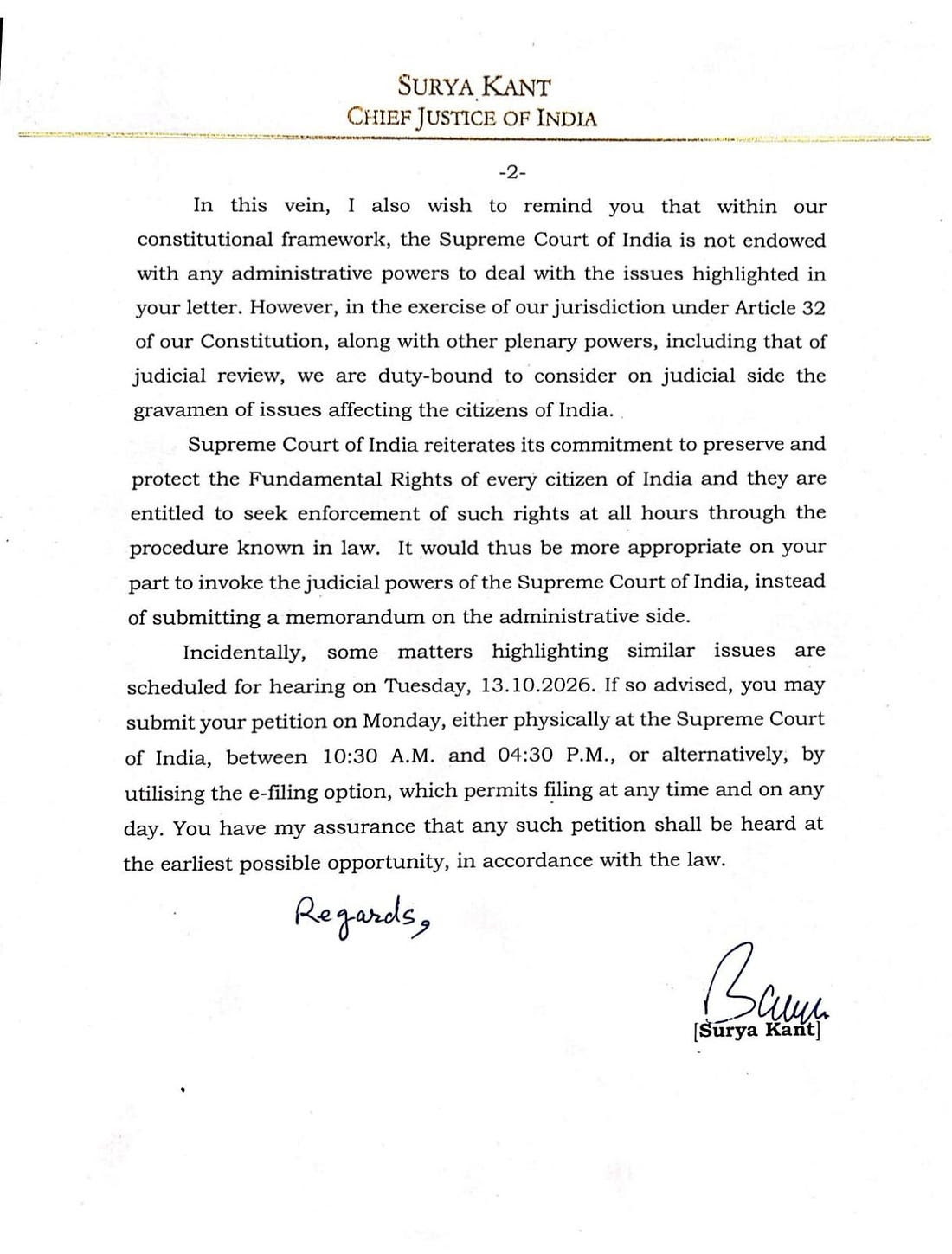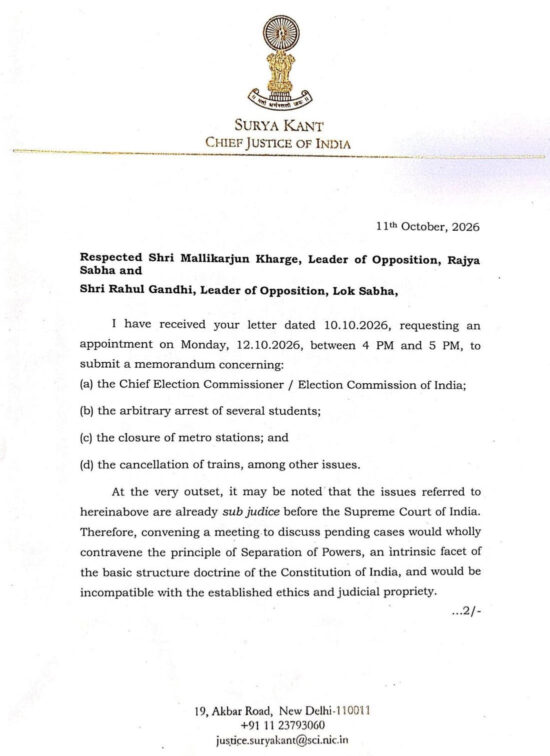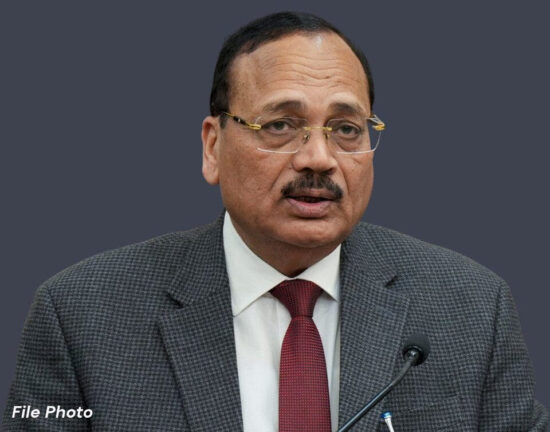
On 10 October 2026, Shri Mallikarjun Kharge and Shri Rahul Gandhi, Leaders of Opposition in the Rajya Sabha and the Lok Sabha respectively, wrote to the Chief Justice of India, Justice Surya Kant, seeking an appointment for Monday, 12 October, between 4 PM and 5 PM. They wished to hand over a memorandum on four matters: the Chief Election Commissioner and the Election Commission of India, the “arbitrary arrest” of several students, the closure of metro stations, and the cancellation of trains during the protests in the capital. The reply, two pages on the Chief Justice’s letterhead from 19 Akbar Road, came within a day. It declined the meeting.
The second occasion came on Monday, 12 October. Leaving a function on human rights, the Chief Justice was asked about the protests by a horde of waiting journalists, and his answer, on camera, was brief: “Law and order ka mudda hai, yeh mera domain nahin” (it is a matter of law and order; it is not my domain). Taken alone, either remark could be read as the court stepping back. Read together, they say something more careful, and for the citizen far more useful.
The headlines compressed it into “not my domain”. The letter says something more careful, and for the citizen far more useful.
A Chamber Door Shut on Principle
The first page makes two points. The issues raised are already sub judice (pending before the court), and a meeting to discuss pending cases would, in the Chief Justice’s words, wholly contravene the separation of powers, which he calls an intrinsic facet of the basic structure, and would be incompatible with judicial ethics and propriety. And the Supreme Court has no administrative power over arrests, metro stations or trains.
Both points are right, and the first is elementary. A judge who receives one side in chambers on a case he is about to hear cannot afterwards be seen by the other side as impartial. Had the Union Home Minister sought the same appointment on the same subjects, the same letter would have had to go to him. The refusal protected the one asset the court cannot replace, its reputation for impartiality, and no fair reader should take it as a snub.
A Courtroom Door Held Open
The second page is where the letter turns, and it is the page the headlines skipped. The court, it says, is duty-bound under Article 32, “along with other plenary powers, including that of judicial review”, to consider on the judicial side the gravamen of issues affecting citizens. Fundamental rights may be enforced “at all hours”. The Leaders of Opposition are invited to file a petition, physically between 10:30 AM and 4:30 PM, or by e-filing at any hour of any day. Matters raising similar issues are listed on Tuesday, 13 October, and the Chief Justice gives his personal assurance of a hearing at the earliest opportunity.
The letter’s real subject, then, is the route rather than the domain. The chamber door is shut; the courtroom door has been held open, with the timings pinned to it.
Behind that courtroom door stand five Articles of the Constitution, 32 and then 141 to 144, and between them they give a bench far more than a hearing and a reserved judgment.
Article 32: The Key in the Lock
Dr Ambedkar called Article 32 the heart and soul of the Constitution, and the description has held up. The right to move the Supreme Court to enforce fundamental rights is itself a fundamental right, which means Parliament cannot take it away and the court cannot decline it on a whim. It is also the article that lets the court act without a formal petitioner. In June 2011, after the midnight police action on Baba Ramdev’s camp at the Ramlila Maidan, the court took suo motu cognizance (acting on its own motion) and in February 2012 held that action to have violated Articles 19 and 21. Since Sunil Batra v. Delhi Administration in the late 1970s, a letter has been enough to start a case; in October 2021, a letter from two lawyers on the Lakhimpur Kheri killings became a suo motu matter.
Article 141: One Judgment, Every Police Station
Whatever the Supreme Court declares as law binds every court in India. A ruling on the limits of crowd control in Delhi is therefore not a Delhi ruling. Guidelines laid down in one case travel to every district magistrate’s office and every police station in the country, the way D.K. Basu (1997) turned a handful of arrest safeguards into a national code of conduct, or Anuradha Bhasin (2020) required every prohibitory order to be reasoned, proportionate and open to review.
Article 142: Complete Justice
This is the widest power the court holds: to pass any decree or order necessary for doing complete justice in any cause or matter pending before it, enforceable throughout the territory of India. It has used Article 142 to settle the Bhopal gas claims, to allot land for a mosque in the Ayodhya judgment, and to fill gaps where Parliament had not yet legislated.
It has two conditions. A matter must be pending, and there now is one, listed for tomorrow. And the power supplements the law rather than overriding it; the court itself held in Prem Chand Garg (1962) that Article 142 cannot be used against fundamental rights, and in Supreme Court Bar Association v. Union of India (1998) that it cannot be used to ignore an express statutory provision.
Article 143: The Door the Executive Holds
Article 143 belongs to the President, not the court. It allows the President to refer a question of law or fact of public importance to the Supreme Court for its advisory opinion. The court cannot invoke it on its own. But it is worth naming, because it is the one door the Union Government holds the key to. If the Government were genuinely uncertain where lawful regulation of protest ends and suppression begins, it could ask. It has not done so.
Article 144: Every Authority in Aid
The last link in the chain is the shortest. All authorities, civil and judicial, in the territory of India shall act in aid of the Supreme Court. Delhi Police, the Lieutenant Governor, the Union Home Ministry, the railways and the metro corporation are all bound. Article 144 turns an order under Article 142 into a command to the entire machinery of the State.
What a Bench Can Do Without a Meeting
Put those five Articles together and a bench hearing tomorrow’s matters has a toolkit no memorandum could match.
It can appoint an amicus curiae, a senior advocate assisting the court independently of both sides. It can call for affidavits from Delhi Police, the Lieutenant Governor and the Union Home Ministry, stating how many persons were detained, under which provision, where, for how long, and where and when each was released, and the reasons for each metro closure and train cancellation. It can direct that CCTV and body-camera footage, police daily diaries and wireless logs be preserved, an order that often matters more than any final judgment. It can ask the Delhi State Legal Services Authority to place panel lawyers at every holding point. It can name a retired judge to observe and report, as it did with the Lakhimpur Kheri investigation. It can lay down interim safeguards under Article 142 (detentions recorded and time-bound, no releases at night or in remote places, restrictions specific, reasoned and short), which Article 141 then carries to every police station in the country. And it can keep a duty bench sitting at night while the protests last, making “at all hours” literal.
These are the powers the bench holds; how many of them it uses tomorrow is for the bench alone to decide.
Restraint, Too, Is a Constitutional Virtue
There are good reasons a bench may use only part of that toolkit. The matters are already listed, so a fresh suo motu proceeding may add little. A court that moved on a letter from two party leaders, at the height of a political confrontation, would risk being seen as a participant in it. The Chief Justice’s letter, read whole, is the work of a judge keeping the court above the quarrel while leaving no doubt that it will hear the quarrel.
The best protection against judicial intervention lies, in any case, with the executive. If every detention is recorded, every restriction reasoned and lifted the moment it has done its work, a bench will find little to correct. Law and order is the executive’s domain; liberty is the court’s. Neither can surrender its share to the other.
And to the reader who is bundled into a bus some evening this week: you do not need an appointment either, nor need you settle whose domain your plight falls in. A habeas corpus petition can be e-filed at any hour of any day. The Chief Justice of India has said so, in writing.
The Leaders of Opposition did not get their appointment, and nobody needs to come away with a disappointment. Law and order may not be the Chief Justice’s domain. The liberty of the citizen caught up in it is, and on that his own letter leaves no doubt. The courtroom door is open, and citizens, and their leaders, should walk through it.