
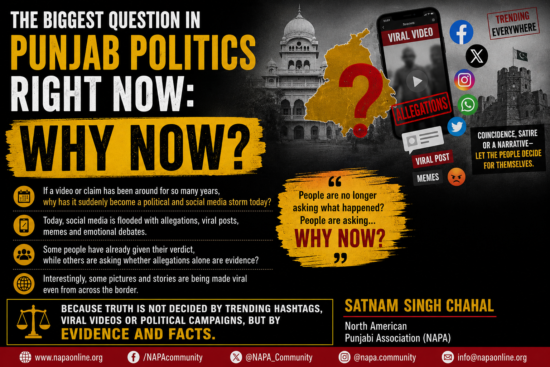
 Punjab politics has once again entered a phase where emotions, allegations, social media campaigns, and political narratives are dominating public discussion. However, amid all the noise, one fundamental question is emerging above everything else: Why has this issue suddenly become a major political and social controversy today?
The debate is no longer centered on what may or may not have happened eight or ten years ago. Instead, the focus has shifted toward the timing of the controversy itself. If certain videos, allegations, claims, or accusations have existed for years, many citizens are asking why they are being aggressively circulated now. Why were these matters not treated with the same urgency when they first surfaced? What has changed politically, socially, or strategically that has transformed an old issue into a headline-dominating storm?
In today’s digital age, social media has become the primary battlefield for political narratives. Within hours, videos go viral, screenshots circulate widely, and hashtags begin shaping public opinion. Memes, emotional posts, edited clips, and selective information often spread faster than verified facts. As a result, many people form opinions before any formal investigation, legal review, or factual verification takes place. This creates a situation where perception can sometimes become more powerful than evidence.
What is particularly noticeable is that a large section of the public appears divided into two camps. One group believes the allegations themselves are sufficient to reach a conclusion. The other group insists that allegations are not evidence and that any serious accusation must be supported by verifiable facts. This divide reflects a larger challenge facing modern democracies: whether public judgment should be based on emotions and viral content or on objective evidence and due process.
Adding another layer to the debate is the observation that some pictures, stories, and narratives are reportedly being amplified from sources beyond Punjab and even across international borders. Whether this is merely coincidence, political satire, organized campaigning, or an attempt to influence public perception is a matter of interpretation. Different groups see it differently. Some view it as a genuine effort to expose wrongdoing, while others believe it is part of a broader political narrative designed to shape public opinion at a crucial moment.
Punjab has historically been a politically aware state where people carefully examine issues before reaching conclusions. The state’s voters have repeatedly demonstrated that they can distinguish between genuine concerns and politically motivated campaigns. Therefore, many observers believe that the public is now looking beyond the allegations themselves and examining the circumstances surrounding their sudden revival.
The timing of political controversies is often as important as the controversy itself. In politics, information can be released, highlighted, or amplified for various reasons. Sometimes it is done to influence public sentiment, sometimes to distract from other issues, and sometimes to gain political advantage. This reality is why many citizens are not merely asking whether the allegations are true or false; they are asking why the issue has resurfaced with such intensity at this particular moment.
Another important aspect is the role of emotional mobilization. Punjab’s political landscape is deeply connected to identity, faith, culture, and community values. When an issue touches any of these sensitive areas, emotions naturally run high. Political parties, activists, influencers, and supporters understand this reality. Consequently, emotional appeals often become a powerful tool in shaping public discourse. Yet emotions, while important, cannot replace evidence-based conclusions.
The larger concern for many Punjabis is the growing tendency to conduct trials on social media. Platforms that were originally designed for communication have increasingly become arenas where accusations, judgments, and verdicts are delivered instantly. In such an environment, facts sometimes struggle to compete with sensational content. The danger is that public opinion may be shaped before all relevant information becomes available.
Ultimately, the biggest question in Punjab politics today is not simply about an old video, an old allegation, or an old controversy. The biggest question is: Why now? Why has this issue suddenly become the center of political discussion after so many years? Who benefits from its revival? What purpose does its timing serve? These are the questions increasingly being asked by ordinary citizens.
Punjab’s people deserve answers based on facts, transparency, and evidence rather than assumptions and emotional reactions. History has shown that truth cannot be established through viral hashtags, social media trends, political campaigns, or online verdicts. Truth emerges through credible evidence, objective investigation, and factual scrutiny.
As the debate continues, one reality remains clear: the people of Punjab are not only seeking answers about the allegations themselves. They are equally interested in understanding the timing, motivations, and circumstances behind the controversy. In the end, facts not narratives—will determine the truth, and evidence not social media trends must remain the foundation of public judgment.