
 Pakistan’s official holiday calendar of 1953 listed Baisakhi on the 13th of April a rare documentary trace of a pan-Punjabi festival that Muslim communities once celebrated alongside their Sikh and Hindu neighbours, before religious identity gradually drew a line through the harvest season.A yellowed government circular from 1953 offers a startling glimpse into Pakistan’s early cultural life. Among the holidays gazetted for that year Eid ul-Fitr, Pakistan Day, Christmas, Diwali, and Muharram sits a single entry that today seems almost incongruous: Baisakhi, 13th April. For a nation barely six years old and still defining its relationship to its pre-Partition past, the inclusion was a quiet acknowledgement that the Punjab’s oldest popular festival did not belong to any one faith alone.
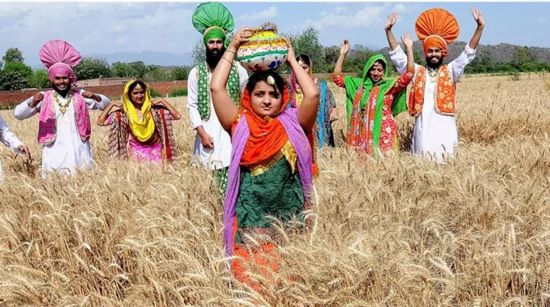
Baisakhi also spelled Vaisakhi marks the solar new year in the Punjabi calendar and the arrival of the spring harvest. For centuries before the formation of Pakistan and India, it was one of the great communal occasions of the subcontinent’s north-western heartland. Farmers of all religions brought in the wheat, merchants settled accounts, and villages rang with the sound of the dhol drum and bhangra dance. The festival transcended creed because it was rooted in the earth and the turning of the seasons.
“Baisakhi was never merely a religious occasion it was the Punjab’s oldest agreement that spring belonged to everyone who worked the soil.”
The complication for Baisakhi’s place in Pakistani public culture came from a second identity the festival had acquired one far more specifically Sikh. In 1699, Guru Gobind Singh chose the chose the day of Baisakhi to establish the Khalsa, the community of the initiated, at Anandpur Sahib. This event, known as Khalsa Sajna Diwas, transformed Baisakhi into one of the holiest dates in the Sikh liturgical year. The two meanings agrarian and religious coexisted comfortably in pre-Partition Punjab, where Sikh, Muslim, and Hindu neighbours often attended each other’s festivals as a matter of social warmth rather than theological endorsement.
Baisakhi appears in Pakistan’s official 1953 holiday list, dated 13th April alongside Diwali, Christmas, and Muharram, reflecting the new state’s early pluralist public calendar.The festival has dual origins: as a Punjabi agricultural new year celebration, and as Khalsa Sajna Diwas the founding anniversary of Sikhism’s Khalsa order in 1699.Before Partition, Muslim Punjabis routinely participated in Baisakhi fairs, melas, and bhangra celebrations as a shared cultural rather than doctrinal occasion.
The festival’s gradual disappearance from Muslim Punjabi observance is attributed to its growing association with Sikh identity, making continued participation feel, for many, like a borrowed ritual rather than a native one.Pakistan retains no official Baisakhi holiday today, though Sikh pilgrims visit Punjabi shrines especially Nankana Sahib and Hassan Abdal for the occasion each spring.Partition in 1947 sharpened the distinction that had previously been blurred. The mass migration of Sikhs from what became Pakistan and of Muslims from what became India did not merely redraw borders it severed the shared social fabric in which such overlapping festivals had flourished. With the Sikh population of Pakistani Punjab effectively gone, Baisakhi lost the community that had most visibly organised and performed its distinctive religious dimension. What remained, in theory, was the older, non-denominational harvest celebration. Yet, by the early 1950s, the cultural memory of a Muslim Baisakhi was already fading.
The 1953 holiday gazette represents, therefore, something of a last institutional flicker. Whether Muslim Pakistanis were actively celebrating Baisakhi by that point or whether the listing was simply an administrative inheritance from the pre-Partition calendar is a matter of historical debate. Oral histories from older Lahoris and Multan residents sometimes recall spring fairs on or around the date, though the explicitly Baisakhi character of such gatherings had grown ambiguous. The festival’s name persisted on paper even as its public observance thinned.Scholars of South Asian religious history note a recurring pattern: festivals that once served as porous cultural commons tend to contract toward their most theologically specific community when inter-community contact diminishes.
Baisakhi, inflected ever more strongly with the language, imagery, and pilgrimage practices of the Khalsa, became in the eyes of many Muslim Punjabis a Sikh festival that they could respectfully observe from a distance, rather than a shared Punjabi one they could inhabit from within.The loss was mutual: the festival lost breadth; Pakistani Punjab lost a strand of its own cultural memory.
Today, Baisakhi is observed in Pakistan primarily by the small Sikh community and by pilgrims who arrive from abroad, particularly for the great gathering at Panja Sahib in Hassan Abdal. For the wider Pakistani Punjabi public, the spring harvest season passes without the communal drumming and dancing that, within living memory, had once been considered simply what Punjabis did when the wheat turned gold. The 1953 holiday list, a faded photograph of an earlier accommodation, is one of the few official documents that testifies to the festival’s broader, more inclusive past.This feature draws on documentary and historical sources for cultural and educational purposes. It reflects the complexity of festival identity in post-Partition South Asia and is presented