
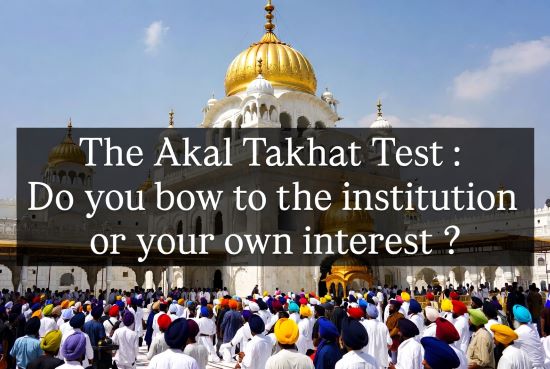
 The Akal Takhat Test: Do you bow to the institution or your own interest? Some fall before Akal Takht Sahib with folded hands, but stand up again only to follow their own political ambitions, personal loyalties and organisational calculations. There is a painful hypocrisy that the Sikh Panth can no longer afford to ignore. Some people publicly proclaim that Akal Takht Sahib is supreme. They bow their heads before it. They speak about Panthic maryada. They invoke the authority of Akal Takht Sahib whenever it strengthens their argument against someone else.But the moment the same authority produces a decision that goes against their personal, political or organisational interests, the language suddenly changes.
The hukam becomes “debatable.”
The decision becomes “questionable.”
The timing becomes “political.”
The procedure becomes “flawed.”
And obedience quietly disappears.
What kind of submission is this?Is this respect for Akal Takht Sahib—or respect for Akal Takht Sahib only when Akal Takht Sahib agrees with us?This is perhaps one of the most uncomfortable questions facing Sikh society today.
The Bow is easy.The comes after the bow .Anyone can bow before Akal Takht Sahib.Anyone can fold their hands.Anyone can make an emotional statement about Panthic unity.Anyone can say, “I accept the authority of Akal Takht Sahib.”But the real test comes when that authority asks something from us that we do not want to give.
Will we still obey?
Will we still accept accountability?
Will we still put the Panth above our position?
Will we still accept a decision when it costs us politically? That is where sincerity begins.
Unfortunately, a disturbing culture of selective obedience has emerged.Some demand strict obedience when their opponents are under scrutiny but suddenly discover constitutional arguments, procedural objections and personal interpretations when the spotlight turns toward them.This cannot be the standard of Sikh leadership.
Akal Takhat can not be weapon against opponents.The greatest danger is when Akal Takht Sahib is turned into a political instrument.If a person invokes Akal Takht Sahib to condemn an opponent, that person must also be prepared to accept its authority when the decision affects him.Otherwise, the institution is being used not respected.Akal Takht Sahib cannot be a sword that we hand to ourselves and a shield that we deny to our opponents.It cannot be used selectively according to political convenience.And it certainly cannot become a ceremonial stage where people bow before cameras, issue grand statements and then return to their own camps to do precisely what suits them.The Sikh Panth deserves better.
The biggest problem is not disagreement
There is nothing inherently wrong with asking questions.There is nothing wrong with respectfully seeking clarification.There is nothing wrong with discussing institutional reform.But there is something deeply wrong with pretending to obey while actually following only those decisions that serve one’s interests.If someone genuinely believes a decision is unjust or procedurally flawed, he should have the courage to say so openly and respectfully.Do not call disagreement obedience.Do not call selective compliance maryada.Do not call political convenience Panthic interest.And do not invoke Akal Takht Sahib merely when it is useful for defeating an opponent.
The Sikh Panth is watching
The ordinary Sikh is not blind.People see the double standards.They see leaders demanding discipline from others while making exceptions for themselves.They see people talking about Panthic ekta while maintaining factional politics.They see individuals speaking about sacrifice while protecting their own positions.They see people declaring that Akal Takht Sahib is supreme—and then deciding for themselves which parts of its authority they will accept.This is precisely how faith in institutions is destroyed.When ordinary Sikhs see influential people treating principles as negotiable, cynicism replaces faith.And when cynicism enters a community’s institutions, rebuilding trust becomes extremely difficult.
Who is realy Supreme ?
This is the question that every Sikh claiming allegiance to Akal Takht Sahib should answer honestly.
Is Akal Takht Sahib supreme?
Or is the individual supreme?
Is Panthic maryada supreme?
Or is political survival supreme?
Is collective Sikh interest supreme?
Or is one’s party, faction, organisation or personal influence supreme?
Because the answer cannot change according to circumstances.You cannot have one principle for your opponent and another principle for yourself.If obedience is sacred, it must remain sacred when it hurts.If accountability is necessary, it must apply to everyone.If Panthic maryada matters, it cannot become a slogan used selectively.
The day we start bowing day we start bowing only when it suits us
The Sikh Panth must be particularly careful about this culture of conditional loyalty.Today someone may reject a decision because it hurts his political interests.Tomorrow someone else may reject another decision because it hurts his organisational interests.The day after, another person may reject it because it affects his personal standing.Soon, every individual will become his own Akal Takht.Everyone will decide for himself what is right.Everyone will interpret authority according to convenience.Everyone will demand discipline from everyone else.And eventually, institutional authority will become nothing more than a photograph, a stage and a slogan.That is the road to institutional collapse.
The real bowing is sacrifice
The Sikh tradition has never measured commitment merely by physical gestures.The true measure is sacrifice.It is easy to bow when everyone is watching.It is much harder to surrender one’s ego when nobody is watching.It is easy to accept a decision that benefits us.It is much harder to accept one that demands personal sacrifice.It is easy to speak about the Panth.It is much harder to put the Panth before oneself.That is the real test.Therefore, those who repeatedly proclaim their submission before Akal Takht Sahib should stop asking others to prove their loyalty.
They should first look into the mirror.Ask themselves whether they have accepted authority when it was inconvenient.Ask whether they have followed the same standards they demand from their opponents.Ask whether they have ever placed the Panth above their personal ambitions.And most importantly, ask:
“If Akal Takht Sahib decides against me, will I still bow?”
If the answer is yes, there is substance behind the words.If the answer is no, then the problem is not Akal Takht Sahib.The problem is the ego standing between the individual and the Panth.The Sikh community does not need more people who know how to bow.It needs people who know how to obey principles, accept accountability and put the Panth before themselves.Because ultimately, the question is not whether someone’s forehead touched the ground before Akal Takht Sahib.
The question is whether their ego did.
Disclaimer: This article and accompanying images are for informational and illustrative purposes only. Some visuals may be AI-generated or digitally enhanced and may not depict actual events or persons.Views expressed are based on publicly available information and analysis.