
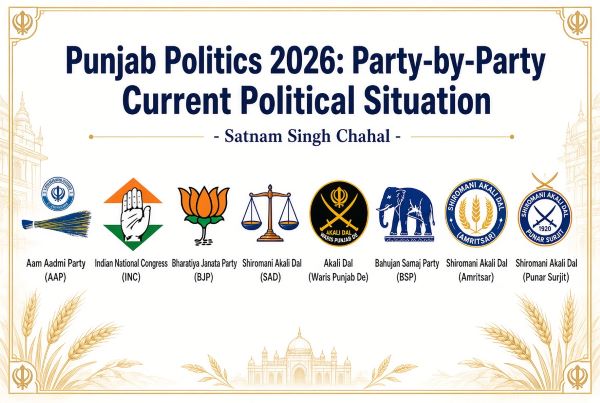
The Aam Aadmi Party(AAP): Government in Power, But facing a tougher 2027 Test
The Aam Aadmi Party entered Punjab politics in 2022 with an extraordinary mandate, winning 92 of the 117 Assembly seats and forming a government under Bhagwant Mann. Four years later, AAP remains the governing party, but the political atmosphere has changed considerably. The party is no longer fighting simply to establish itself; it is now defending its record in government and preparing for the 2027 Assembly election. Chief Minister Bhagwant Mann remains the central face of the Punjab government. AAP continues to highlight its record on government recruitment, free electricity, welfare measures, education, healthcare, infrastructure and investment. Mann has also pushed back against criticism of Punjab’s finances, arguing that borrowing is being used for development rather than waste. At the same time, the government faces persistent criticism over unemployment, drugs, law and order, agricultural distress, fiscal pressures and the handling of protests. Opposition parties are attempting to turn these issues into a broader argument that the AAP government has failed to deliver the transformation promised in 2022.AAP’s political strategy appears increasingly focused on portraying the Opposition as a collection of parties united primarily by their opposition to Bhagwant Mann. The party has accused Congress, BJP and Shiromani Akali Dal of coming together against the government. The challenge for AAP is therefore straightforward yet enormous: it must convert its achievements into a convincing public narrative before 2027. The party won Punjab on the promise of change. It will now be judged on whether ordinary Punjabis believe that change actually reached their homes, villages, farms and workplaces.
Congress: The biggest challenge is inside the party
Congress remains one of the principal challengers to AAP, but its biggest problem at present is not necessarily its opponents—it is internal unity. The Punjab Congress has experienced continuing tension involving different senior leaders, with the rivalry between Amarinder Singh Raja Warring and former Chief Minister Charanjit Singh Channi becoming an important part of the party’s internal political debate. Recent reporting describes the Punjab unit as facing serious organisational and leadership questions ahead of 2027.Raja Warring continues to occupy an important organisational position, while Partap Singh Bajwa remains a prominent Opposition voice in the Punjab Assembly. Charanjit Singh Channi also retains considerable political visibility. The presence of several senior leaders with their own support bases can be an advantage for Congress, but only if the party can convert those individual strengths into a united campaign.Congress has enough political experience and grassroots presence to challenge AAP. It also has the advantage of being able to attack the government on its performance rather than having to explain its own administration. But internal disagreements can quickly weaken that advantage.The real Congress question is therefore not whether it has leaders. It has many. The question is whether those leaders can agree on one leadership structure, one campaign strategy and one message for Punjab. If internal competition continues until the election, Congress risks allowing AAP to remain in power despite anti-incumbency. If the party achieves unity, it could become one of the strongest contenders for government.The coming months will be particularly important because the Congress high command has already been examining the organisation and leadership structure in Punjab.
BJP: Expanding beyond its traditionl urban base
The BJP is attempting perhaps its most ambitious expansion in Punjab politics. For decades, the party’s strength in the state was concentrated largely in urban constituencies and was closely linked to its alliance with the Shiromani Akali Dal. After the BJP-SAD relationship broke down, the BJP began attempting to build an independent political organisation across Punjab.That expansion has accelerated ahead of 2027. In August, Punjab BJP president Kewal Singh Dhillon announced a major organisational restructuring, appointing new vice-presidents, general secretaries, secretaries and leaders of various party wings. The party says the objective is to strengthen its organisation and reach every section of Punjab.But the restructuring has also exposed internal tensions. Veteran BJP leaders and workers have reportedly expressed dissatisfaction with some appointments, and several leaders resigned from organisational positions. The dispute has raised questions about how successfully the party can balance long-time BJP workers with leaders who have joined from Congress, SAD and other political backgrounds.The BJP’s national leadership has responded by asking the Punjab unit to address dissent and strengthen its booth-level organisation. Reports indicate that the party wants to expand its presence to approximately 24,000 polling booths across the state.The BJP’s larger challenge is social and electoral. Expanding an organisation is one thing; converting that organisation into votes in rural Punjab is another. The party is attempting to broaden its appeal among farmers, Sikhs, rural voters, youth and other sections that have historically not formed its core support base in Punjab.The BJP therefore enters 2027 as a party with significant national power and growing organisational ambition, but it still has to answer the most important Punjab-specific question: Can it build an independent social coalition strong enough to compete for power in the state?
Shromani AkaliDal (SAD): Tring to rebuild its political space
The Shiromani Akali Dal faces perhaps the most complicated political rebuilding exercise among Punjab’s major traditional parties. Once one of the dominant political forces in Punjab, SAD has experienced a prolonged period of electoral decline and internal challenges.The party’s principal leadership remains associated with Sukhbir Singh Badal, while senior figures including Bikram Singh Majithia and Daljit Singh Cheema remain important voices in the organisation. SAD has increasingly attempted to focus attention on Punjab-specific issues, including employment, farmers, Sikh concerns, federalism and the state’s economic situation.Daljit Singh Cheema recently demanded a comprehensive white paper from the AAP government on Punjab’s employment situation, arguing that the government should provide detailed information about employment and unemployment.The most significant political development surrounding SAD, however, is the possibility of renewed cooperation with the BJP. Sukhbir Singh Badal’s recent meeting with Prime Minister Narendra Modi has generated considerable political speculation. While the details of the meeting have not been publicly established as a formal alliance agreement, the encounter has intensified discussion about whether the former allies could work together again before the 2027 election.Bikram Singh Majithia has publicly said that people in Punjab want SAD and BJP to come together again, while reports indicate that leaders of the two parties have been exploring the possibility of renewed cooperation.For SAD, a BJP alliance could provide organisational and electoral advantages. But it could also create political complications because the party would have to explain why it is returning to a relationship that previously ended amid serious disagreements.SAD’s fundamental challenge is bigger than alliance arithmetic. It must rebuild trust among voters and reconnect with the traditional Akali base while simultaneously presenting itself as a modern political alternative. The 2027 election could therefore become a crucial test of whether SAD can recover its position as a major independent force in Punjab politics.
The panthic political space: A New Battlefield
Alongside the four major political formations, Punjab is witnessing renewed activity around Panthic and Sikh political issues. Recent developments involving religious institutions, Bandi Singh-related demands, parole controversies and other Sikh issues have once again brought questions of Panthic politics into the centre of political discussion. The Indian Express has described recent developments as signs that Panthic issues may again become important in the run-up to the 2027 election.This political space is complicated because it does not automatically belong to one party. Different groups, religious organisations and political formations may attempt to mobilise voters around different interpretations of Sikh identity, justice and Punjab’s relationship with the Union government.The recent statewide bandh call over the release of Bandi Singhs demonstrates that such issues can still generate significant mobilisation.For every major political party, the lesson is clear: Punjab’s electoral politics cannot be understood only through economics, welfare schemes and development. Questions of identity, history, religion, justice and Punjab’s political rights remain deeply influential.
The real political battle: AAP VS Everyone else?
The emerging political picture suggests an unusual 2027 contest. AAP is attempting to defend its government. Congress wants to return to power but must first overcome internal divisions. BJP wants to expand from a primarily urban base into a statewide political force. SAD wants to recover its traditional position and is simultaneously involved in renewed alliance speculation with BJP.AAP is already describing the Opposition as increasingly united against it. At the same time, BJP and SAD leaders are openly discussing or signalling the possibility of renewed cooperation, while Congress is wrestling with its own leadership questions.This creates a fascinating political situation: Punjab could enter 2027 with no single Opposition formation clearly established as the alternative to AAP.That may benefit AAP if the Opposition remains divided. But if Congress resolves its internal problems and BJP-SAD cooperation becomes a reality, the electoral arithmetic could change dramatically.
The thirst question: What about the people of Punjab?
Behind all the political manoeuvring is the most important constituency—the people of Punjab.Political parties are discussing alliances, leadership, committees, organisational appointments, tickets and election strategies. But the voter is asking different questions.A farmer wants a sustainable income. An unemployed graduate wants a job. A parent wants a good school. A patient wants affordable healthcare. A village wants reliable roads and clean water. A young person wants a reason to remain in Punjab rather than leaving for another country. A small businessman wants an environment where he can operate without unnecessary harassment. A family affected by drugs wants treatment and justice.These are the issues that will ultimately determine whether political slogans become votes.Punjab’s 2027 election should therefore not become merely a referendum on Bhagwant Mann, nor merely a contest between political families, nor simply a battle between national and regional parties.It should become a referendum on performance, accountability and the future direction of Punjab.
The Road to 2027
The political road to 2027 has already begun. AAP is defending its record. Congress is trying to put its house in order. BJP is building an organisation across the state. SAD is attempting a comeback and exploring whether its old alliance with BJP can be revived.The political chessboard is being rearranged before the voters even receive their ballot papers.But Punjab has seen enough political experiments to know that alliances alone cannot solve its problems. Parties may change partners, leaders may change positions and slogans may change, but the fundamental problems remain.The party that ultimately convinces Punjabis that it has a credible, financially sustainable and implementable plan for Punjab’s future will have the strongest chance in 2027.Until then, Punjab’s politics will remain a fascinating mixture of power struggle, internal rebellion, alliance negotiations, identity politics and the search for a new political direction.
And the final question remains brutally simple:
Will Punjab’s political parties fight for Punjabor merely fight for power in Punjab?
Disclaimer: This article and accompanying images are for informational and illustrative purposes only. Some visuals may be AI-generated or digitally enhanced and may not depict actual events or persons.Views expressed are based on publicly available information and analysis