
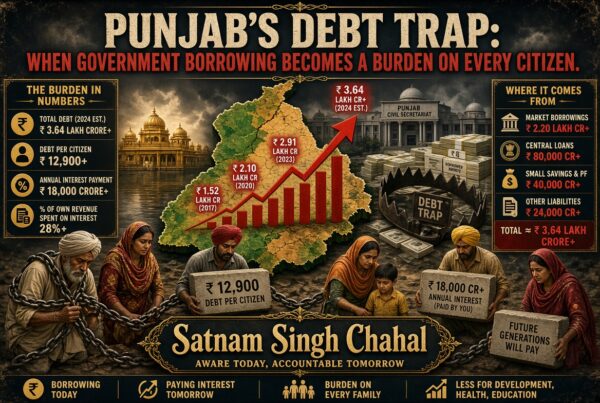
Punjab is standing at an uncomfortable economic crossroads. The state has enormous agricultural resources, a globally successful diaspora, established industries, fertile land and a hardworking population, yet its public finances have become one of its biggest weaknesses. The most worrying part of the story is not simply that Punjab owes several lakh crore rupees. The real concern is that the state’s debt has continued to rise while its per-capita income remains considerably below that of neighbouring Haryana and Himachal Pradesh.
According to the Punjab Budget Analysis for 2026-27, Punjab’s per-capita income at current prices was estimated at ₹2,30,523 for 2025-26, an increase of 6.4 per cent over the previous year. The number sounds respectable when viewed in isolation, but the comparison with neighbouring states tells a different story. Haryana’s per-capita GSDP for 2025-26 is estimated at ₹4,41,216, according to the state’s Economic Survey and PRS analysis. Himachal Pradesh’s per-capita income is estimated at about ₹2.83 lakh for 2025-26.
This means Punjab is not merely competing with richer states such as Maharashtra, Karnataka or Telangana. It is struggling to keep pace with its immediate neighbours. Haryana has developed a powerful industrial and services economy around Gurugram, automobiles, manufacturing, logistics, information technology and its proximity to Delhi. Himachal Pradesh, despite its geographical limitations, has built important economic pillars around tourism, horticulture, hydropower and services. Punjab, meanwhile, remains heavily dependent on agriculture and has struggled to create an equally powerful second economic engine.
The debt figures make the situation even more serious. Punjab’s total outstanding debt has been projected at around ₹4.17 lakh crore by March 2026. Other estimates and accounting measures can produce somewhat different figures, but the broad direction is unmistakable: Punjab’s liabilities have reached a level that can no longer be treated as an ordinary budgetary issue. The state’s debt is now a structural problem that affects the government’s ability to spend on development.
Per-capita debt provides an even more powerful way of explaining the problem to ordinary citizens. A PRS-based comparison reported Punjab’s per-person debt at around ₹1.23 lakh, placing Punjab among the most heavily indebted states on this measure. The exact number can change according to the accounting year, population estimate and definition of liabilities, but the broader message remains the same: every Punjabi effectively carries a share of the state’s accumulated obligations.
Of course, a citizen does not receive a government bill asking him or her to personally repay ₹1.23 lakh. Government debt does not work that way. But the economic burden ultimately reaches citizens through the state budget. Money that goes towards interest payments and debt servicing cannot simultaneously be used for new schools, hospitals, roads, industrial parks, universities, irrigation systems or employment programmes.This is why the most important question is not simply, “How much does Punjab owe?” The more important question is, “What did Punjab get in return for all this borrowing?” If borrowed money is used to create infrastructure, productive industries and assets that generate future revenue, borrowing can contribute to economic growth. But if borrowing increasingly finances recurring expenditure without creating new productive capacity, the debt can become a trap.
Punjab’s fiscal problem is therefore not created by borrowing alone. It is created when the state becomes increasingly dependent on borrowing while its revenue-generating capacity does not grow sufficiently fast. The government then borrows more money to meet existing commitments, and future governments inherit an even larger financial burden.The danger is particularly serious when debt is combined with a relatively modest per-capita income. Haryana provides an important contrast. Haryana also carries a large absolute debt, but its economy is considerably larger and its per-capita income substantially higher. The ability of a state to carry debt depends not simply on the number of rupees it owes but on the size and strength of the economy supporting that debt.Punjab therefore needs to stop looking only at the absolute debt figure and start looking at debt as a percentage of the economy, debt per citizen, interest payments, revenue receipts and the amount of money left for capital investment. These indicators tell the real story of fiscal health.
The state’s budget itself demonstrates how difficult the situation has become. Punjab’s 2026-27 fiscal deficit is targeted at 4.1 per cent of GSDP, while the state continues to depend on substantial borrowing. A government can manage a deficit in a particular year, but persistent deficits combined with high outstanding liabilities create increasing pressure on future budgets.This is where politics and economics collide.Political parties naturally want to announce schemes that provide immediate benefits to voters. Governments want to show that they are delivering something today. But debt has a different timetable. The political benefit may be received today, while the financial cost can remain for ten, fifteen or twenty years.A government may announce a benefit in one budget, but the interest on the borrowing used to finance it may appear in the budgets of governments that have not even been elected yet.That is why Punjab needs to have a serious public conversation about fiscal responsibility.
This does not mean that every welfare scheme should be abolished. Poor families need support. Farmers need assistance. Students need scholarships. Women, senior citizens and vulnerable sections of society need protection. The question is not whether the government should spend money on people. The question is whether Punjab can design welfare programmes that are financially sustainable while simultaneously investing in economic growth.A state cannot permanently borrow its way into prosperity.Punjab’s economic challenge is particularly painful because it has so many potential sources of revenue. The state has a powerful diaspora. Punjabis have built successful businesses across Canada, the United States, Britain, Australia, Europe and many other parts of the world. Yet Punjab has not fully converted this global network into sustained investment, manufacturing partnerships, technology transfers and export-oriented businesses.
Imagine if even a fraction of the Punjabi diaspora’s entrepreneurial capital were systematically connected to Punjab’s industrial and technological development. Imagine international Punjabi businesses establishing manufacturing units, research centres, logistics operations and technology companies in Punjab. Imagine universities partnering with institutions abroad and creating research and innovation ecosystems.
Punjab has the human capital. What it needs is an environment in which capital feels safe, businesses feel confident and young people believe they can build their future at home.The unemployment problem is directly connected to this economic weakness. When young people cannot find attractive employment, they naturally look elsewhere. Punjab’s airports have become symbols of this phenomenon. Every year, large numbers of young Punjabis leave for foreign universities, jobs and permanent settlement.The tragedy is that Punjab spends years educating its children, families spend enormous amounts of money on their education, and then the world’s strongest economies receive the benefit of that educated workforce.This is not simply migration.It is also a form of economic leakage.Punjab invests in its human capital, but other countries frequently capture the economic value of that human capital.
The solution cannot be to stop young people from leaving. Young Punjabis have every right to seek opportunities anywhere in the world. The real solution is to create a Punjab where leaving is a choice rather than an economic necessity.The debt problem also has consequences for infrastructure. When too much of the budget is consumed by committed expenditure and debt servicing, governments have less flexibility to invest in long-term infrastructure. Roads require maintenance, hospitals require modern equipment, schools require laboratories, universities require research funding and cities require modern transport systems. These investments may not generate immediate political headlines, but they determine whether an economy becomes competitive.Punjab therefore needs to distinguish between expenditure and investment.
A government salary is expenditure. A well-designed industrial park that creates thousands of jobs can become an investment. A subsidy may provide immediate relief. A modern irrigation system can increase agricultural productivity for decades. A temporary announcement may win political applause. A functioning manufacturing ecosystem can transform an entire district.The state’s economic strategy should therefore be judged not by the number of announcements but by the number of productive assets created.The comparison with Himachal Pradesh is also instructive. Himachal itself faces significant fiscal pressure. Its 2026-27 budget analysis projects a fiscal deficit of 3.5 per cent of GSDP, while its revised fiscal deficit for 2025-26 was estimated at 6.6 per cent. Thus, Punjab should not romanticise its neighbour as a state without financial problems. Himachal has serious challenges of its own.But Himachal’s experience demonstrates that economic size is not the only measure of development. Social indicators, human development, tourism, horticulture and women’s participation can create important strengths even in a small and geographically difficult state.Punjab therefore needs both economic growth and social development.
The most dangerous mistake would be to treat Punjab’s debt as merely an accounting problem. Debt is ultimately about the future. It determines how much freedom future governments will have to make decisions. A heavily indebted state has less room to respond to economic crises, natural disasters, agricultural emergencies or sudden unemployment.It also creates an intergenerational burden.Today’s political decisions can become tomorrow’s financial obligations.Punjab’s children should not inherit a state where an increasing portion of government revenue is already committed to paying for decisions made decades earlier.The answer is not pessimism. Punjab has recovered from much greater crises in the past. The state has survived Partition, terrorism, agricultural crises and economic transitions. It has repeatedly demonstrated extraordinary resilience.But resilience alone is not enough.Punjab now needs fiscal discipline combined with economic ambition.The government must increase its tax base without unnecessarily burdening ordinary citizens. It must reduce leakages, improve tax administration, control wasteful expenditure, encourage private investment and expand industries that generate employment. It must make government departments more accountable and ensure that announced projects actually reach completion.
Most importantly, Punjab needs a bipartisan or all-party economic strategy extending beyond one election cycle. Political parties may disagree on ideology, welfare policies and governance models, but they should be able to agree on a few basic objectives: reduce the debt burden, increase per-capita income, create private-sector employment, improve women’s participation, modernise agriculture and attract investment.Punjab cannot afford another decade of political arguments without structural economic reform.The state that once led India’s Green Revolution now needs a second revolution—not of wheat and rice, but of technology, industry, education, entrepreneurship and employment.The ultimate measure of success should not be how much money a government distributes. It should be whether Punjab’s children have better opportunities than their parents, whether young people can find respectable jobs at home, whether women can participate fully in the economy, whether farmers can earn sustainable incomes and whether the state can pay its bills without continuously borrowing more.Punjab’s debt is therefore not just a number written in a government document.It is a warning about the future.If borrowing creates prosperity, debt can be an investment.If borrowing merely postpones today’s problems until tomorrow, debt becomes a trap.Punjab must decide which path it wants to take.
Disclaimer: This article and accompanying images are for informational and illustrative purposes only. Some visuals may be AI-generated or digitally enhanced and may not depict actual events or persons.Views expressed are based on publicly available information and analysis