
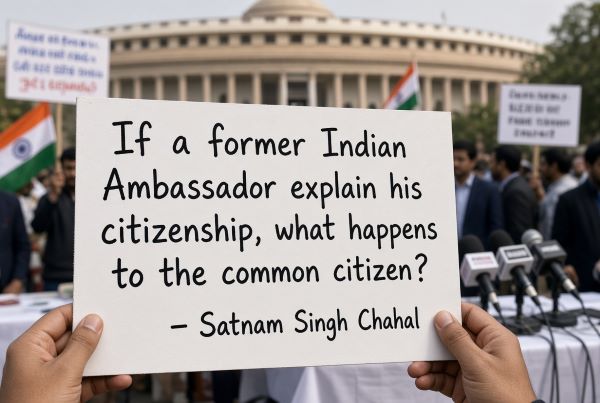
The experience of former diplomat Navdeep Suri during the ongoing Special Intensive Revision of electoral rolls in Punjab raises a legitimate and uncomfortable question. Mr. Suri served India as Ambassador to the UAE and Egypt and as High Commissioner to Australia. He says that after submitting his voter ID and Aadhaar, he was informed that his details did not match the 2003 electoral records and was subsequently asked to appear with additional documents, including his passport, to establish his citizenship.
The Election Commission’s clarification is equally important: Mr. Suri’s name has not been removed from the electoral roll. Officials say the issue arose because his present details could not initially be mapped with the 2003 records, particularly because he was serving abroad at that time.That clarification, however, does not eliminate the larger question raised by Mr. Suri.
If a highly educated former diplomat, who spent decades representing the Republic of India abroad, can encounter difficulty in navigating a process because his current records do not correspond with records from 2003, what about an ordinary villager who may have changed his address, lost old documents, migrated for employment, lived abroad, or simply does not possess a comprehensive collection of historical records?This is where the SIR exercise must be handled with extraordinary sensitivity.
There can be no argument against cleaning electoral rolls. Genuine voters should be protected, duplicate or fraudulent entries should be removed, deceased voters should not remain on the rolls, and the integrity of elections must be maintained. But electoral-roll purification should never become a bureaucratic obstacle course for genuine citizens.
A voter should not feel that the state is asking, “Prove that you belong to this country,” when the real purpose should be to establish whether the person is legitimately entitled to remain on the electoral roll.The distinction is crucial.Verification is necessary.Harassment is not.Documentation is necessary.But unnecessary bureaucratic complexity should not become a barrier to a citizen’s democratic rights.Punjab is a highly mobile society. Punjabis have moved from villages to cities, from Punjab to other states, and from India to virtually every corner of the world. Thousands of families have members who have lived abroad for years. Many voters were studying, working or serving the country outside Punjab when older electoral rolls were prepared.
A 2003 electoral record cannot automatically be treated as the only practical gateway to establishing a person’s present identity and electoral eligibility.Mr. Suri’s case should therefore be treated not merely as the personal experience of a former diplomat but as an opportunity to examine whether the system is sufficiently citizen-friendly, transparent and flexible.The Election Commission should ensure that every notice clearly tells the citizen exactly what documents are required, why they are required and what alternative documents will be accepted. Citizens should not be left guessing about what they need to produce.Most importantly, there should be a simple mechanism for genuine citizens to correct discrepancies without fear, intimidation or unnecessary repeated visits to government offices.
The purpose of democracy is not merely to conduct elections. It is to make sure that eligible citizens can participate in them without unreasonable barriers.Mr. Suri’s question—”If I have trouble establishing citizenship after representing India in three countries, what’s the fate of the common citizen?”—therefore deserves to be taken seriously.This should not become a political battle between supporters and opponents of SIR.It should become a citizen-versus-bureaucracy question.If the system can identify and remove genuinely ineligible voters while simultaneously protecting every genuine voter, then SIR will strengthen democracy.But if genuine citizens are forced into repeated rounds of documentation simply because old records do not match new records, then the process risks creating a new problem while trying to solve an old one.Clean electoral rolls are essential. But clean electoral rolls must not come at the cost of making genuine citizens prove their existence to the state.
The ultimate test of SIR should be very simple:
Remove the fake voter but do not lose the genuine voter in the process.
Disclaimer: This article and accompanying images are for informational and illustrative purposes only. Some visuals may be AI-generated or digitally enhanced and may not depict actual events or persons.Views expressed are based on publicly available information and analysis