
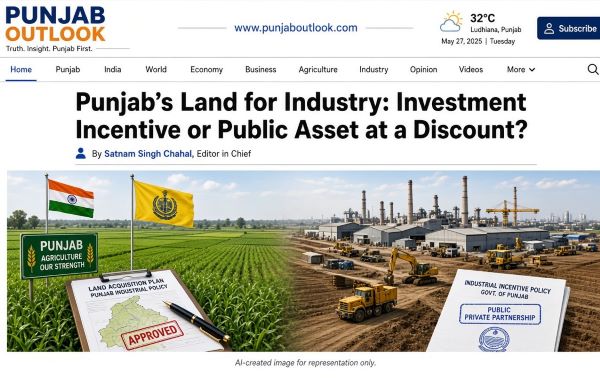
Punjab has long promoted industrialisation by making industrial land available to private companies, developers and large industrial houses. The policy argument is straightforward: provide land and incentives, attract investment, create employment and strengthen the state’s economy. But the bigger question is not whether Punjab should attract industry. The real question is at what price, under what conditions and in whose interest is Punjab’s valuable land being transferred?
The issue deserves renewed public scrutiny because Punjab’s land is not an unlimited resource. Every acre handed over for an industrial project represents a public asset, particularly when the land has been acquired, developed or facilitated through government agencies. The government therefore has a responsibility to demonstrate that the public receives a fair return through investment, employment, tax revenue, infrastructure and long-term economic benefits.
Punjab’s own industrial framework recognises land as a major component of industrial policy. The 2026 industrial policy proposes faster land allotment through transparent e-auctions and says the objective is to reduce upfront costs and accelerate industrial establishment. It also promotes plug-and-play industrial infrastructure and industrial parks.
But Punjab’s history shows why transparency matters. A Punjab and Haryana High Court record concerning Ludhiana’s Phase VIII Focal Point noted that 774.62 acres had been acquired for industrial development and that about 345 acres of undeveloped land was allotted to six industrial units at ₹126 per square yard. The case records substantial allocations to major industrial houses.Another judicial record provides an even more striking example. In Mohali, the government had acquired 157.99 acres for an Industrial Focal Point, transferred 80 acres to the Punjab State Industrial Development Corporation, and PSIDC subsequently allotted a 25-acre plot to Punjab Anand Lamp Industries on a freehold basis. The property later passed through corporate amalgamations and ultimately became associated with Signify Innovations India.
These examples are historical, but they raise a question that remains highly relevant today: when public land is transferred to private industry, does Punjab adequately protect the long-term public interest?There is nothing inherently wrong with giving industrial concessions. In fact, every serious state competing for investment provides incentives. The problem begins when the incentive becomes more valuable than the investment itself.If an industrialist receives several acres of land at a heavily subsidised rate, the government should be able to answer some basic questions. How much money is being invested? How many permanent jobs will be created? How many local residents will be employed? What tax revenue will the state eventually receive? What happens if the promised factory never materialises? Can the land be sold or transferred? If the company changes the land use, does the government recover the increase in value?
These questions are particularly important because land values in and around Punjab’s major cities have risen dramatically. A piece of industrial land that may have been justified as an incentive at one point can become an extremely valuable private asset years later.Punjab already has mechanisms through which industrial plots can be allotted, including e-auction processes administered through PSIEC’s estate management system. The official system provides details such as plot sizes, reserve prices, eligibility requirements and auction conditions.That is the direction Punjab should increasingly follow: transparent, competitive and publicly auditable land allocation rather than discretionary distribution.The state’s earlier policies also demonstrate why the distinction between an industrial incentive and a land giveaway matters. Under an older policy framework, land for industrial parks could be allotted through auction or competitive bidding, while the government retained the right to allot land at reserve price for projects considered to have special significance.
The phrase “special significance” deserves particular attention. Who determines what qualifies as special? What objective criteria are applied? Is the decision published? How does the public know that one company deserved preferential treatment while another did not?Punjab cannot afford a system in which the government celebrates the investment figure but remains silent about the value of the land concession.An investment announcement may say that a company will invest thousands of crores. But if the government provides hundreds of acres of prime land, subsidised infrastructure, tax concessions, electricity incentives and other benefits, the headline investment number alone does not tell the whole story.The public deserves a cost-benefit statement.For every major industrial land allocation, the government should publish the acreage, original ownership of the land, acquisition cost if applicable, development expenditure, reserve price, actual allotment price, market value, investment commitment, employment commitment, implementation deadline and penalties for non-compliance.Most importantly, there should be a clawback mechanism.
If an industrialist receives public land at a concessional price on the promise of creating 5,000 jobs but creates only 500, Punjab should have the legal power to recover the benefit. If a company receives land for manufacturing but subsequently seeks to convert it for commercial or real-estate purposes, the government should recover the difference in land value.Otherwise, an industrial policy can quietly become a real-estate policy.This danger is not theoretical. Punjab’s development agencies have historically handled very large land parcels for industrial and other projects. The Amritsar Development Authority’s records, for example, list industrial mega-projects involving hundreds of acres, including projects of 100, 255 and more than 200 acres.At the same time, Punjab continues to face enormous fiscal pressure, unemployment concerns, agricultural distress and demands for better public services. Every acre therefore carries an economic opportunity cost.If the government gives away land worth hundreds of crores, the people of Punjab should be able to ask: what did Punjab receive in return?
This is not an argument against industrialists. Punjab needs entrepreneurs, manufacturers, investors and new industries. It needs capital and technology. It needs jobs for its young people so that they do not have to leave Punjab in search of opportunities abroad.But Punjab needs responsible industrialisation, not unconditional concessions.Industrialists should be welcomed as partners in Punjab’s economic development, not treated as beneficiaries of public property without measurable obligations.The government should also distinguish between genuine manufacturing and projects that primarily involve land development. A factory that employs thousands and produces goods is fundamentally different from a project that obtains large parcels of land and later benefits from appreciation in property values.The public debate must therefore move beyond the simple slogan of “investment coming to Punjab.”The more important question is:
How much public wealth was sacrificed to attract that investment, and how much wealth will actually remain with the people of Punjab?
Punjab has already witnessed instances in which land acquired for industrial development ended up in the hands of major industrial companies under concessional arrangements. History should not be repeated without stronger safeguards.The government should place every major land concession before the public. Let the people see the numbers. Let the opposition examine them. Let independent auditors verify them. Let the media ask questions.If the deal is genuinely beneficial to Punjab, there should be nothing to hide.Punjab’s land belongs to the people of Punjab. Government can use it to create wealth—but it should never forget that it is a trustee, not the owner.The ultimate test of industrial policy should therefore not be how many acres were allotted or how many investment MoUs were signed.The test should be much harder:How many sustainable jobs were created? How much revenue came to Punjab? How much public land was given away? What was its real value? And, after all the concessions, did the people of Punjab actually become richer?If the answer to those questions is not publicly available, then Punjab has every right to ask whether its land is being used to build industries—or simply to build private fortunes.
Disclaimer: This article and accompanying images are for informational and illustrative purposes only. Some visuals may be AI-generated or digitally enhanced and may not depict actual events or persons.Views expressed are based on publicly available information and analysis