
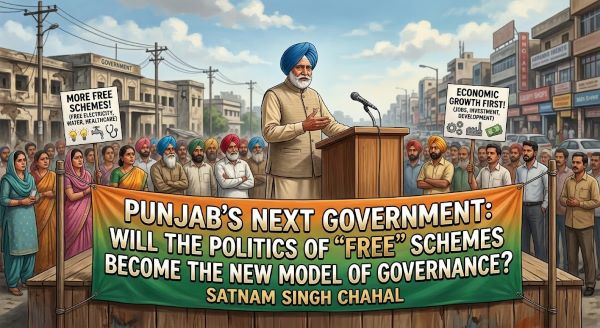
Punjab is moving toward another Assembly election, and one question is becoming increasingly important: will the next Punjab government compete primarily on jobs, investment, industry and economic growth or on how many benefits and “free” schemes it can promise to households? The answer may shape Punjab’s political economy for years to come.
The politics of welfare is not new in Punjab. Successive governments have offered subsidies, pensions, free or subsidised electricity, transport concessions and other benefits. But the scale and political importance of direct benefits have grown considerably in recent years. The present AAP government has made free electricity, free healthcare and direct financial assistance central elements of its political narrative.
The timeline: from promises to a welfare-based political model
2021 — The promise begins. Before the 2022 Punjab Assembly election, AAP leader Arvind Kejriwal announced that an AAP government would provide 300 units of free electricity to every household. The party also promised free healthcare through Mohalla Clinics and ₹1,000 per month for women above 18.
2022 — AAP comes to power. Bhagwant Mann became Chief Minister after AAP won the Punjab Assembly election. The government soon began converting several of the major election promises into government programmes.
July 2022 — 300 units of free electricity. From July 1, 2022, Punjab households became eligible for up to 300 units of free electricity under the government’s scheme. This became one of the most politically visible welfare measures of the Mann government.
August 2022 — Free primary healthcare expands. The government launched 75 Aam Aadmi Clinics on Independence Day. The network subsequently expanded substantially. By March 2026, the government said Punjab had reached 990 Aam Aadmi Clinics, with free medicines and diagnostic services.
2022–2025 — The subsidy model becomes permanent politics. Free electricity, healthcare and other welfare measures increasingly became part of the government’s political identity. The important question, however, is not whether poor families should receive assistance. They should. The question is how much Punjab can afford, for how long, and whether welfare is accompanied by enough economic growth to pay for it.
2026 — The biggest direct-cash promise finally arrives. The government’s long-promised women’s cash-support programme, now called the Mukh Mantri Mawan Dheeyan Satkar Yojana, began moving toward implementation. A pilot registration exercise started in April 2026, several years after the original election promise.
July 1, 2026 — ₹1,000 per month for women. The scheme formally began, providing ₹1,000 per month to eligible women and ₹1,500 to eligible women belonging to Scheduled Castes. The government allocated ₹9,300 crore for the programme for 2026–27.By late July, the government reported that payments had reached millions of women, with the money being transferred directly into bank accounts.
2026–27: The welfare basket gets even bigger
The 2026–27 Punjab Budget shows that this is no longer simply a collection of election promises. Welfare and subsidies have become a major component of the state’s recurring expenditure.The budget provides ₹9,300 crore for the women’s cash-transfer scheme and ₹900 crore for the new Meri Rasoi scheme, which aims to provide free quarterly ration kits to vulnerable households.At the same time, Punjab has budgeted approximately ₹15,550 crore for power subsidies in 2026–27, including ₹7,715 crore for agriculture and ₹5,771 crore for domestic consumers.This creates a very important political question: if one government introduces a free or subsidised benefit, can a future government realistically withdraw it?
Usually, the political answer is no.Once people begin receiving a benefit, it stops being viewed merely as a government scheme and starts being viewed as an entitlement. A future government that attempts to remove it can immediately be accused of being “anti-poor” or “anti-women.”
What could the next government do?
If the present political trend continues, the next Punjab government—irrespective of which party forms it—may find itself under enormous pressure to retain existing schemes and add new ones.
The political competition could gradually become:
300 units of free electricity versus more free electricity.
₹1,000 for women versus ₹1,500 or ₹2,000.
Free ration versus larger ration packages.
Free healthcare versus expanded health coverage.
Existing pensions versus higher pensions.
Existing subsidies versus additional subsidies.
And eventually, every party may try to prove that it can give the public more than its rival.
That is where the real danger begins.
Punjab cannot run an economy only on announcements
Disclaimer: This article and accompanying images are for informational and illustrative purposes only. Some visuals may be AI-generated or digitally enhanced and may not depict actual events or persons.Views expressed are based on publicly available information and analysis