
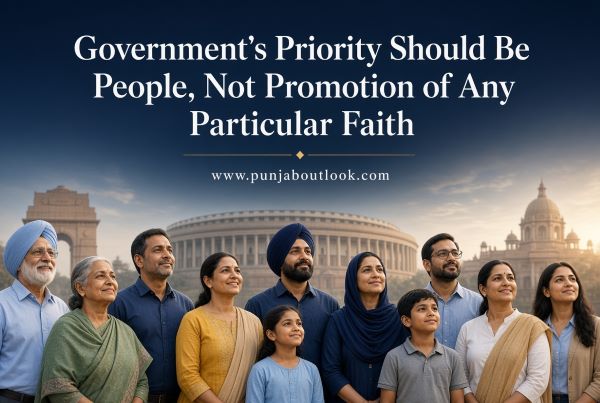
It is not the duty of an elected government to promote or favour any particular faith, religion or community. The responsibility of a government is to govern fairly, protect the rights of every citizen and ensure that public resources are used for the common good. The recent step taken by the Bhagwant Mann government in this direction therefore raises serious questions about its priorities and the proper role of the state.
Punjab is facing a long list of pressing everyday problems. Ordinary families are concerned about rising electricity bills, unemployment, education, healthcare, roads, drinking water, public transport, inflation and the deteriorating condition of basic infrastructure. Farmers, workers, students, small traders and unemployed youth are looking to the government for practical solutions to these issues rather than symbolic initiatives that may create political or religious divisions.
A government must remain equally accessible and accountable to citizens belonging to every faith and community. Public institutions and the state machinery should not become instruments for promoting one particular religious identity. In a diverse and democratic society such as Punjab, the government’s role is to protect religious freedom, not to become a promoter of religion.
This does not mean that places of worship or religious institutions are unimportant. They are deeply significant to millions of people and deserve appropriate protection under the law. But responsibility for religious institutions should not become a substitute for responsible governance. Where there are legitimate issues concerning security, heritage, public access or civic infrastructure around places of worship, the government can certainly act within the law and established policy.
The real test of governance, however, is whether people can afford their electricity bills, whether children are receiving quality education, whether hospitals provide accessible healthcare, whether young people can find employment and whether roads and other public infrastructure are functioning properly. These are the issues that directly affect the daily lives of Punjab’s people.
Public money and administrative attention are limited. Every decision to spend government resources or deploy the machinery of the state should therefore be examined against the priorities of ordinary citizens. When basic services remain under pressure, governments must explain why attention and resources are being directed toward matters that could be perceived as promoting a particular faith or community.
Punjab has already witnessed enough political competition over religion, identity and symbolism. What the people need now is competition over governance, development, employment, education, healthcare and economic growth. Political parties should be judged by what they deliver for every citizen, not by how effectively they use religious issues for political messaging.
The Mann government should therefore reconsider its priorities and ensure that governance remains secular, inclusive and focused on the public interest. The government should protect every faith equally, interfere in religious matters only where there is a legitimate constitutional or administrative responsibility, and concentrate its energy on solving the problems that Punjab’s people face every day.
Ultimately, the question is simple: Is the government working first for the basic needs of the people, or is it becoming distracted by matters that belong primarily to the religious and social sphere? The people of Punjab deserve a government whose first priority is their livelihood, security, education, healthcare and quality of life—not the promotion of any particular faith.