
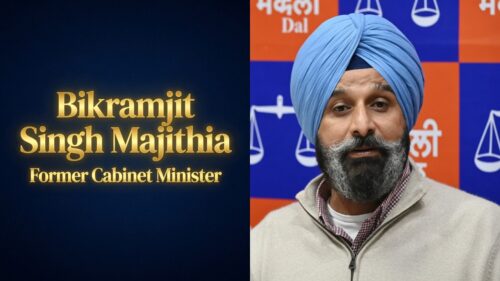
 Chandigarh: Shiromani Akali Dal leader Bikram Singh Majithia has launched a sharp attack on the Punjab government over alleged corruption in the Greater Mohali Area Development Authority (GMADA), claiming that the problems facing the development authority reflect a wider deterioration in governance across the state.
In a post on social media, Majithia alleged that “GMADA has today become a centre of loot” and argued that the issue should not be viewed as being confined to a single department or government agency. He alleged that corruption has become widespread under the Bhagwant Mann government and has affected various departments across Punjab.
Majithia particularly highlighted comments attributed to Aam Aadmi Party MP Malvinder Singh Kang, who, according to Majithia, has announced that his party workers would gherao GMADA over allegations of corruption. Majithia said the reported position of a ruling-party MP was significant because it suggested that concerns about the functioning of the authority were being raised from within the ruling establishment itself.
“When an elected MP himself has to announce a struggle against corruption, imagine what the condition of an ordinary Punjabi must be,” Majithia said while questioning the functioning of the government.
The Akali leader also challenged Kang to remain consistent with his stated position and pursue the issue to its logical conclusion rather than backing away later. He urged the AAP MP to stand by his allegations and demand accountability from the authorities concerned.
The allegations have placed GMADA once again at the centre of a broader political debate over transparency, land administration, development authorities and alleged corruption in Punjab. Development authorities such as GMADA handle matters involving urban planning, land development and major infrastructure projects, making transparency and accountability particularly important because decisions involving public land and development can have significant financial implications.
Majithia has demanded that what he described as a “hub of loot” be shut down and that those responsible for any wrongdoing be held accountable. However, the allegations made by the opposition leader require verification through an independent investigation and examination of official records before conclusions about individual wrongdoing can be established.
The controversy also raises a larger question for the Punjab government: if allegations of corruption are being publicly raised even by members of the ruling party, will the government order a transparent and independent inquiry into the functioning of GMADA?
For ordinary citizens, the issue goes beyond political rivalry. GMADA’s decisions affect landowners, developers, homebuyers, businesses and residents across the Mohali region. Any allegation of corruption involving approvals, land, planning or development therefore warrants serious examination.
The government now faces the challenge of demonstrating that allegations of corruption are being addressed through transparent investigations, administrative accountability and time-bound action, rather than being treated merely as another political confrontation between the ruling party and opposition.
The credibility of Punjab’s governance institutions ultimately depends not only on how corruption allegations are made, but on whether credible mechanisms exist to investigate them and establish the truth