
There is a peculiar arithmetic to every subsidy, dear reader, that its architects never quite disclose at the moment of announcement: what is given away free today is rarely, if ever, taken back tomorrow. Over thirty-seven years in the Indian Administrative Service, and five years since superannuation as an independent analyst, writer, and coordinator of a non-partisan think tank, I have watched politicians of every hue — in India and abroad, and with metronomic regularity before elections — announce freebies with a confidence that never quite extends to the arithmetic of their withdrawal. I can tell you, with the weary confidence born of that vantage point, that a subsidy’s true cost is not what it spends. It is what it forecloses.
I. Rome: A Precedent, Briefly Stated
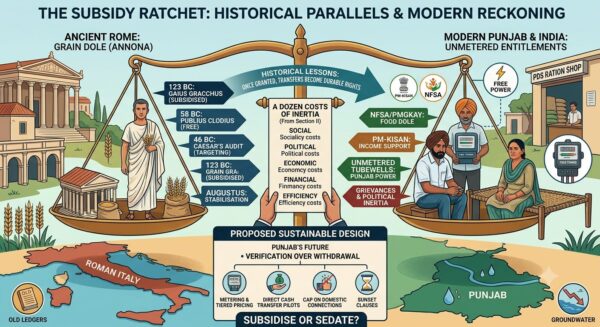
Let us begin, as I am fond of doing, with Rome — not the Rome of togas and gladiators, but the Rome of ledgers and grain-rolls, a Rome that wrestled with entitlement long before Punjab discovered free power. In 123 BC, Gaius Gracchus’s law fixed a subsidised price for grain — a controlled rate, not a gift — for eligible Roman citizens. It took another sixty-five years, and a tribune with sharper populist instincts, for the ration to become genuinely free: Publius Clodius’s law of 58 BC removed the price altogether, converting a subsidy into a durable entitlement. By 46 BC the rolls had swelled to some 320,000 names; Julius Caesar, alarmed, ordered what we would today call a beneficiary audit, cutting the number to roughly 150,000 — not by abolishing the dole, but by verifying who was actually entitled to it. Augustus, inheriting the problem, stabilised the rolls at roughly 200,000 and held them there for decades, drawing increasingly on Egypt — annexed only in 30 BC — to keep Rome fed.
The lesson I draw from this sequence is narrow, and I will not labour the parallel beyond this single section: once a transfer becomes a right rather than a discretionary grant, a state’s remaining freedom is not whether to give, but how rigorously and sustainably it verifies who receives. That lesson — geography determines history, and history, in its turn, determines geography — carries us now from the Tiber to the Yamuna and the Sutlej.
II. A Necessary Disclosure: The Costs of Getting It Right
Let me be direct about what I am not arguing: that subsidies, as a category, are unjustified. They can be entirely defensible — on social grounds, protecting the vulnerable; on economic grounds, correcting market failure or smoothing volatility; on political grounds, the legitimate demand of citizens on a state that taxes them. My argument is narrower: that such transfers, once created, must be built to be sustainable, and that sustainability requires more than good intentions at the moment of launch.
It requires, in particular, an honest reckoning with what targeting itself costs — a reckoning most subsidy debates skip, mine included. The intuitive fix for an unsustainable universal transfer is to narrow it: fix eligibility criteria, means-test the applicant, let only the genuinely needy through. But every eligibility window, however carefully drawn, becomes in practice a site of contest rather than a simple sieve. Consider the Centre’s finding — later disputed by the Punjab government — that roughly a third of the state’s PM-KISAN beneficiaries were income-tax payees or otherwise ineligible for a scheme meant for smallholders. This is not an aberration; it is what happens at every narrow gate: real resources, and no small amount of local ingenuity, get spent squeezing through it, by the eligible and the ineligible alike, while a share of genuinely intended beneficiaries fail to get through at all, defeated by a missing document or an unseeded Aadhaar number rather than by any lack of need.
And then there is what happens after the gate. Once a beneficiary is admitted, administrative and political inertia conspire to keep them there long after the circumstance that justified their entry has changed — the marginal farmer whose holding has since been sold, the domestic consumer whose household has since prospered. Re-verification is expensive to conduct and, worse, politically costly to act upon: ask any Punjab farm-union leader what he thinks of the Centre periodically purging the PM-KISAN rolls, or any Punjab government finance official what he thinks of a court ordering the release of dues he had hoped to defer indefinitely. Removing a beneficiary generates a grievance; failing to remove one generates only a diffuse, invisible fiscal cost — and grievances vote, while diffuse costs do not.
A different objection is worth answering, since I hear it often: that subsidies as such do not work, and that incentives — rewards tied to a specific, measurable behaviour — are the more honest instrument. There is something to this: an incentive rewards an act rather than a status. PM-KISAN pays a farmer for existing on a landholding; a genuine incentive would pay for something done — a tubewell solarised, a hectare diversified out of paddy, a tonne of stubble not burnt. But incentives are not exempt from the disease they are meant to cure — if anything, they are more exposed to it, since an incentive is, by definition, a measure turned into a target. Charles Goodhart’s 1975 observation on British monetary policy — since generalised well beyond banking — was that any observed regularity collapses once placed under such pressure: reward a number, and people optimise for the number, not for what it was meant to track. The parable attached to this law, whatever its precise historicity, is the cobra bounty of colonial-era Delhi: householders paid for dead cobras took to breeding them quietly for the payout, and released the now-worthless stock the moment the scheme was cancelled, leaving the city with more cobras than it started with. I have set out this argument at greater length in these pages before. The relevance here is narrow but exact: an incentive swaps the eligibility-gaming problem described above for a metric-gaming problem of its own. The choice between a subsidy and an incentive is a choice of failure mode, not an escape from failure.
The honest conclusion is that administering a subsidy scheme, however well designed, carries five costs of its own, not one: a social cost — the genuinely eligible turned away by procedure, or stigmatised by the means test itself; a political cost — the backlash against every act of pruning, however justified; an economic cost — the misallocation and behavioural distortion a targeting rule invariably invites; a financial cost — the verification apparatus itself, Aadhaar-seeding, e-KYC, audits, appeals, litigation, rarely costed into the original scheme; and an efficiency cost — the administrative friction of continually re-deciding who qualifies. None of this is an argument against targeting. It is an argument against imagining that targeting is a costless alternative to a badly designed universal transfer, rather than a different, and differently expensive, set of trade-offs.
III. India’s Three Transfers: Food, Income, and Inputs
India’s food security architecture illustrates the general principle directly. The Public Distribution System traces its lineage to wartime rationing in 1939, was expanded through the Green Revolution years, and was all but constitutionalised by the National Food Security Act of 2013 — an entitlement, not a discretionary scheme, covering some two-thirds of the country’s population. Converting a programme into a statutory right has the same effect everywhere it is tried: withdrawing it, even trimming it, becomes unthinkable for any government of any persuasion.
The scale bears stating plainly, because the Prime Minister repeats it often, at G20 podiums and on Independence Day alike: India, he reminds us, feeds more than eighty crore of its own people — 81.35 crore, by the Cabinet’s own arithmetic — free of cost, every month, under the Pradhan Mantri Garib Kalyan Anna Yojana. The scheme, extended in November 2023 for five years from January 2024, carries an approved outlay of ₹11.8 lakh crore over that period; the Union Budget for 2026–27 alone provisions some ₹2.28 lakh crore under the food subsidy head. It is a free ration made permanent by Cabinet decision, which no government since January 2023 has dared re-price by even the rupee or two it once cost.
The one durable exception to this ratchet has been verification rather than withdrawal: the Aadhaar-linked direct benefit transfer regime, beginning in earnest with the PAHAL cooking-gas scheme of 2014–15, pruned tens of millions of duplicate and ineligible names from subsidy rolls — an audit, not an abolition, and the only politically survivable form of reform yet attempted at scale, precisely because auditing a list generates less grievance than deleting a right.
Set beside the food dole is a second, newer transfer aimed at the same broad constituency by a wholly different mechanism: cash paid not for grain received but for land held. Under PM-KISAN, launched in February 2019, every eligible landholding farmer family draws ₹6,000 a year in three instalments; the twenty-third instalment, released in June 2026, carried ₹18,880 crore to more than 9.4 crore farmers, and in August 2026 the Union Cabinet approved the scheme’s continuation from 2026–27 to 2030–31 at a fresh outlay of ₹3.15 lakh crore, on top of the ₹4.47 lakh crore already disbursed since inception. Add a third leg, on inputs: the fertiliser subsidy, budgeted at ₹1.71 lakh crore for 2026–27, though officials of the Department of Fertilisers concede the actual bill — driven by the West Asia crisis and a spike in global urea prices — may run closer to ₹3 lakh crore by year’s end. Food, income, inputs: three separate entitlements, each defended by its own constituency, each equally difficult to unwind.
Here a distinction must be insisted upon, one Punjab’s farmers do not press nearly loudly enough. The eighty-crore free-ration figure is a subsidy in the strict sense set out in Section I — a transfer with no return flow. The Minimum Support Price paid to the wheat and paddy grower of Punjab and Haryana is not. It is, definitionally, a price: the government’s payment for a commodity of genuine economic value and real market demand, procured in no small part to stock the very godowns from which the eighty crore are fed. To fold MSP into the same “freebie” ledger as free foodgrain, as television panels increasingly do, is to confuse a purchase with a gift. One may argue — and I do, forcefully, in Section IV — that the MSP regime has locked Punjab into an ecologically ruinous paddy-wheat monoculture. That is an argument about what is bought, in what quantity, and at what environmental cost. It is not an argument that the farmer is receiving alms.
Yet the boundary between price and subsidy is not always so clean, and the sugar shelf offers a case in point this very season — not as an accusation, for the ethanol-blending programme has genuinely strengthened mill balance sheets and eased cane arrears, but as an illustration of how one policy’s price guarantee becomes another’s shortage. The government’s own guaranteed procurement price for ethanol, drawn from cane juice and B-heavy and C-heavy molasses alike, pulled an estimated three million tonnes of sugar-equivalent cane into fuel tanks rather than sugar bags this season — roughly a tenth of national output, toward the E20 blending target. India, ordinarily the world’s largest sugar producer and consumer and a regular exporter besides, found itself in August 2026 authorising duty-free imports of a million tonnes of raw sugar, its first such recourse in nearly a decade, even as retail prices in Punjab itself touched ₹65 a kilogram. The government points, not without some justice, to a weak production year, festive demand and firmer global prices; the sugar industry points, with equal conviction, at the distilleries. Both are probably a little right. The larger point survives the argument: even a price paid for a genuine commodity can, through guarantees made elsewhere in the system, produce a shortage the consumer experiences exactly as she would a subsidy’s cost — except that this bill is presented at the sweet-shop counter, not by the exchequer.
IV. Punjab’s Free Power: The Arithmetic of an Unmetered Promise
It is Punjab, my own Punjab, that offers the sharpest illustration of the general argument — and I say this not as an outsider’s critique but as a former Financial Commissioner who has watched the state’s fiscal arithmetic buckle under a promise made nearly three decades ago.
In 1997, the Akali-BJP government led by Parkash Singh Badal announced free electricity for the farm sector — handed out unmetered and uncapped, with no reference to landholding size. What began as relief for a genuinely distressed agrarian class has, over successive governments — Congress, Akali, and now AAP, none of whom has dared reverse it — become exactly what Section I would predict: free, permanent, and politically radioactive to touch.
The numbers make the shape of the thing precise. Punjab today carries some 13.94 lakh agricultural tubewell connections drawing free power, at a subsidy cost running to roughly ₹10,000 crore a year, irrespective of whether the connection sits under two acres or two hundred; an Agricultural Census tally found well over half on holdings of ten acres or more. Set this beside PM-KISAN, the Centre’s income-support transfer for the same constituency: Punjab’s beneficiary count, after successive Centre-driven purges of ineligible names, fell from over 23 lakh at the scheme’s 2019 launch to 17.07 lakh in 2022-23 and to 9.33 lakh by 2023-24 — meaningfully fewer than the number who draw free power, though not by the margin popular retelling assumes. The gap understates itself: a share of PM-KISAN’s own smallholders farm without owning an electric tubewell at all, irrigating instead by a rented diesel pump-set or a turn on the canal, and so draw no benefit from the larger subsidy. The free-power rolls, in other words, are not a rough proxy for Punjab’s farming population. They are tilted, and substantially so, toward those who already had the capital to sink a bore.
The domestic sibling of this scheme shows the same dynamic at household scale. Since July 2022, every metered household in Punjab has drawn 300 units a month free of charge — a promise that today covers close to 80 lakh domestic connections, at a cost approaching ₹8,800 crore this fiscal year, up from ₹5,739 crore in the scheme’s first full year. PSPCL’s own audits point to part of the reason for that climb: households splitting into two or three separately metered connections, each drawing a fresh 300-unit allowance — precisely the efficiency cost anticipated in Section II, a bureaucratic mitosis the scheme’s incentives induced, and one no household census was ever built to catch.
Here is the governing image I keep returning to, and forgive me if it is unkind: a subsidy of this vintage is less a support than a drip-feed left running long after the patient has recovered — nobody dares pull the tube, because pulling it, however medically overdue, looks on television like an act of cruelty. A transfer designed for the small and marginal farmer tends, in practice, to be drawn most heavily, in absolute volume, by the large landholder whose tubewells run longest and deepest — simply what an uncapped, unmetered entitlement does over time, in any jurisdiction. The consequence in Punjab’s case is a genuine ecological crisis. Free power removed any price signal against pumping; the paddy-wheat cycle, itself locked in by an assured Minimum Support Price, does the rest. Punjab’s water table falls by roughly half a metre a year across large tracts of the central districts, by the Central Ground Water Board’s own reckoning — an environmental and fiscal drain that starves every other head of expenditure, from schools to hospitals to the very roads I once built as Chief Administrator of PUDA.
The pattern repeats, freshest ink first, in the AAP government’s Mukh Mantri Mawan Dheeyan Satkar Yojana, its payments rolling out from July 2026: ₹1,000 a month to virtually every adult woman in the state, ₹1,500 to Scheduled Caste women, budgeted at ₹9,300 crore and expected in time to reach well over a crore beneficiaries. I do not begrudge Punjab’s women this transfer; the case for it can be argued on its own terms. What I find harder to reconcile is the government’s conduct on dearness allowance owed to employees and pensioners. The Punjab and Haryana High Court, dismissing the state’s appeal in early August 2026, ordered the release of all pending DA and DR — arrears running, on the government’s own liquidation plan, to some ₹14,000 crore, and closer to ₹20,000 crore if settled in one tranche — within a fortnight, or face a six per cent interest penalty. The deadline passed on 18 August. The Finance Department’s response, that same week, was to instruct every department to release nothing pending talks with employee representatives. A state that can find ₹9,300 crore for a new entitlement within the same budget cycle in which a court has twice told it that it may not lawfully withhold what it already owes its workforce is not short of money. It is choosing, as governments of every hue eventually do, which of its subsidies to prioritise — and it is choosing the one that faces the electorate over the one that merely faces the law.
V. Toward a Sustainable Design
What, then, is to be done? Not abolition — no government that values re-election will attempt it, and I would not counsel electoral suicide. Nor, per Section II, is the answer a simple slogan of “better targeting,” as though targeting itself were free.
Verification, not withdrawal, remains the only politically survivable lever: metered, tiered power pricing above a defined connected-load threshold for large agricultural holdings; direct cash transfer of the power subsidy amount in place of free units, on the direct-benefit-transfer model Punjab has already piloted on a handful of feeders; a hard cap of one subsidised domestic connection per residential address, enforced against the meter-splitting PSPCL has already documented; and sunset clauses written into every future scheme, women’s cash transfers and farm-income support alike, so that “temporary relief” cannot again calcify into permanent entitlement through simple inertia.
None of this is costless. Each measure requires its own administrative apparatus, generates fresh grievances, and will be resisted with the political ferocity Section II predicts. The honest case for attempting it regardless is not that verification is cheap. It is that the alternative — an unmetered, unaudited, indefinitely growing entitlement — is costlier still, and grows more expensive with every year it is left alone.
VI. Subsidise or Sedate?
The title of this piece is a small provocation — subsidies do, of course, subsidise; that is what they do, and, as Section II insists, are often right to. My argument is narrower, and I hope more useful: a subsidy that is never verified, never sunset, and never priced at even a notional cost does not subsidise production, or welfare, or growth. It subsidises the postponement of reform — and the reform, once postponed long enough, becomes prohibitively expensive to attempt at all, whether the ledger was kept in Rome two thousand years ago or in Chandigarh this week. Punjab is discovering this now, one falling metre of groundwater, one unpaid court order, at a time. Sustainability, not sentiment, is the test every transfer must eventually pass — and the sooner a state designs for that test, the less painful the passing.